@@INCLUDE-HTTPS-REDIRECT-METATAG@@
Dam Safety Organisation finds ‘deficiencies’ in 1,352 dams
Dam Safety Organisation finds ‘deficiencies’ in 1,352 dams
By Kartik Lokhande:
The deficiencies are rectifiable but need immediate attention
MAHARASHTRA,which has total 1,358 Class-I and Class-II large dams, has recently seen the incident of breach of Tiware dam. However, there are several large dams -- 297, to be precise -- that have deficiencies that are rectifiable but need immediate attention. Besides, there are 1,055 dams that have minor deficiencies. These deficiencies were pointed out by Dam Safety Organisation (DSO) in its report for the year 2017-18. DSO prepares Annual Health Status Report of identified large dams. There are total 265 large damsin Class-Iand1,093 in Class II. Of these, DSO took into account the reports for 265 ClassI dams and 1,087 Class-II dams. As per the DSO report, 94 of the Class-I dams were found to have Category-2 deficiencies, that is, deficiencies that arerecti fiable but need immediate attention. Also, there were 171 Class-I dams that hadCategory-3deficiencies, that is, minor deficiencies.
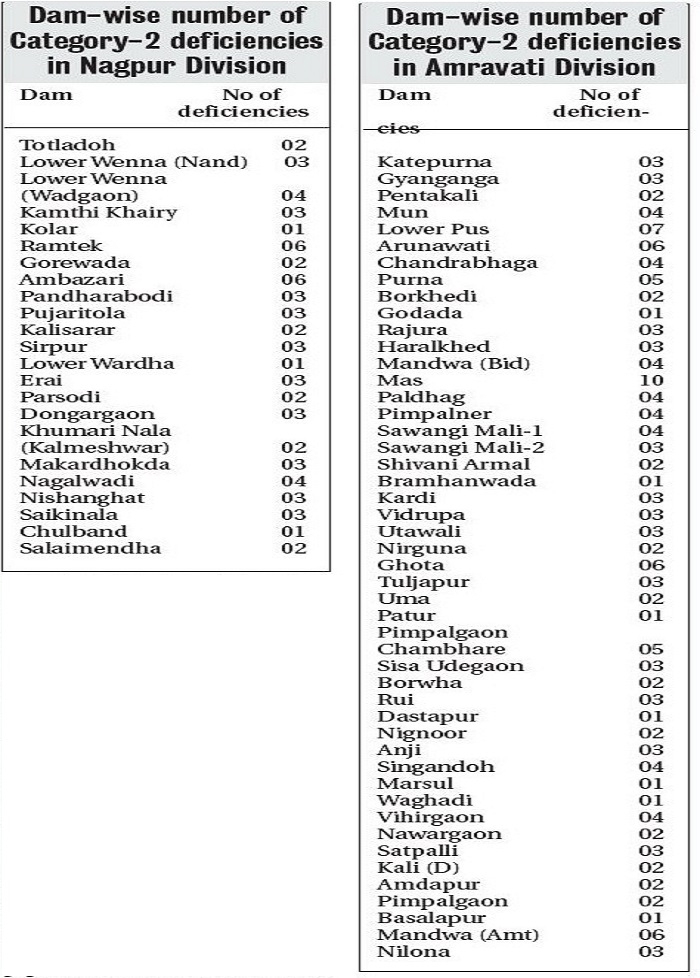
As far as Class-II dams were concerned, 203 hadCategory-2, and 884 had Category-3 deficiencies. As far as Nagpur Division is concerned, it has 80 large dams of which 20 are Class-I and60 are Class-II.DSO inspection revealed that 23Class-I andClass-IIdams in the division had ‘major deficiencies of Category-2. Amravati Division has 200 Class-I and Class-II dams, of which 48 had major deficiencies. Thus, in Vidarbha region, of a total 280 Class-IandClass-IIdams,atleast 71 had major deficiencies. As per the DSO report, there are five major deficiencies found in Class-I dams in Nagpur Division. At least in case of four dams, alternative power system generatorfor gate operation was not working properly. In case of two dams, the relief wells were not functioning properly and therewas‘abnormal rise’in water level in wells. Further, inspection of two dams revealed retrogression/ scouring in tail channel.Excessive considerable leaching from see page water was noticed in two dams.
And, in two dams, damages or erosion of foundation, scouring, undermining were observed in the vicinity of flank walls, guidewalls, junctionwalls, and return walls. As far as Class-II dams in Nagpur Division were concerned, dam section was found ‘not as per design’ in six cases. In case of five dams, the standing pool, ponding, waterlogging, slushy condition were noticed. Outlet gates were not functioning properly and stem rod was bent at service gate, emergency gate, stop-log gate, sluice gate in case of four dams. Retrogression and scouring were observed in tail channel in three dams. Also, in case of three dams, stilling basin was damaged and hydraulic performance was ‘not good’. In case of Totladoh dam on Pench river, which is a major project for Nagpur,‘major leakages through outlet conduit/pipe joints/gates’ were noticed. In Totladoh and Kamthi Khairy reservoirs, foundation drains/ holes/ porous pipe were choked and there was no seepage through foundation drain holes.
At Lower Wenna (Wadgaon) and Kamthi Khairy, relief wells were not functioning properly and there was abnormal rise in water level in wells. Retrogression/scouring in tail channel were noticed in case of Lower Wenna (Wadgaon) and Lower Wenna (Nand). In case of dam at Ramtek, considerable settlement of embankment/rocktoe/pitching was found apart from bulging/concavity of slopes. Further, outlet gates were not functioning properly and stem road was bent, and major portion of pitching was damaged or washed away. As far as Amravati Division is concerned, ‘major leakages through outlet conduit/pipe joints or gates’ were noticed in case of Arunawati and Chandrabhaga dams.
The relief wells at Katepurna, Lower Pus, and Arunawati were found ‘not functioning properly’ and there was abnormal rise in water level in wells. Further, cross and toe drains were not working properly and drains were silted or vegetated, causing stagnation of water or pool formation, at Arunawati. The outlet gates were not functioning properly and stem rod was bent in case of Pentakali, Arunawati, Chandrabhaga, and Purna. Based on the observations recorded in its report, DSO has suggested to the authorities concerned to remove the deficiencies to achieve dam safety. At the same time, it has suggested to carry out inspections of Class-III dams and small dams through competent field officers and to prepare Health Status Report of these dams at regional level. “This has been also perused through letters, but the response from field officers is not encouraging. So, special needs to be paid by field Chief Engineers in this regard,” states the report.
Deficiencies in Gorewada, Ambazari, Pandharabodi
THE DSO report alsomentions about the Category-2 deficiencies found in Gorewada, Ambazari, and Pandharabodi reservoirs in Nagpur city. The highest six deficiencies were noticed in case of Ambazari, followed by three in Pandharabodi, and two in Gorewada. In case of Ambazari reservoir, six significant deficiencies were noticed. These included poor crest profile and depression, slopes of damn otas per design, growth of bigtrees on up stream and down streams lopes of dam, leakage on left of the bar, generally ‘poor condition’ of dam. Also, construction ofthe monument of Swami Vivekananda immediately downstream of waste weir bar in tail channel, has beenlistedas a ‘significant deficiency’ by DSO.The remedial measures suggested by DSO include excavation of cracked portion in the form of trench up to bottom of cracks and trench field by well-compacted proper grade of soil.
Design section should be corrected and levelled by adding duly compacted earthwork. Also, DSO has suggested necessary repairs and removal of trees from slopes. As far as the monument is concerned, it has suggested that waterway for passing of flood water in tail channel should be clear. As per the report, in case of Pandharabodi reservoir in Nagpur city, standing pool of water in gorge portion was notices. Besides, the rubber seal was damaged and needed replacement. A ‘major retrogression’ was noticed at 50 metre mark from spillway bar. On the basis of these observations, DSO suggested that from toe an area up to 200 metres should be free from stagnation and the area should be well drained. Also, it suggested necessary repairs. If the retrogression was moving closer to spillway or waste weir bar, protective measures should be undertaken to prevent progressive damage.
DSO recommended that the extent of retrogression should be ascertained and monitored every year by mapping it. If the retrogression moved upstream, DSO suggested to rope in agencies for undertaking proper investigations and studies for evolving suitable solution. In case of Gorewada, seepage water was found near downstream toe of the dam. DSO suggested dam section to be brought to correct design section and level by adding duly compacted earthwork, and also to carry out necessary repairs.