@@INCLUDE-HTTPS-REDIRECT-METATAG@@
Mauryan era mud fort excavated in Reewa
Mauryan era mud fort excavated in Reewa
By Roshan Chachane
AN ancient Mauryan era mud fort dating back to over 1st century to 5th century BC and the only ‘Buddhist Mud Stupa’ outside Afghanistan was excavated at Reewa, a nondescript village located on National Highway-53, 24 kilometres from Raipur.
Renowned Archaeologist Dr Arun Sharma and his team made this discovery and talking to this reporter who visited the site, Dr Arun Sharma said that driving down the NH-53 one can see Reewa, a large mound just beside the road. About the excavation, he said that there appeared a ‘Buddhist Stupa’ and inside the village, they found 40 several mounds containing ancient pottery, which are yet to be fully explored.
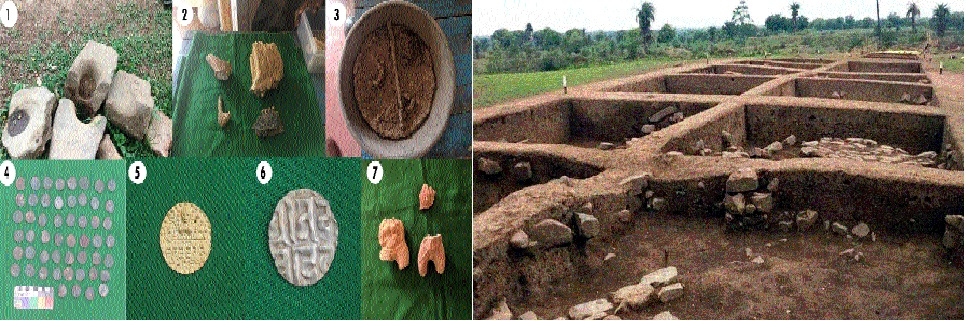
The excavation at Reewa was started on June 22 and the first one was a Mud Stupa consisting of nine layers of the soil of different colours of equal thickness over natural soil. On the top of the mound, there is a square called ‘Harmika’, a square railing or fence that surrounded the mound of dirt, marking it as a sacred burial site. The Stupa is surrounded by different sizes of Burnt Bricks. This is the first Mud Stupa discovered in India as such Stupas, until the Reewa discovery, were only found in Afghanistan. Digging at the site is still going on and in the centre, over the natural soil, archaeologist hopes to find relic casket. They have also recovered human bones at the Stupa.
Inside the village, there is a huge water tank. By the site of the tank a Devi temple and to the west of the temple there are numbers of mounds, which contains plenty of pottery. From the surface, they recovered two gold coins, copper coins and silver coins. The digging is going in this sector as per the archaeological rules and so far they have reached up to 3.70 metre beneath the soil in Mud Fort area, which sprawls over 100 acres of land.
In one of the trenches, a ringed well has been recovered, which the ancient people used to construct for drinking water. Two terracotta figurines of Maa Ambika and a local deity, several iron objects, beads of semi-precious stones, and other antiquities discovered from the trenches are being studied. Of the two gold coins, one belongs to Kramaditsya and another to the Shrimad Ratna Dev (Kalchuri) whereas most of the copper coins are from Kushan (Shardpuri/Panduwansh). Recovery of gold coins indicates that Reewa was a prosperous state nearly 2000 years back and was a commercial centre, connected both by water and land route. In those days, Mahanadi contained a profuse quantity of water and ships used to go right up to Cuttack. Ship berths have been found cut in bedrock at Silkatti on Gariyaband road.
Recovery of loads of coins indicates that Reewa was a commercial centre. The stone-built house walls clearly show that people used local stones and walls were constructed in South-West/North-East direction so that they are not damaged by monsoon rains. The most important feature is that so far which was called Northern Black Polished Ware discovered in Ganga Valley only has also been found at Reewa. Earlier pottery recovered from the excavation at Sirpur and Rajim indicated that such pottery making was not limited to Ganga valley only. A lot of bones have been recovered, the majority of which belong to wild animals, showing that this area was well forested.
An elephant molar discovered, which is also at least 5000-year-old, has been fossilised, along with horse bones. Wild elephants and horses used to roam the area, which dispels the idea of western scholars that the horse was not known to India. Even today, cattle, sheep and goat found in Reewa are very strong and sturdy indicating their wild origins. Generally, Red Rice and a variety of present-day rice automatically grow in ponds and ditches around Reewa, which point to the beginning of domestication of rice. This fact is still prevalent as on a particular day, the ladies eat only naturally grown red rice and vegetables grown in uncultivated fields and Milk/ghee of only bison.
Chhattisgarh has so copious numbers of such sites, particularly in Bastar. Biggest Stone Age site is at Sarangarh, Manekpur. But, owing to the shortage of fund and technical staff, octogenarian Dr Arun Sharma is finding it impossible to uncover the true glorious history of Chhattisgarh. Dr Sharma and two sight supervisors Sandeep Kathane and Heman Vaishnav, who are Master in Archaeology and Asian/Indian History, and Chetan Manhare guided the reporter through the site and the relics recovered by them.