The tale of ‘Laxmi Building: 1917’, in 2019
| Date :18-Aug-2019 |
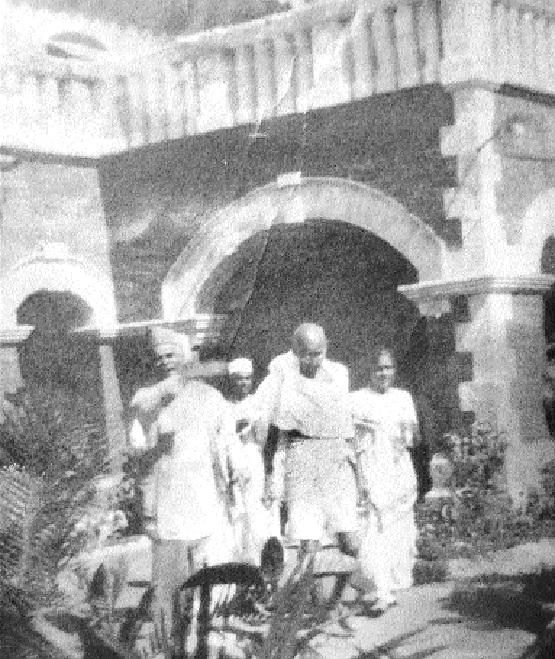
Mahatma Gandhi walking down the porch of the iconic ‘Laxmi Building’ during one of his stays there. (Pics by Satish Raut)
By Kartik Lokhande:
Strong are structures that survive the onslaught of time. And, iconic are the structures that not only survive through time but also preserve the memories of glorious days. The city of Nagpur has several such structures, and 102-years-old ‘Laxmi Building’ is one of those iconic structures in Dhantoli. As one tries to locate the historic mansion in the present-day tall jungle of concrete that has come up over the years, the red-brick structure is barely visible through tin-sheds that cover the courtyard. But, then, one locates it, thanks to the 25-years-old ‘Laxmipalli’ Ganesh idol exhibition sign-board.
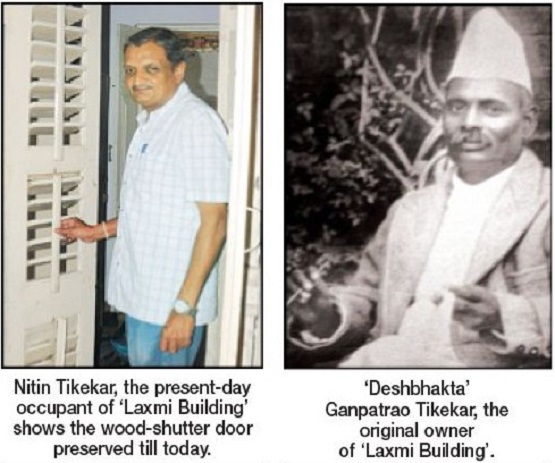
The old Laxmi Building is no more a landmark... it has faded in time. Nonetheless, when one crosses the courtyard that presently houses the idol exhibition, and enters the main building, one realises how grand the mansion must have been in its glorious days. As the present-day owner Nitin Tikekar, grandson of ‘Deshbhakta’ Ganpatrao Tikekar, shows around the mansion, one also gets to know how many things have survived the onslaught of time.
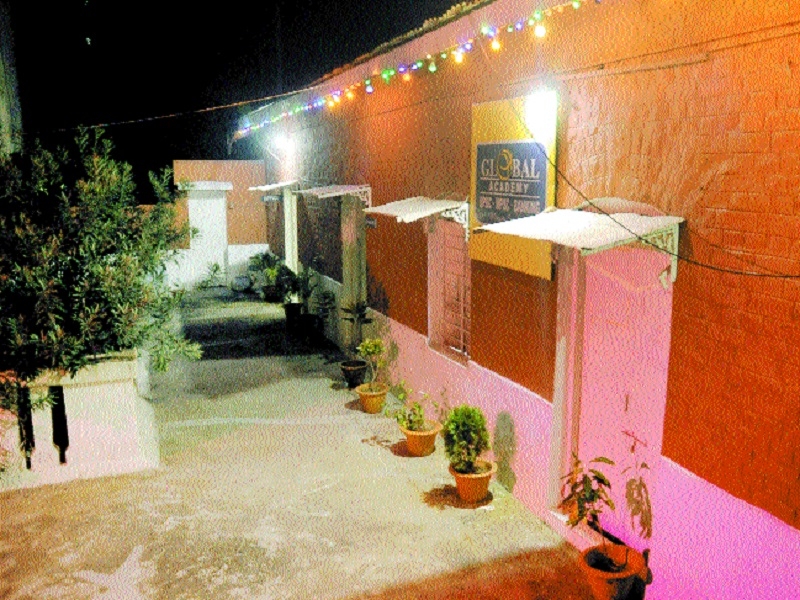
These were the rooms where once Mahatma Gandhi, Motilal Nehru and other stalwarts stayed. Today, it has been rented out to an academy.
“The mansion was constructed using limestone, iron beams, stone... and aspiration,” Nitin Tikekar tells ‘The Hitavada’. Aspiration? Yes! It is explained in the book ‘Biography of Deshbhakta Ganpatrao Tikekar’ written by Dr Jagadis Gan-Chaudhuri. “Ganpatrao Tikekar earned sufficient money to have a permanent residence in the city. His preference was for a house in Nagpur, which stands at the centre of Bharat. In 1914, he purchased two adjacent plots at Craddock Road, Dhantoli, each plot measuring 100x100 feet. The entire land stands in north-south direction. He used the southern plot for construction of a mansion, and the northern plot for an orchard and cow-shed.
Having completed the work of construction, he named the mansion after the name of his mother. ‘Laxmi Building, 1917’ is engraved in the facade,” the book reveals. The building is not only the story of a man’s aspirations, but also a witness to many a development in the history of India from the British Raj to Independence. “The ‘Salt Satyagraha’ started in Nagpur in Laxmi Building. Sarojini Naidu had brought sea-water and carried out desalination process in the courtyard of this very mansion. The salt so obtained was auctioned as part of Satyagraha in presence of Mahatma Gandhi,” Nitin Tikekar informs ‘The Hitavada’, while pointing a finger towards a part of the courtyard.
Also, Nagpur’s first ‘Holi’ of foreign clothes was ignited in another part of the courtyard, where a tall building has come up now. Besides, there were several occasions when ‘Deshbhakta’ Ganpatrao Tikekar made it a point to patronise the freedom struggle of India. He received the participants of Talegaon Jungle Satyagraha, stood firmly for promotion of Khadi. On many occasions, including the famous Congress convention held in the city, he made arrangements for stay of the then national leaders in Laxmi Building.
“The rooms on the first floor served as accomodation for the stalwarts like Mahatma Gandhi and his wife Kasturba, Pt Madan Mohan Malviya, Lala Lajpatrai, C Rajagopalachari, Ravi Shankar Shukla, Motilal Nehru, Ram Manohar Lohiya, Acharya Vinoba Bhave, Netaji Subhash Chandra Bose, Dr Rajendra Prasad, Sarojini Naidu, Shaukat Ali and Mohammed Ali and a galaxy of leaders,” says Nitin Tikekar, taking a glance at the framed old photograph of Mahatma Gandhi in the porch of ‘Laxmi Building’, adorning a wall in the drawing room. Pointing to a corner in the drawing room of the mansion, Nitin Tikekar says that the first meeting of Mahatma Gandhi and Rashtrasant Tukadoji Maharaj had taken place ‘there’. He has tried to preserve the old charm of the mansion as much as possible. For instance, he has built an iron staircase to go to the first floor, without demolishing the balcony wall. The open space just in front of the rooms upstairs, he says, was where Mahatma Gandhi used to sit for prayer early in the morning and people used to sit in front of him.
Apart from the history in the minds and hearts, some structural remnants of past glory have survived in the building. Nitin Tikekar shows the wood-shutter doors in the bungalow. “This is very unique thing now. Back then, my grandfather must have employed artisans from the erstwhile Bengal to create these doors. One can just adjust the flaps in the foor by moving the attached wooden stick upwards or downwards, to allow light and air to come in,” he adds with pride. But, he quickly adds, “It is really very difficult to maintain the old building in all its glory. For, the structure is old and need frequent repairs. Still, we have made it a point to live here.
After all, it is a part of our family history...”. Over the years, due to partition in the family, the huge area of mansion and the courtyard and backyard stands divided in various pieces. The orchard that once formed part of the estate was sold years ago, and today one cannot even imagine that Dhantoli once had an orchard. The tall buildings have come up by 2019, and overshadow the iconic ‘Laxmi Building’ that was constructed in 1917. The fountain in the courtyard stands demolished to make space for present-day occupants. There were two steps that helped one get down in the courtyard and then on to the road. After years of tarring and re-tarring, the road has risen to the level of the floor of the main building, indicating probably how the layers of time are aggressively rising to gulp the past glory. As soon as one steps out of the premises of ‘Laxmi Building’, one is back into the cacophony of the present-day crowded Dhantoli, making one wonder: Much of the iconic building has survived so far, but will it continue to survive?