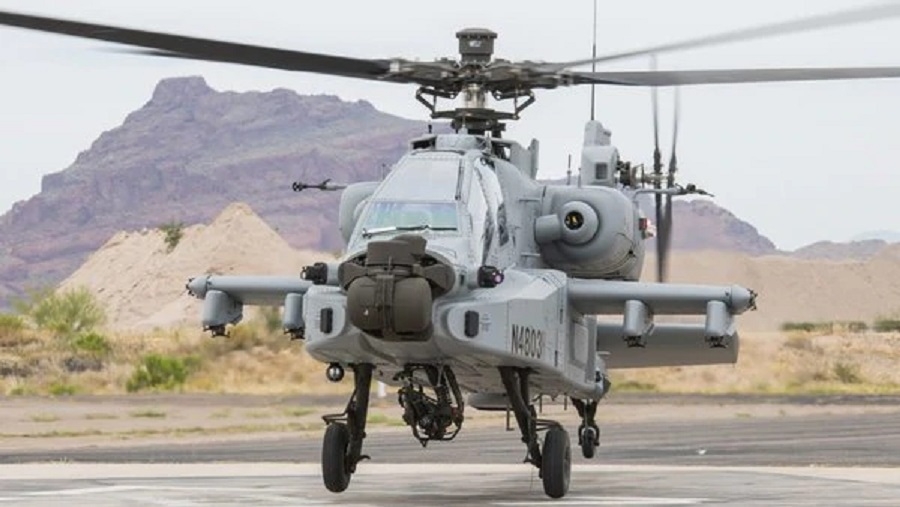
THERE may not be many weapons with apt names that Apache stealth attack helicopters boast of. The terrific flying machine has all those tribal qualities that are associated with the name that represents certain culture of no-nonsense -- even raw, so to say -- standards where mercy has little place. In the American parlance, Apache is a proud Red Indian tribe that brooked no nonsense, accepted no compromise, yet was willing to accommodate change. In Apache museums, all these tribal, primal qualities come to fore standing for something that is rarely amenable to acts of opposition. The addition of as many as eight Apache stealth attack helicopters which India got from the United States in a Government to Government deal will add all those capabilities of raw aggression to the originally very professional Indian Air Force in the years to come. In due course, the remaining Apache choppers, too, will arrive, adding tremendous power to the IAF. True, the deal came rather too late in the day, four years ago and the first delivery has come now, in due course. Actually, the lethal flying machine was first introduced to Indian consideration in Bangalore Air Show more than two decades ago, but the Government took its sweet time dilly-dallying on the issue, steeped in indecision.
Even at that time of introduction, the IAF had indicated an inclination to add Apache to its fleet on the basis of the capabilities the machine had. Still, the decision waited for years until the Narendra Modi Government closed the deal four years ago. The acceptance on professional ground came because the Apache suited Indian requirement the best, given the geographical and other features of the region in which it was expected to operate. Now also, the AH-64E Apache choppers the IAF has received have been custom-made for the Indian requirement, thus adding much punch to the country’s air attack and defence capabilities.
They are described to be the world’s most advanced combat helicopters, which the US Armed Forces have been using for a long time. In the geophysical conditions in the Indian subcontinent, the Apache choppers are believed to prove extremely useful in not just for blocking and defeating any aggression from air, but also for mounting swift attacks on the enemy if the need be. Air Chief Marshal B.S. Dhanoa has expressed a deep satisfaction about this particular acquisition. In an atmosphere loaded with tensions and hostilities vis-a-vis Pakistan with a possible Chinese angle, the AH-64E choppers will add a tremendous power-punch to the Indian Air Force’s firepower and attack capabilities, particularly in Indian hands. Over decades of hostilities, the Indian Armed Forces have often proved their capabilities of planning and executing precise operations even with the help of age-old MiGs. With an advanced Apache stealth attack helicopter in the fleet, the Indian Air Force will prove to be a more lethal force than before, as was rightly stated by the Air Chief (who just flew a sortie with Wing Commander Abhinandan Varthaman recently to add to the young flier’s sense of pride after his terrible experience in Pakistani captivity). Modern warfare is expected to be fought on cyber platforms.
Despite that, conventional support will be crucial for all the time, thanks to the physical need of Armed Forces to establish territorial supremacy to authenticate victory. In the conditions of such a warfare, the Apache stealth attack helicopters will add a unique, multiple-role punch to the IAF’s overall mandate. In addition, this acquisition will also endorse India’s freedom to make its own choice in defence acquisitions, beyond the partisan pressures many manufacturing countries may be wanting to exert against one another. This practical ‘non-alignment’ (or choice-based alignment), if we may use the term, will certainly be of critical importance in the days ahead.