4 IAF pilots chosen for Gaganyaan mission: ISRO
| Date :02-Jan-2020 |
BENGALURU :
India’s maiden manned mission Gaganyaan around the Earth’s orbit is scheduled for 2021-22
The astronauts would start training in Russia
Chandrayaan-3 launch likely in 2021. The project cost for Chandrayaan-3 will be Rs 250 crore, Sivan said
ISRO on Wednesday announced that four Indian Air Force (IAF) pilots have been selected for the ambitious ‘Gaganyaan’ manned space mission programme, whose astronaut training would commence soon in Russia. A day after Union Minister Jitendra Singh said India will launch Chandrayaan-3 most likely in 2020, Indian Space Research Organisation chairman K Sivan said the activities for the mission were going on very smoothly and the take-off may shift to next year.
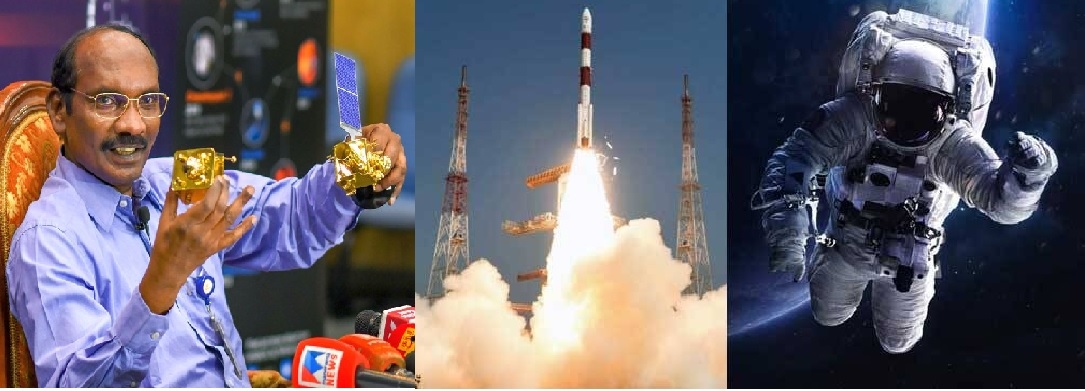
Addressing a press conference here, Sivan said four Indian Air Force airmen have been identified for the country’s maiden manned space mission and their astronauts training would start from the third week of this month in Russia. “We have selected 4 IAF pilots for our first manned space mission in 2021-22. Three of them will go into space to orbit around the earth for a week and conduct experiments in micro-gravity and bio-science,” state-run Indian Space Research Organisation (ISRO) Chairman K. Sivan told reporters here, but did not reveal their identities or names.
The quartet will undergo training in Russia from the third week of this month for becoming the first Indian crew to go into space from native soil. “The four pilots have undergone medical tests at the Indian Aviation Medicine of the IAF in Bengaluru and in Russia at the space agency which will train them in all aspects of a manned mission in outer space,” said Sivan.
Though Prime Minister Narendra Modi hinted in his Independence address on August 15, 2018 from the Red Fort that three Indians, including a woman, would be sent into space, Sivan said that the crew would be all men as all the four selected are males. In the run-up to the ambitious manned mission, the space agency will launch 2-3 unmanned missions in 2020 and 2021 with humanoids to test the human rating of the propulsion modules, including the crew module and the escape system in the event of any emergency in the spacecraft. On Chandrayaan-3, he said the work was going on smoothly.
“One major announcement I wanted to make here officially is that the Government has approved Chandrayaan-3 and the project has been formed. The activities are going on for Chandrayaan-3 very smoothly and its configuration will be similar to that of Chandrayaan-2,” he said. It will have a lander, rover and a propulsion module, he noted. Asked about the launch date, he said it would be announced only when the project nears completion. He also said the launch of Chandrayaan-3 may shift to next year. Work on both Chandrayaan-3 and Gaganyaan, was going on simultaneously, he added. Noting that Chandrayaan-2 orbiter’s mission life was seven years, he said it would be used for the third lunar mission as well. Giving an estimate of the project cost for Chandrayaan-3, Sivan said, “This particular cost of lander and rover configuration thing is about Rs 250 crore. The total cost of the project is Rs 615 crore.” The objective of Chandrayaan-3 would also be to land in the lunar south pole, he said.
On the launch pad to come up at Tuticorin in Tamil Nadu, Sivan said, “apart from the space port at the Sathish Dhawan Space Centre in Sriharikota, the land acquisition for a second one has been initiated in Tuticorin district.” As regards the choice of location, he said, “It was mainly to get advantages of southward launch especially for SSLV (Small Satellite Launch Vehicle).” Observing that the pad, once set up, would be used for launching SSLVs initially, he said it may be expanded for big ones in future. On future missions, he said, “25 missions have been planned for 2020.”
“The missions that were planned in 2019 and could not be completed would be finished by March this year,” he said. Asked what went wrong with the Vikram lander of Chandrayaan-2, he said it was due to velocity reduction failure. “The velocity reduction failure was due to internal reasons,” he said. Chandrayaan-2 mission was India’s first attempt to land on the lunar surface. ISRO had planned the landing on the south pole of the lunar surface. However, Vikram hard-landed. Sivan also congratulated the Chennai based techie who recently located the Vikram lander that hard-landed and maintained that it was the space agency’s policy not to release pictures of the crashed module.
The space agency has sought an allocation of Rs 14,000 crore from the Centre in the budget for 2020-21 for various projects. India has signed agreements with Russia and France for cooperation on the ambitious Gaganyaan mission, which was announced by Prime Minister Narendra Modi during his Independence Day speech in 2018.