Rani ki Vav, living root bridge among R-Day attractions
23 Jan 2020 08:57:20
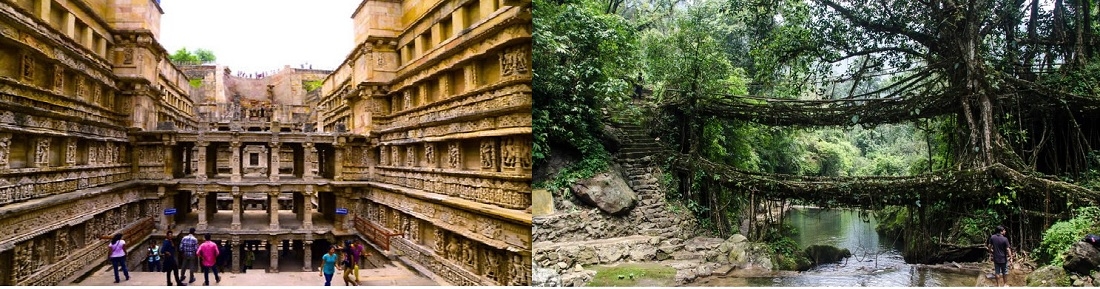
‘Rani ki Vav: Jal Mandir’ in Gujarat. The living root bridge in Meghalaya.
By Anand Singh :
NEW DELHI,
ON the 70th Republic Day ceremony, Gujarat will showcase the ‘Rani ki Vav: Jal Mandir’ (Queen’s stepwell) in its tableau, which has been recognised as the ancient engineering marvel and also features on the UNESCO’s World Heritage Site list, while Meghalaya will showcase the double decker living root bridges. The work of the preparation of the Gujarat tableau is being looked after by Pankaj Modi, younger brother of Prime Minister Narendra Modi. Pankaj Modi, who works as Deputy Director in the Information Department of Gujarat Government, told IANS, “The Rani ki Vav is the best example of Gujarat’s traditional means for water conservations that exhibits a unique combination of civilisation, culture, and arts along with engineering marvel.”
‘Rani ki Vav’, the original seven-storeyed mausoleum monument is located on the banks of historical Sarasvati River at Patan town in Gujarat. It was built by Queen Udaymati in memory of her husband King Bheemdev of the Solanki dynasty. Meanwhile, Meghalaya has prepared the replica of Umshiang double decker living root bridge located in Nongriat in Cherrapunji to highlight the capacity of the Khansi and Jaintia people of Meghalaya of building bridges from secondary roots of trees.
The tableau also demonstrates three girls from the three major tribes of Meghalaya -- Khasi, Jaitia and Garo. Besides Gujarat and Meghalaya, Punjab has prepared its tableau on the theme of 550th birth anniversary of Guru Nanak Dev to propagate his ideology. Randeep Singh Ahluwalia, Deputy Director of the Information Department told IANS, “The theme of the tableau has been vividly depicted as a mark of yearlong celebrations of 550th Prakash Purb of Sri Guru Nanak Dev ji.
Through our tableau we are trying to spread his message of interfaith, understanding and creation of harmonious society on the ethos of tolerance, peace, communal harmony, women empowerment and protection of natural resources.” Ahluwalia said that the tableau comprises three principles -- Kirat Karo, Naam Japo and Vand Chhako, which forms the cornerstone of the Sikhism. The Chhattisgarh tableau on the other hand reflects the artistic beauty of folk life. The tableau also earmarks the art forms of tribal society as the art ranges from ornaments to idols to things used in day to day life has been showcased. Rajasthan will also showcase the glory of heritage of buildings and sites of Jaipur city. The Rajasthan tableau has been decorated with jaali jharokha, to display the city’s magnetic heritage beauty that encompasses markets, monuments, grand gateways, City Palace Gateway, Tripolia Gate, and Statue Circle.