Project is fine, what about inconvenience?
09 Oct 2020 09:26:07
Staff Reporter :
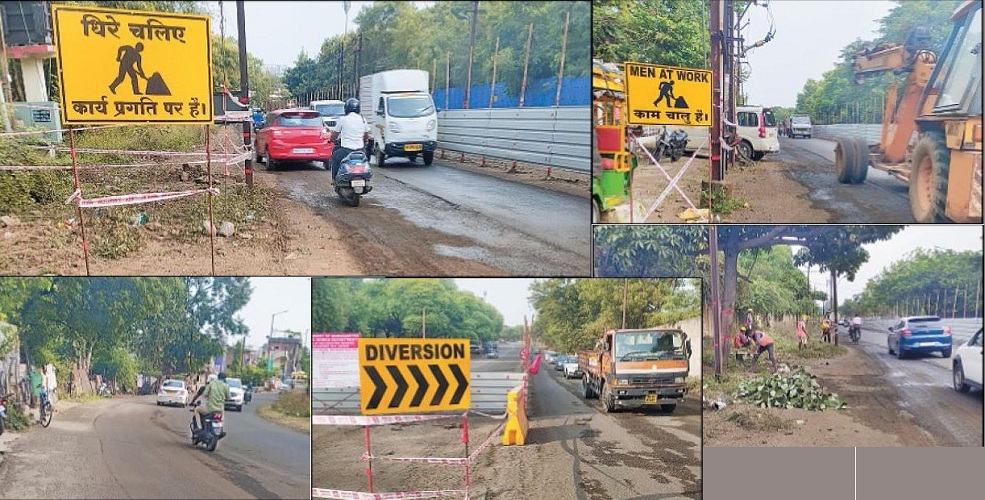
The work of cement- concrete roads has almost always caused a great inconvenience to people. The latest case in point is the work ongoing on road from Ambazari T-Point to Amravati Road junction
A development work, sometimes, also causes inconvenience to people, at least till the project is completed. In case of Nagpur, the work of cement-concrete roads has almost always caused a great inconvenience to people. The latest case in point is recently begun construction work of cement-concrete road from Ambazari T-Point to Amravati Road junction. If one takes road from Shri Gajanan Maharaj Mandir on the banks of Ambazari lake to Amravati Road, one must rest assured of an adventurous journey. Apart from negotiating the potholes, which are of variable sizes and shapes, on the road from the temple to Ambazari T-Point, one now has to be extra cautious while taking the road that joins Amravati Road junction near Rashtrasant Tukadoji Maharaj Nagpur University campus.
For, a big width of the road stands barricaded owing to ongoing construction of cement-concrete road. And, whatever width of road is left is being used by vehicles ascending and descending at Ambazari T-Point. The entire stretch of a few kilometres is barricaded on one side, except the curvy stretch from Sukhniwas Apartment to Vice-Chancellor’s bungalow. Apart from barricaded one, whatever portion is left open for traffic is narrow in width. In fact, of this ‘open’ portion of road, barely half is tarred and rest is just road shoulder. But, since this ‘open’ portion is in use for two-way traffic, the traffic incoming from Amravati Road direction, is forced to make good use of road shoulder.
After rainfall on Wednesday, there was chaos for quite some time. Rains or no rains, riding or driving through a patch that is not tarred is a bad experience for road-users. Damaged parts, even if small, of usable road width of tarred portion just adds to the challenge. This road is used by heavy vehicles including fuel tankers and trucks. At the time of ascent from Ambazari T-Point, these heavy vehicles raise their speed to ensure smooth climb. However, the smaller vehicles ahead have to adjust their speed according to ‘two-way’ situation ahead of them. In such a situation, if a smaller vehicle slows down a bit, the heavy vehicle ascending in speed from behind just blows horn loudly, startling everyone.
If the heavy vehicle slows down its climbing speed, inconvenience is caused to other vehicles behind it as they, too, are climbing at a raised speed. Throughout this entire stretch, people have been left to adjust. The onus is on the people to keep themselves safe in two-way flow of traffic on a congested patch of road. At night, the situation becomes even more tricky. For, there are issues with proper illumination of road stretch available for flow of traffic.
Poor light often increases chances of a road-user riding/driving through damaged portion of road or a bump. The situation at road-curve becomes even trickier. For, the vehicles coming from opposite direction have ‘upper’ lights on, thereby increasing the chances of mishap. On a narrow road-width, street-dividers are not possible. And, this increases the risk even more. The authorities may feel that this much inconvenience will have to be borne for a development project.
However, from people’s point of view, a little more attention to planning the execution of a road construction work would reduce the degree of inconvenience, and risk. For instance, before barricading one portion of road for construction, it can be ensured that the other portion open for traffic is kept in good shape. Also, traffic monitoring can be done by executing agency at least during peak hours, so that the risk of accident is reduced. The most important thing that can reduce the duration of inconvenience to a great extent is completion of project strictly within the set deadline. The construction of road work from Ambazari T-Point to Amravati Road junction is just one case in point. If some more thinking is done by the authorities concerned, and experts, the level of inconvenience and risk faced by people during execution of a project can be reduced.