‘Man-animal conflict cannot be removed completely, but contained’
14 Dec 2020 08:26:16
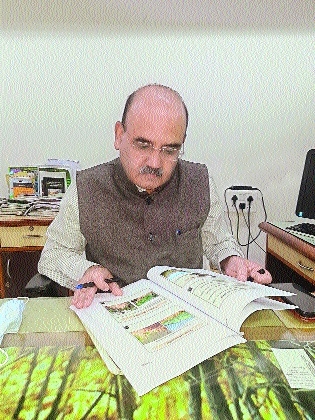
Nitin Kakodkar
By Kartik Lokhande :
Study group constituted by State Government expected to submit its report by December 31, says Nitin Kakodkar, PCCF (Wildlife)
NITIN Kakodkar, Principal Chief Conservator of Forests (Wildlife) of Maharashtra, is a busy man. He faces multiple tasks, from sifting through various study reports to advising the State Government on issues relating to new sanctuaries and conservation reserves, to responding to situations arising out of rising incidents of man-animal conflict. Despite pressure situations, Kakodkar never loses his cool. Whenever one meets this top officer in Forest Department, one is welcomed by a soothing smile. Conversation becomes a pleasant experience as the man adds information and perspective in a composed voice. An avid wildlifer, a good photographer, and author of celebrated book ‘Tadoba: The Untold Story’, Kakodkar is a scholar-officer.
Having worked previously in Tadoba-Andhari Tiger Reserve (TATR) in Chandrapur district, which has been making headlines for past some years due to rising man-animal conflict, Kakodkar is also the man who can offer wider perspective on the issue. ‘The Hitavada’ caught up with him, sneaking through his busy routine, for a conversation on conservation.
Q: Wildlife encompasses a vast idea. It involves multiple factors, which sometimes make the wildlife protection efforts a complex matter. What is the state of wildlife protection efforts in Maharashtra?
A: Maharashtra has a protected area network covering 9,395 sq km, which is 3.05 per cent of State’s geographical area. There are 49 sanctuaries, six national parks, seven conservation reserves. Ten more conservation reserves have been recently approved by State Board for Wild Life. The newly sanctioned Kanhargaon sanctuary covers 269 sq km and the new conservation reserves will cover around 1,000 sq km area. Wildlife gets necessary protection in protected area network and elsewhere. The threats to wildlife are multifarious. These threats include habitat fragmentation, degradation of habitat because of biotic pressures (grazing, non-timber forest produce collection etc.), poaching (through snaring), electrocution (mainly fencing put up by farmers to protect their farms from damage by wild animals), road kills, animals falling into open wells without boundary wall, disease transmission etc. Problems are different in various parts of State. If we treat tiger population as an indicator of protection, it is good in Maharashtra. Tiger population in Maharashtra has grown from 189 in the year 2014 to 312 in 2018. But, we cannot be complacent because dangers like poaching are lurking.
Q: It is said that the man-wildlife conflict is expected to increase in days to come. With rising incidents of man-animal conflict, management part is becoming more dominant than mere wildlife protection. How is Forest Department responding to the situation?
A: Man-animal conflict is rising and it will increase further because of rise in population of humans as well as wild animals. Conflict cannot be removed totally from the landscape. But, it can be contained and responded to in a better manner. At some places, people have learned to co-exist with leopards to reduce conflict. Sensitisation of people, better co-ordination with road, electricity, and other agencies concerned can improve management and protection of both. For example, overpasses have been constructed at places like Gosikhurd canal, and several structures are proposed across Samruddhi Mahamarg wherever it is passing through wildlife focus areas. Over the years, there has been a positive change in thinking among other agencies. This is contributing to better management and protection of wildlife.
Q: Of late, much is being talked about man-animal conflict in areas around Tadoba-Andhari Tiger Reserve (TATR) in particular and Chandrapur district in general. Forest Department had moved a proposal to shift 50 tigers from TATR to elsewhere in the State/India to ease pressure on the landscape. Please shed light on the proposal and the concept behind it.
A: Of total 312 tigers in Maharashtra, as many as 160 are in Chandrapur district alone. Eighty of them are in TATR area and 80 are outside. Naturally, there will be conflict. The area outside tiger reserve is fragmented and interspersed with villages, and the population is dependent on forest produce. So, conflict comes naturally. Tiger is a territorial animal. It keeps searching for territory. Besides, there is another challenge. There are 63 breeding females. Even if we consider that one-third of them breed annually and each one gives birth to three cubs, there is increase in tiger numbers by 63 every year! It translates into more tigers looking for territory. We thought of shifting 50 tigers, as part of likely solution to the situation. But, even if we decide on that, it is not a task that could be accomplished in a matter of days. It may take months. Even if some tigers are shifted or they move out of district, the territory will not remain unoccupied. For, another tiger in search of territory will occupy it. Because of space constraint, the conflict will always be there. But, let me make it clear that we never indicated castration of tigers to control their population, as highlighted in some sections of media.
Q: Recently, State Government constituted a committee to look into the Chandrapur incidents and recommend measures to mitigate the crisis arising out of man-animal conflict. How is the progress so far?
A: The study group constituted by State Government is expected to submit its report by December 31, 2020. Once I receive its report, I shall examine it and then add comments before processing it to State Board for Wild Life or State Government for further action.
Q: Often, Forest Department faces criticism over tigers killing humans especially in fauna-rich Vidarbha region. May it be Yavatmal or now Rajura, Forest Department is caught between local people and conservationists. As PCCF (Wildlife), how do you tackle this pressure?
A: It is indeed a tricky thing to deal with. As PCCF (Wildlife), I have as much responsibility towards wildlife as towards people. I am looking at conservation of species, and not just an individual animal. Sometimes, I do face situations wherein I have to carefully decide on passing an order for capture of a wild animal. If I do not order capture of wild animal, when people are facing threat, that inaction on my part may turn people hostile against wildlife. It will harm the larger cause. So, there is pressure, and that is part of my job.