Ghoda Yatra: A unique tradition in Chimur completes 248 years
09 Feb 2020 11:27:01
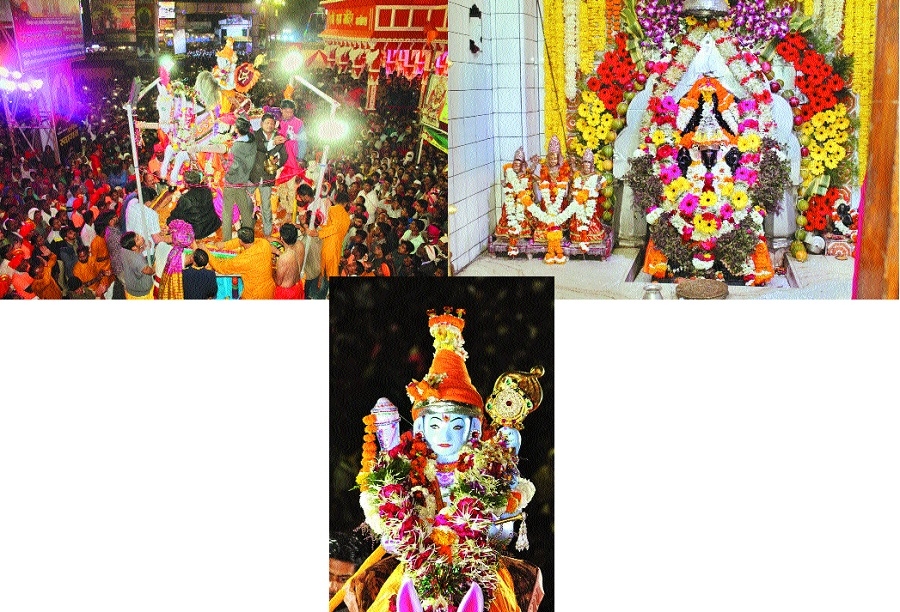
By Rajendra Diwe :
The Ghoda Yatra festival was started on the day of Vasant Panchami with Balaji Navratra. The Ghoda Ratha Yatra will conclude on February 9 with Rudra Swahakar Yadnya and Navratri will conclude on February 10. The festival will conclude on February 22 on Mahashivratri
Lord Venkateswara also termed as Lord Balaji has been considered as the savior of mankind in the troubled era of Kalyug. If prayed with full devotion the Lord Venkateswara grants all legitimate demands of his disciples. According to scholars, Venkateswara is not a name but a title. Ven-kata means one who cuts or washes away one’s sins. Kaliyuga is considered as an age of downfall or degradation.
In every aspect of life, the downfall is witnessed. For many people, Lord Balaji, a form of Lord Vishnu is the only God to be worshipped in Kaliyuga. For them, Lord Balaji assures spiritual transformation. Lord Balaji is also referred to as Venkatesha, Govinda, Srinivasa, Sriman Narayana etc. Devotees of Lord Balaji or Venkatesha believe, Lord removes sins and blesses with nectar, energy, prosperity and wealth. Lord Balaji is also considered as Kali Yuga varada that is the boon granting Lord of Kaliyug and remover of all sins. Vidarbha has three and half shaktipeeths of Lord Balaji. They are situated in Deulgaon Raja, Mehekar, Washim and Chimur. The Balaji from Deulgaon Raja is considered as the ancient one as according to the archeologists, the Balaji idol is more than 1, 000 years old.
The Balaji temple in Washim is about 245 years old. The Balaji idol in Mehekar is known as Lord Sharangdhar which was found in the tear 1888 during the excavations at Mehekar. The Balaji temples in Deulgaon Raja, Mehekar and Washim are in West Vidarbha region while the only Balaji temple in East Vidarbha is in Chimur in Chandrapur District. This temple was built during Bhonsala period about 394 years ago. These temples are the three and half shaktipeeths of Balaji.
The idol of Balaji in Chimur is strikingly similar to the idol in the famous Tirupati Balaji temple. This temple is famous for the ‘Ghodayatra’ which begins as per Hindu calendar on Magh Shuddha Trayodashi. During the ‘Ghodayatra’ the idol is paraded through town in a colorful procession which is attended by devotees in large numbers. The Chandrapur District Gazetteer mentions, “The importance of Chimur lies in the antique temple of Balaji which has a great reputation and the Ghoda ceremony which is held two days prior to the annual fair. It is said that the image of Visnu or Balaji was discovered by one Bhika. Patil, a Kunbi while digging the plinth of the shed for his cattle. He constructed a small temple to house the idol and appointed a priest for its worship.
The priest, Devajipant Corghade, prayed the god every day that if he became a sardar he would construct a grand temple replacing the small one. It so happened that Devaji actually rose to a position of high rank in the service of the Bhosles and in fulfillment of his vow he constructed the temple that is seen to-day with the consent of Janoji Bhosle. It was he who instituted what is known as the Ghoda ceremony which is held in connection with the annual fair on the 15th day of the bright half of Magha. The Ghoda fair is one of the biggest fairs in the district and attracts a large number of people. Two days prior to the fair, Balaji's horse, which is of wood, with his image on it, is taken round the village and then back to the temple. The fair lasts for about 15 days and the daily average attendance is over 2,000 persons. Its importance is more commercial now than religious, and a number of traders attend from long distances. A considerable trade is done in rengis (carts) and cart-wheels and cattle are also brought for sale.
The temple construction including the inauguration cost Devaji nearly two lakhs of rupees. The Bhosles had presented it with a gem-studded ornament with a lakh of rupees which was deposited in the Bhosle darbar in 1804 by one Vasudev Bapu Naik for fear of Pendhari depredations, It was never brought back. The Bhosles had also made an annual grant of 1612 Nagpuri rupees and about 200 acres of land. Nearby is a talav spread over an area of about sixty acres in which is planted the temple-flag.”
According to President of Shrihari Balaji Devasthan Chimur, Dr Mangesh Bhalme; “This year the Ghoda Yatra festival has been started from Vasant Panchami with the Navratra of Balaji in traditional way. The Ghoda Yatra has completed 248 years of its tradition. The Ghoda Rath Yatra the three day procession on chariot was started on February 7 at 10 pm with the Kirtan by Khond Maharaj and at 12 midnight the four armed wooden idol of Shrihari Balaji arrived to meet Mehetab in the decorative lighting. The energy of Balaji Maharaj got converted in to wooden idol and then the idol was placed on the white horse kept outside the temple. Four soldiers also escorted the horse.” n