Y M Kale The first historian of Vidarbha
| Date :15-Mar-2020 |
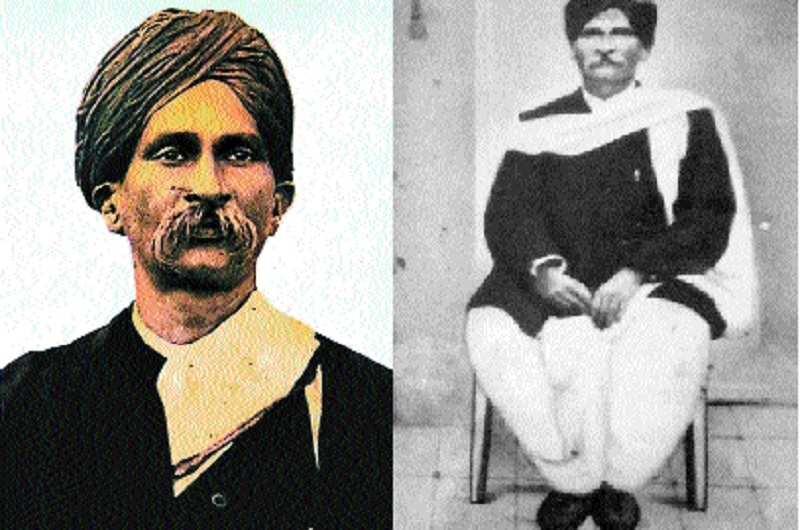
By Rajendra Diwe :
Family members of Y M Kale paid tributes to him on his death anivsersary on March 11
“Yadav Madhav Kale alias Annasaheb was the Advocate of Raje Vyankoji Raje Bhonsale of Tanjaore. When Vyankoji Bhonsale came to know about sad demise of Annasaheb, Vyankoji sent a message to family members of Annasaheb not to conduct last rites till the floral wreath from Tanjore did not reach. Vyankoji sent the floral wreath and then the family members of Anasaheb conducted his last rituals. After some days, Vyankoji Bhonsale came to Buldana and met the family members of Annasaheb,” this remembrance of Yadav Madhav Kale was narrated by Sheshshayan Deshmukh, member of Vidarbha Sanshodhan Mandal.
The second edition of ‘Vidarbhache Aadya Itihaskar Va Kayade Pandit, Yadav Madhav Kale, Charitra’ published by Shakuntala Bhagwat, Devidas Yadav Kale and Sadhna Koyal was released at the hands of Sheshshayan Deshmukh in Nashik on March 11, 2020. “In Maharashtra, people remember great historians like V K Rajwade, Raosaheb Sardesai, V V Mirashi etc, but the work and dedication of Yadav Madhav Kale, the great historian of Vidarbha has been neglected over the years. He was the first scholar in Vidarbha who unearthed the ancient history of Lonar Lake,” Deshmukh stated. Y M Kale was the ancient historian of Varhad prant. He was born on February 18, 1882 in Lonar and completed his primary education on Mehekar. He got a scholarship and free ship for education after 7th standard and passed matric in 1898. After completion of matriculation, he joined as a teacher and worked at Mehekar, Washim, Elichpur, Yavatmal and Wardha. He came in contact with Dattopant Aapte in Yavatmal and developed interest in ancient history and research. His first book ‘Lonar Darshan’ was published in 1904 when he was just 22. His second book ‘Gond Rajacha Itihas’ (History of Gond Dynasty) was published in 1905.
He completed B A and MA simultaneously. When he was working in Wardha as a teacher, he took admission to LLB in Nagpur and completed LLB in 1909. From 1910 he started practicing as a lawyer and settled in Buldana in 1919. He continued his interest in ancient history and research and wrote books like ‘Varhadcha Itihas’ in 1924, ‘Nagpur Prantacha Itihas’ in 1934. Deshmukh recalled, “When Yadavrao Kale was 17 or 18 years old, a Sanyasi named Sachchidanand Swami came to Lonar. Swamiji unearthed ancient history of Lonar and wrote ‘Viraj Mahatmya.’ Viraj Mahatmya penned by Sachichidanand Swami made long lasting impact on the mind of Yadavrao Kale and under the guidance of Swamiji, Kale penned down the Lonar Darshan, his first historical book at the age of 22.”
The history of Rashtriya Swayamsevak Sangh (RSS) is not complete without the reference of Y M Kale. Dr Keshav Baliram Hedgewar established RSS on September 25 in 1925. Dr Hedgewar declared his mission to establish RSS as: “The Hindu culture is the life-breath of Hindusthan. It is therefore clear that if Hindusthan is to be protected, we should first nourish the Hindu culture. If the Hindu culture perishes in Hindusthan itself, and if the Hindu society ceases to exist, it will hardly be appropriate to refer to the mere geographical entity that remains as Hindusthan. Mere geographical lumps do not make a nation.The entire society should be in such a vigilant and organized condition that no one would dare to cast an evil eye on any of our points of honour. Strength, it should be remembered, comes only through organisation. It is therefore the duty of every Hindu to do his best to consolidate the Hindu society. The Sangh is just carrying out this supreme task.
The present fate of the country cannot be changed unless lakhs of young men dedicate their entire lifetime for that cause. To mould the minds of our youth towards that end is the supreme aim of the Sangh.” To promote these principles, Dr Hedgewar conducted tours across the state. Dr Hedgewar had selected 100 sanghachalaks and assigned them the responsibilities to build the organisation. Y M Kale was one among these 100 Sanghachalaks selected by Dr Hedgewar for Buldana. On the day of Vijaya Dashmi, that is on October 25, 1936, Rashtra Sevika Samiti was inaugurated and Yadav Madhav Kale presided over the inaugural function of Samiti. Vidarbha Sahitya Sangh was first established in 1923. Y M Kale was one of the founders of Vidarbha Sahitya Sangh.
Justice Keshavrao Koratkar was the first president of Vidarbha Sahitya Sangh, Madhav Shrihari Ane, Shripad Krushna Kolhatkar and Yadav Madhav Kale were chosen as the vice presidents. Second Convention of Vidarbha Sahitya Sangh was held at Brahmavidya Mandir, Amravati on April 19 and 20, 1924. Yadav Madhav Kale from Buldana presided over the convention.
“Y M Kale wrote the history of the Nagpur province in 1934. He was the member of Central Province legislative council and for some time he was the president of the council. Y M Kale was the advocate for Nizam state in Hyderabad for some years. The legislative council halls in Bhopal and Hyderabad still have the portraits of Y M Kale. Lokmanya Tilak started Ganeshotsav in Maharashtra. Similarly, the credit of starting Ganeshotsav in Nizam state goes to Y M Kale,” Deshmukh said. This great historian, lawyer, literateur died on March 11, 1943 and entire Maharashtra has forgotton the contributions of this great historian, he added.