‘Ring of fire’ solar eclipse 2020 to occur today
21 Jun 2020 00:51:26
NEW DELHI ;
The solar eclipse will start at 10.23 a.m. and last till 1.48 p.m.
Allying rumours that the eclipse will mark end of coronavirus Aniket Sule of Astronomical Society of India, said eclipses do not impact micro-organisms on Earth
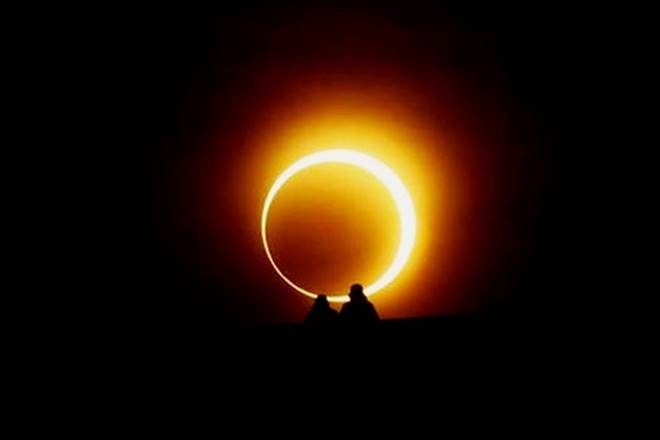
A RARE celestial event, annular solar eclipse, which is popularly known as the “ring of fire” eclipse, will be visible this Sunday in India. It will be the first solar eclipse of this year takes place on the summer solstice, which is the longest day in the Northern Hemisphere. While people living along the path annular eclipse passing through Anupgarh, Suratgarh, Sirsa, Jakhal, Kurukshetra, Yamunanagar, Dehradun, Tapowan and Joshimath will be able to see the annular phase, people in rest of India can witness a partial eclipse, said the Ministry of Science and Technology. Obscuration of the Sun by the Moon at the time of the greatest phase of partial eclipse will be around 94 per cent in Delhi, 80 per cent in Guwahati, 78 per cent in Patna, 75 per cent in Silchar, 66 per cent in Kolkata, 62 per cent in Mumbai, 37 per cent in Bangalore, 34 per cent in Chennai, 28 per cent in Port Blair. The solar eclipse will start at 10.23 a.m. and last till 1.48 p.m.
When Moon comes between the Sun and Earth, the shadow falls on the surface of the Earth. The Sun is entirely covered by the Moon for a brief period. Those places that are engulfed by the dark, dense umbral shadow of the Moon experience the total solar eclipse. In the regions that plunge into the soft diffused penumbral shadow of the Moon experience the partial eclipse. “Annular solar eclipse is a particular case of the total solar eclipse. Like the total solar eclipse, the Moon is aligned with the Sun. However, on that day, the apparent size of the Moon happens to be a wee smaller than the Sun. Hence the Moon covers the central part of the Sun, and the rim of the Sun appear like a ‘ring of fire’ in the sky for a very brief moment” explains Samir Dhurde of The Inter-University Centre for Astronomy and Astrophysics, Pune.
During the solar eclipse, the apparent size of the Moon is smaller than that of the Sun by 1 per cent, the expert said. Allying rumours that the eclipse will mark the end of coronavirus, Aniket Sule, Chairperson, Public Outreach and Education Committee of the Astronomical Society of India, said: “Solar eclipse is caused when the Moon comes in front of the Sun for a short time.
Eclipses do not impact micro-organisms on Earth. Likewise there no danger in eating of stepping out during an eclipse. No mysterious rays come out of the Sun during an eclipse.” Chardham temples to remain closed from 10 pm on Saturday till Sunday afternoon: AHEAD of the solar eclipse, all the Chardham temples in Uttarakhand will remain closed from 10 pm tonight till Sunday afternoon. The temple of Badrinath-Kedarnath and Gangotri-Yamunotri will remain closed from 10 pm tonight.