ICAR-CCRI issues advisory on locust warning and its management
04 Jun 2020 08:37:11
Staff Reporter :
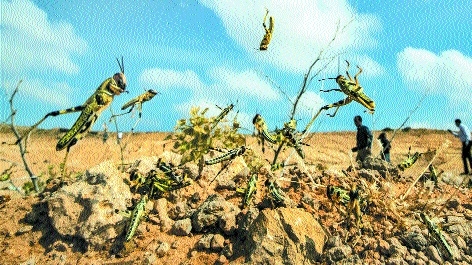
ICAR-Central Citrus Research Institute (ICAR-CCRI), Nagpur issued an advisory on locust warning and its management measures that affecting citrus crop in Amravati and Nagpur districts in past 15 days. Swarms of the desert locust, which invaded India from Pakistan in April, have made their way to at least five states like Rajasthan, Madhya Pradesh, Gujarat, Uttar Pradesh and Maharashtra. Based on recent press notes and electronic media reports, locusts swarms were observed in certain citrus growing belts in Amravati district, Maharashtra. These locusts look like ordinary grasshoppers having big hind legs that help them hop or jump and they move through several phases before maturing into flying adults.
Locust swarms devastate crops and cause economic damage in several agricultural and horticultural crops. During the process of adult maturation, they fly in search of favourable breeding condition and may cover thousands of kilometres. On maturation the adults become bright yellow and the mature female drills hole at a depth of 8-10 cm in moist sandy soil, oviposit thrice at weekly interval about 1000 egg pods/sqmt area. Adults fly in swarms and migrate in millions from country to country or from place to place. There are two types of groups: Swarms and Bands. Swarms are composed of winged adults while bands are composed of hoppers (nymphs). A single swarm covering 1 square kilometre area can contain up to 80 million individuals. Both swarms and bands rest on crops and trees at night while morning they hop and fly to form a swarm when temperatures rise.
They are voracious feeders and feed on any vegetation they come across during their flight. Since the locust attacks the crops in groups aerially, management of this pest is very difficult. The control strategies should only be initiated when the population of locust crosses its Economic Threshold Level (ETL) which is 10,000 Adults/Hectare or 5 to 6 nymphs/bush or tree. Control strategies are not effective, if the population of locust is less than the ETL and if it is in scattered manner. Community based management is most effective and practicable against hoppers though taken up against all stages and are listed below:
Identification of the oviposition sites on a large scale and same can be destroyed by ploughing, digging and harrowing. n Digging trenches (45 cm deep and 30 cm across) to trap the marching of hoppers. The first instar nymphs are more vulnerable than later instars. n When swarms settle on vegetation or ground, they are beaten to death, swept together, and buried in heaps. n They can be burnt with fire torches (flame throwers) at night or early morning when sluggish.
Kites and crows, common mynahs are predaceous on locusts.
Poison baits with wheat or rice bran plus an insecticide (chlorpyriphos) + attractant (molasses) + enough water could be scattered either in morning or evening where hopper feeds.
Following insecticides approved for controlling of desert locust on crops and other trees can be sprayed as per recommended doses; Chloropyriphos 20%EC (@2.4ml/L), Chloropyriphos 50%EC (@1.0ml/L), Deltamethrin 2.8%EC (@1.0ml/L), Fipronil 5%SC (@ 0.25ml/L), Lamdacyhalothrin 5%EC (1.0ml/L), Lamdacyhalothrin10%WP (@0.5gm/L), Malathion 50% EC (@3.7ml/L), Malathion 25% WP (@7.4gm/L).