WRCS research on putting colour bands to owls in Melghat proves beneficial
06 Sep 2020 08:41:33
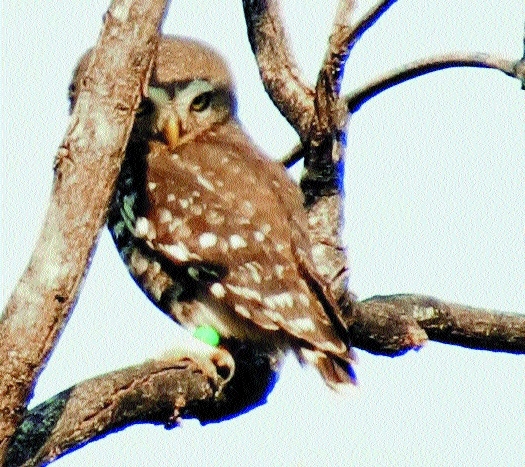
A forest owlet in Melghat.
By Ramesh Marulkar :
A team of Wildlife Research & Conservation Society (WRCS), a Pune-based NGO, has been conducting research on forest owls/owlets in Melghat and putting colour bands to some birds in Chaurakund Forest Range, Sipna Wildlife Division, Melghat, to yield useful insights in management of the species and their habitat. The species is endangered and the study helps understand their ecological requirements and other aspects. The organisation has taken up the research project since 2017 in collaboration with Forest Department, Melghat Tiger Reserve with the permission from Ministry of Environment, Forests & Climate Change.
The team captures and puts colour bands around the legs of owls/owlets and releases them in the wilderness. This technique is called ‘Mark-Visual Recapture’. The objectives of the study are to know movements of the birds, counting number of birds, finding locations, monitoring and collecting other information. The results of the studies are helpful to Forest Department for planning, better habitat management and strategy for the endangered species in the area. It also underlines importance of protection/conservation of the birds that are nesting and roosting on trees as well as other feeding areas, seasonal movements and population monitoring, said Dr Prachi Mehta, Senior Scientist and Executive Director of WRCS, Pune, while talking to ‘The Hitavada’ on Saturday.
Dr Mehta said that it was very difficult to identify and count individual owls just by looking at them and follow their movements to understand their habitat use. WRCS colour-banded the owls to identify individual birds. Each owl is banded with a different colour band as per its locality. “So, if a bird with a green band from area ‘A’ moves to area ‘B’, we will know which bird has travelled how much distance,” she added. Dr Mehta further said that this data was very useful in monitoring bird movement. She explained the importance of using radio-tags in such studies. Radio-telemetry is also another very useful technique to study which habitats are used by the birds for feeding, nesting and for seasonal movement. This information is very useful to Forest Department for planning site-specific protection measures.
Scientists from Wildlife Institute of India, Dehradun, are studying seasonal migration of species with the satellite tags, which provide information on how these birds cross the continent and oceans and come back to their breeding grounds in India. WRCS will be using radio-tags and not satellite tags during the research as these owls are not migratory, Dr Mehta pointed out. Jayant Kulkarni, former IFS officer from Maharashtra and Executive Director of the organisation, said, “Through the project we are also working towards generating awareness among field staff and local communities in protecting owls and their habitat. The owl project is just beginning to reveal information on owl ecology and throwing light on little known aspects of the owls.
Our technical manual prepared in collaboration with Zoological Survey of India scientist on identifying prey remains was released in the World Owl Conference held in 2019. It helps in identifying which prey is consumed by the owls,” he said. Kulkarni commended State Forest Department’s initiatives in supporting research stating that good science was the need of the hour for conservation of precious biodiversity.