New study to reveal feeding style of ‘terrible lizards’
20 Oct 2021 08:11:49
By Shirish Borkar :
Fossilised jaw bones of Noasaurid theropod dinosaurs were found in Chandrapur district
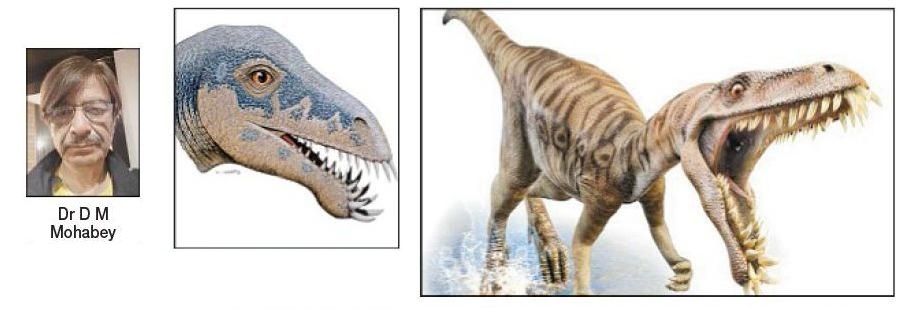
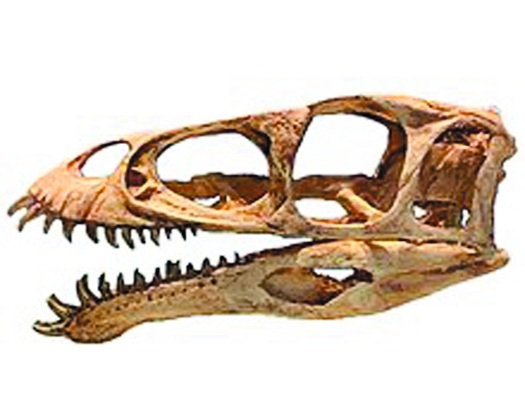
THE scientific study on fossilised jaw bones of small-sized Noasaurid theropod dinosaurs, being conducted by internationally acclaimed city-based dinosaurian scientist Dr D M Mohabey, is likely to throw a new light on the feeding style of these ‘terrible lizards’. Dr Mohabey had collected these fossilised jaw bones from Pisdura and Dongargaon localities in Chandrapur district. The study would not only help in understanding the diet and food habits of Noasaurid dinosaurs but also their palaeoecology, plaeoclimate and palaeogeography. After discovering hundreds of fossilised eggs and nests of dinosaurs, who ruled the earth some 67 million years ago and for whom parts of Vidarbha, Madhya Pradesh and Gujarat were home, Dr Mohabey is now conducting in-depth research with Prof Jeffrey Wilson of University of Michigan (USA) on Noasaurid theropod that would reveal how wide these Jurassic creatures could open their jaws.
Dr Mohabey, former Deputy Director General of Geological Survey of India (GSI), told ‘The Hitavada’ that dinosaurs were known from two different areas in Vidarbha, geographically separated by a distance of around 250 kilometres. These areas included Sironcha in Gadchiroli district and Pisdura and Dongargaon in Warora taluka of Chandrapur district, he added. Dr Mohabey, who extended his scientific expertise to Government of Gujarat for setting up country’s first Dinosaur Museum & Fossil Park at Raioli, Balanisor taluka in Mahisagar district, said, “The earliest dinosaur in Sironcha area is known as Alwalkeria Maleriensis. It was a carnivore bipedal theropod whose fossils were found in the rocks of Triassic age dating back to around 230 million years.” The fossil remains are found in the Pranhita-Godavari valley in the adjoining areas of Vidarbha and Telangana.
However, the fossil bones found by palaeontologists were fragmentary and incomplete. And hence, it is not known how Awalkeria looked like. “The palaeontologists have tried to reconstruct the animal model but it is speculative,” Dr Mohabey said. Fossils of comparatively younger dinosaurs were excavated from 200 million years old Jurassic rocks from the same area. Fossilised and well-preserved articulated dinosaurian bones were unearthed from the site. Based on the studies, palaeontologists from GSI, Hyderabad and Indian Statistical Institute (ISI), Kolkata were able to reconstruct and mount the skeletons of two different basal quadrupedal and herbivorous sauropods. Dr Mohabey said, “Two different types of skeletons are named ‘Barapasaurus’ and ‘Kotasaurus' which were displayed in the museum of ISI Kolkata and Birla Science Museum, Hyderabad respectively. These two are the only articulated, re-constructed and mounted skeletons in India.” Dinosaur bones have been found from Pisdura and Dongargaon areas in Chandrapur District since 1860. These bones occur in the rocks of Late Cretaceous period.
It is also geologically known as Lameta formation dating back to 66-67 million years. Dr Mohabey said, “Both Titanosaurs sauropods and Abelisaurid theropod dinosaurs are known. Partial but articulated skeleton of sauropod dinosaurs known as ‘Isisaurus colberti’ (earlier known as Titanosaurus colberti) has been excavated from Dongargaon. The bones are currently housed in ISI Kolkata.” Noasaurid dinosaurs were small-sized abelisaurid theropods growing up to one meter in length from snout to tail, slightly bigger than house cats. Based on their slender jaw with curved conical shape, they are thought to be mainly piscivores, he added. “So far,” Dr Mohabey said, “Only a single valid noasaurid species -- Laevisuchus indicus -- is known from Jabalpur (MP) that was found in 1932-33 by British palaeontologist Charles Matley from nearly 66.5 million years old sediments.”
These dinosaurs lived contemporarily with giant herbivore titanosaurs, large sized carnivore hunters like Abelisaurid theropods, madtsoid snakes, large side necked turtles and crocodiles under semi arid climate some 67 million years ago. It may be mentioned here that Pisdura is a unique locality in the world that prolifically yielded coprolites (fossilised dung of sauropod dinosaurs). Discovered and studied by Dr Mohabey, these plant bearing coprolites contain soft tissues of angiospermic and pteridophytic plants. These coprolites suggested that these sauropods preferred soft tissues of plants as their solid diet 67 million years back. Interestingly, the fossil dung of sauropods also yielded phytoliths (silica tissues) of rice family grasses ‘Oryza’. This interesting find from Pisdura coprolite and the DNA analysis had revealed that rice originated in India at least 150 million years ago and much older to its origin in China as known earlier. Implicitly, it is suggested that sauropod herbivore dinosaurs relished the rice as their staple diet much before mankind tasted it.