Rocks remember: This repository in city has largest collection of drill cores
25 Oct 2021 08:53:55
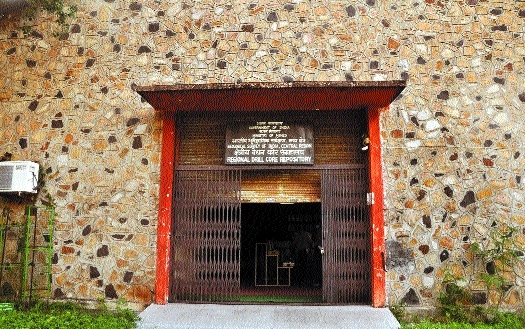
The entrance to Regional Drill Core Repository, which is the largest in the country. (Pic by Anil Futane)
By Kartik Lokhande :
Celebrated astronaut Neil Armstrong’s quote is widely popular: “Geologists have a saying -- rocks remember”. Imagine, if there is a place that has preserved ‘drill cores’, which a layman may refer to as mere rocks or stones? Shouldn’t that place be called a museum of history through the ages? And, if that place has the largest collection of ‘drill cores’ in the country, that too, in Nagpur? Wish to know more? Read on... Headquartered at Calcutta, Geological Survey of India (GSI) was founded in 1851. Central Region, headquartered at Seminary Hills in Nagpur, is one of the six regions of GSI. It covers Maharashtra, Chhattisgarh, and Madhya Pradesh. Presently, GSI Central Region is headed by Hemraj Suryawanshi, Additional Director General and Head of the Department. Central Region has five missions -- Baseline Geoscience Data Generation that looks after mapping etc; Natural Mineral Resource Assessment that looks after mineral exploration, resource/mineral potential, recovery of drill cores etc; Geoinformatics that publishes information resources like maps, reports etc; Research and Chemical Labs covering petrology, palaeontology, earthquake geology, landslide etc; and Training and Capacity Building.
The Regional Drill Core Repository at Nagpur comes under Natural Mineral Resource Assessment Mission of Central Region. GSI has one Regional Drill Core Repository in each of six regions in India. However, the one at Nagpur is the first one in the country. The facility at Nagpur was constructed in the year 2001-02. It has two types of drill cores -- Stratigraphic (recovered after deepest digging and representative of a big area), and Skeletonised (recovered from a small area and mineralisation varies). The oldest drill core preserved at Nagpur repository was taken for geothermal investigation and it dates back to 1984. It was recovered from Salbardi in Amravati district. Significance of Regional Drill Core Repository is huge, says Vijay V Mugal, Deputy Director General and Regional Mission Head-II, GSI. “Exploration is expensive. If drill cores are not preserved, further study for exploration will incur cost repeatedly. Why should the same area be explored again and again by spending huge money?
The drill cores preserved at the repository tell the researchers, geologists, and students about structure, geology, depth, grade etc of drill core at a particular location,” he explains. Mugal, who holds additional charge as Regional Mission Head-III also, tells ‘The Hitavada’ that drill core analysis is also available at the repository. Some section of a core can be made available for study if required by researchers, geologists, he adds. Drill cores provide valuable data for planning mineral exploration programme and ‘perception of 3D extension of data’, says Mugal. With its help, mineralisation zone can be accessed directly. Stratigraphic sequence and lithology of an area can be seen directly. Sub-surface geological data including palaeontological content can be verified. Data acquisition is very expensive and it is very expensive to re-acquire data. Hence, repository is of a big help here.
Further, it helps in planning, investigation, and training. The drill cores preserved at the Nagpur repository represent almost all geological formations exposed and mineralisation occurring in the area under Central Region of GSI. There are rakes and rakes in which as many as 11,902 boxes containing drill cores from 139 projects are kept, at Regional Drill Core Repository at Nagpur. Of these, as many as 5,107 boxes are from 248 Stratigraphic boreholes, and 6,795 boxes are from 792 Skeletonised boreholes. Together, there are 11,902 boxes of cores from 1,040 boreholes. The number keeps on increasing, with new additions being made regularly. This is the highest number of drill cores preserved in the country. The combined length of cores put together at the said repository is 40,145 metres! Presently, the Regional Drill Core Repository is housed in a large tin-roofed shed. There are multiple wooden and tin boxes in which neat rows of drill cores, which may appear like mere stone to a layman, are preserved. However, for geologists, it is a treasure trove of data. For, there are drill cores recovered from sites with possibility of reserves of gold or Kimberlite (diamond) or strategic mineral like Tungsten etc. According to Mugal, modernisation of the said facility has been already proposed keeping in mind its significance.