This Diwali, noise pollution in city was higher than that in last 2 yrs: NEERI
| Date :13-Nov-2021 |
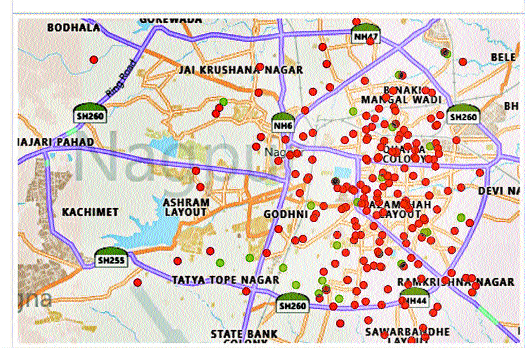
Noise monitoring by CSIR-National Environmental Engineering Research Institute (NEERI) during this Diwali, by sourcing the data from citizens, has revealed that noise pollution in Nagpur city was higher than that in last two years.
Satish Lokhande, CSIR-NEERI Noise Expert and Senior Technical Officer, launched a campaign for noise monitoring across Nagpur city. An appeal was made to the citizens of Nagpur to volunteer and record noise levels with the help of the Android app ‘Noise Tracker’ developed by Lokhande to report noise pollution status of the city. NEERI received an overwhelming response to this call.
A careful analysis and evaluation of the data received revealed that this Diwali, the overall noise pollution of Nagpur city was much higher than that in the last two years. According to Lokhande, “As many as 50 per cent of the noise readings were found between 70 dB and 89 dB, while 29 per cent were between 60 dB and 70 dB, and 21 per cent were below 60 dB.
In the city, 46 highly polluted locations had noise levels between 75 dB and 80 dB, whereas 16 areas were severely affected with above 80 dB noise levels. Zone–wise data reveals that Hanuman Nagar, Nehru Nagar, Satranjipura, and Ashinagar zones had critical noise levels above 80 dB.”
As per the data analysed by NEERI, 13 locations in Hanuman Nagar Zone had noise pollution levels above 75 dB. Raghuji Nagar, Bhagwan Nagar, Rameshwari, and Manewada in Hanuman Nagar Zone were the ‘most noisy places’ having pollution above 80 dB. Nehru Nagar Zone had 10 locations with noise pollution above 75 dB, but Nandanvan, Ramna Maruti, Narsala, Dighori, Senapati Nagar had pollution above 80 dB. As many as six locations in Satranjipura and Ashinagar zones had noise pollution above 75 dB. Tandapeth, Panchaoli, Itwari, and Hansapuri in Satranjipura Zone, and Bezonbagh and Vaishali Nagar in Ashinagar Zone were among the ‘most noisy places’ with noise pollution above 80 dB.
Though the NEERI report does not specify the names of locations, it does mention that Laxmi Nagar Zone had four locations with noise pollution above 75 dB. Lakadganj and Mangalwari had three such locations each, and Dhantoli Zone had one such location. As per report compiled by Lokhande, Dharampeth and Gandhibagh Zones did not have any location with noise pollution above 75 dB.
Bursting of firecrackers causes noise and air pollution and invariably affects the health of citizens. NEERI has recently published a paper ‘Evaluation and analysis of firecrackers noise: Measurement Uncertainty, legal noise regulations and noise-induced hearing loss’ in a reputed International journal discussing all related issues, noise pollution.
Ahead of Diwali, the Supreme Court had prohibited manufacture, use, and sale of crackers except green ones. Accordingly, States and Union Territories had framed guidelines for use, sale, and purchase of firecrackers. Consequently, Nagpur district administration allowed bursting of firecrackers only for two hours -- between 8 pm and 10 pm. Central Pollution Control Board set the permissible noise limit of 55 dB up to 10 pm, and 45 dB post 10 pm for residential areas.
Nagpurians of all age-groups from different parts of the city joined NEERI campaign. With volunteers’ contribution in noise monitoring and sharing of recorded data, for the first
time, NEERI could report noise pollution status of the entire city comprehensively. “We received 676 data feeds from various locations all across Nagpur district,” said Satish Lokhande. He thanked all volunteers for participation in noise monitoring campaign. He also thanked students of Kamla Nehru Mahavidyalaya, Sakkardara for their active participation, and young researchers at NEERI Vinit Kala and Mohindra Jain for jointly co-ordinating the activity from the front.