Babasaheb, Vidarbha and the idea of Sahitya Prasar Kendra
16 Nov 2021 10:25:36
By Kartik Lokhande :
City mourns demise of iconic historian Purandare
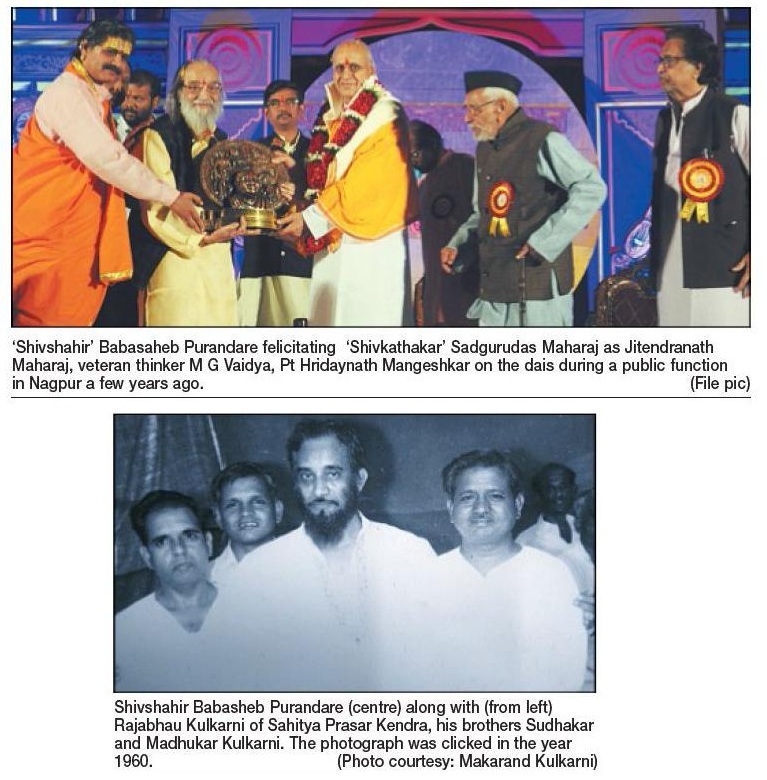
IT WAS 1954-55. A young Balwant Moreshwar Purandare, fondly known as Babasaheb, was on a whirlwind tour of Vidarbha to popularise ‘Shivcharitra’ that he had penned after painstaking research on Chhatrapati Shivaji Maharaj. Not many of present-day generation know that Purandare had spent several days in Sitabuldi and used to sleep on the verandah of eminent litterateur P B Bhave’s residence, after a tiring day. While on tour, he and his close associate Rajabhau Kulkarni spent many nights sleeping at bus-stands in villages and towns of Vidarbha. They were devoted to the cause -- of re-energising Maharashtra with the authentic and inspiring tale of Chhatrapati Shivaji Maharaj. On Monday early morning, the news of sad demise of ‘Padma Vibhushan’ recipient Shivshahir Babasaheb Purandare hit Nagpurians like a bolt from the blue. The city mourned the demise of the iconic historian, whose works have inspired generations of historians. The legend had close association with Nagpur, and especially the Kulkarni family that runs Sahitya Prasar Kendra in Sitabuldi.
In fact, the very idea of establishing Sahitya Prasar Kendra came up during the whirlwind tour of Vidarbha that Purandare and Rajabhau Kulkarni had embarked upon. “In 1954-55, Babasaheb had written 10 volumes of ‘Shivcharitra’. Then, the estimated cost of publishing these volumes was Rs 25,000/-. Raising the huge amount was a big challenge. So, Purandare and my father Rajabhau Kulkarni decided to sell books of renowned authors by visiting various villages and towns and schools, and also secure pre-release orders for ‘Shivcharitra’. As part of that mission, they came to Nagpur from Puntambe,” recalled Makarand Kulkarni, who runs Sahitya Prasar Kendra now. According to Kulkarni, Babasaheb and Rajabhau visited several villages and towns. They used to visit the schools with books to sell and also to receive orders for ‘Shivcharitra’.
“From whatever they earned as margin after selling books, they used to meet the travel expenses. If they missed the last bus, they had to spend night at villages where they knew no one. On such occasions, they used to sleep at bus-stands and eat only ‘Churmure-Futane’ to save money for the larger cause,” Makarand Kulkarni added while speaking to ‘The Hitavada’. When Babasaheb and Rajabhau returned to Nagpur after a trip to other places in Vidarbha, Babasaheb used to sleep in the verandah of the residence of noted litterateur P B Bhave in Soni Galli in Sitabuldi. On occasions, they also stayed at Rashtriya Swayamsevak Sangh headquarters. Later, they realised that Nagpur did not have a good Marathi book shop.
That is how, the idea of establishing Sahitya Prasar Kendra germinated and later took shape as an energy centre for Marathi literature and literary activities, said Makarand Kulkarni. During this period, Rajabhau also decided to organise lectures of Shivshahir Babasaheb Purandare in Nagpur. Initially, Makarand Kulkarni said, the lectures were free but to meet travel, food, and other expenses, suggestion was made to have tickets for the lectures. “However, Babasaheb was averse to the idea of charging tickets. So, then RSS Sarsanghchalak Golwalkar Guruji and other elders had to convince him. He agreed, but never kept the money for himself. All the money went to the foundation that worked for the cause of popularising the life and works Chhatrapati Shivaji Maharaj,” he added. That time, Makarand Kulkarni was a child. He and others used to check tickets of people. The ticket price was nominal -- 5 paise for one day and 15 paise if one bought tickets for five-day lecture series.
“Our family had very close ties with Babasaheb. His sad demise has come as shock for us all. A legend is no more. But, his legacy of research, hard work, writing only after visiting a place, collecting evidences, and presenting authentic history will live on,” Makarand Kulkarni said.
Purandare bought ticket for his own lecture! Shivshahir Babasaheb Purandare was very punctual about time. He used to start his lectures at scheduled time. Usually, he reached the venue of his lectures at least 10 minutes earlier. Since his lectures started in time, audience also used to start gathering 10-15 minutes earlier. On one occasion, in Nagpur, as people were pouring in at the venue of his lecture, Babasaheb also came at the same time. However, the gateman who was checking the tickets, did not recognise Babasaheb and refused to let him in without ticket. Babasaheb calmly went to the ticket-counter, bought ticket for his own lecture, and then got in. “Since then, Babasaheb made it a point to buy ticket for his own lecture in advance. For, he said, the money finally went to the larger cause,” Makarand Kulkarni told ‘The Hitavada’.