Vultures sighted in Bijapur distt
01 Dec 2021 10:09:49
By Roshan Chachane :
RAIPUR,
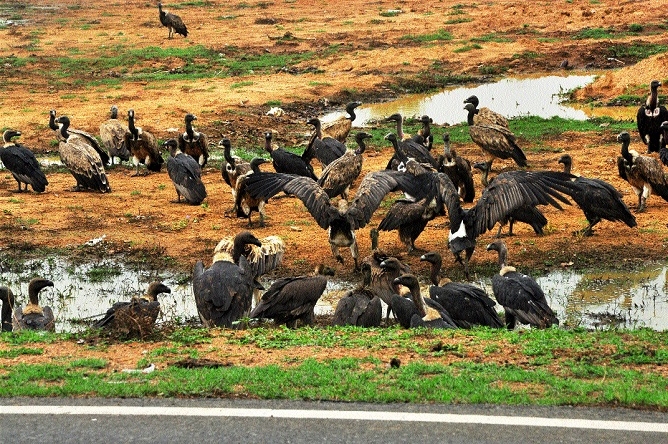
One of the nature’s apex scavengers, ‘Vultures’ are making a return to the skies of Chhattisgarh with the ban on Diclofenac, which is a non-steroidal anti-inflammatory drug that was used by veterinarians for the treatment of inflammation, fever and pain in domestic livestock. The vulture population is slowly recuperating from the ‘Diclofenac disaster’ with the ban on veterinary use of the drug by the Government of India in May 2006. When the vulture population was almost decimated from Chhattisgarh by the widespread use of Diclofenac in the 1990s, these giant birds found refuge in the hinterlands of Bastar and Bijapur. A group of researchers have recently sighted vultures in good numbers, often in the outskirts of remote villages surrounded by dense trees, higher cliffs and flat tops on higher rocky hills, particularly near protected areas and far from Urbanisation. Seven out of nine vulture species of India are found in Chhattisgarh.
In this study, concurrent sighting records of Gyps Bengalensis and Gyps Indicus at Jamguda village of Bastar. Krishna Swami Gutta hill is identified as a nesting-roosting habitat for both species. These surviving vultures most likely consumed wildlife carcasses that sustained a residual population. In these areas, the age-old practice of disposing of dead domesticated bovines away from settlements near reserve forests may also have supported the recovery of the vulture population. The researchers gave valuable suggestions to conserve vulture as the traditional practice of disposing of dead bovines free of diclofenac contamination should be promoted in other designated communal sites instead of burying - to ensure a safe, constant source of food enabling vulture populations to grow further. Camera traps should be fixed in nesting, roosting and scavenging areas to moni tor inter and intraspecies interactions.
Long-term vulture monitoring projects should be undertaken; fitting of satellite telemetry on discrete population in roosting and scavenging areas for understanding movements, other parameters and physical challenges due to vast home range. Krishna Swami Gutta hill must be designated as a ‘Vulture Sanctuary’ to protect the nesting sites of these vultures. Vigilance and legal actions should be adopted on any diclofenac use in veterinary. Sensitization of chemists and drug associations, pharmacists, veterinary councils and farmers should be undertaken along with understanding the implications of substitute of diclofenac drug in veterinary use. Lead contamination is also a serious concern for vultures and needs to be monitored for future vulture recovery. Authors of the paper “Recovery of vulture population in roosting and scavenging areas of Bastar and Bijapur, Chhattisgarh, India” published on international scientific journal ‘Journal of Threatened Taxa’ are Professor Sushil Kumar Dutta, Muntaz Khan, P R S Nagi, Santosh Durgam and Surabhi Dutta.