Chandrapur makes more money from waste management system than it spends on it
13 Dec 2021 06:38:00
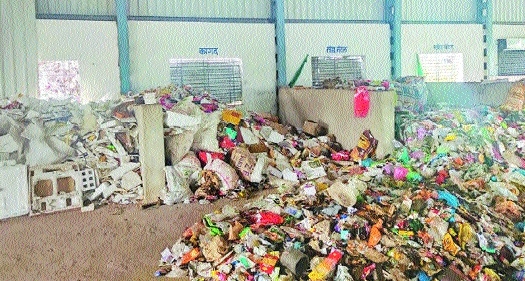
Sub-segregated waste at the material recovery facility. (*Source: NITI Aayog-CSE handbook ‘Waste-Wise Cities: Best Practices in Municipal Solid Waste Management’)
By Kartik Lokhande :
Chandrapur’s landfill management wins praise nationally, incorporated in best practices handbook prepared by NITI Aayog and CSE
Chandrapur, the newest municipal corporation in the region, has won national recognition for solid waste management practice especially in the area of landfill management. It has won praise for mandating at-source segregation and practising scientific processing of waste to reduce the load on its landfill. For this, its performance has been incorporated along with 27 other cities from across the country, in the best practices handbook prepared by NITI Aayog and Centre for Science and Environment (CSE). Under the newly launched Swachh Bharat Mission (Urban) 2.0, efforts for sustainable waste management are being strengthened further. The focus in second edition of the mission is to make cities garbage-free with efficient waste source segregation, 100 per cent door-to-door collection, and complete remedial treatment of waste material. NITI Aayog and CSE have compiled the handbook detailing best practices in 10 different thematic areas of waste management, by 28 cities from 15 States. This has been done to ‘help and guide cities to develop their waste management plans with greater efficiency’. From Maharashtra, five cities feature in the handbook titled ‘Waste-Wise Cities: Best Practices in Municipal Solid Waste Management’. These include Chandrapur (only one from Vidarbha region), Vengurla, Karad, Pune, and Panchgani. Praising the Chandrapur model, the NITI Aayog and CSE handbook appreciates that Chandrapur makes more money from its waste management than expenditure incurred on it.
“This not only makes the system self-sustaining in the long run but also makes it a positive source of revenue which can be used to maintain and improve the system,” the handbook observes. As per the accompanying details, Chandrapur spends Rs 91 lakh on processing, collection and transportation of waste. However, with the initiatives taken in the past few years, it now generates revenue of Rs 1.32 crore. This revenue includes Rs 77 lakh from user fee, Rs 55 lakh from penalties, service charges, taxes etc, and Rs 46,000/- from sale of recyclables and compost. CMC has converted waste from a liability to a source of revenue. In fact, as per the handbook, Chandrapur’s landfill management has made it the second cleanest city after Navi Mumbai in all of Maharashtra. A 1.6 hectare garden has been set up on the landfill after remediating that area. More importantly, CMC has integrated the former rag-pickers into the system by giving them work in waste processing units. This helped in giving them stable employment. Also, it is the most efficient way to run the programme as rag-pickers have both traditional knowledge about sorting waste and skills earned through experience. “It saves the cost of training new people as well.
Every waste worker earns around Rs 7,000/- to Rs 9,000/- a month, which allows them to achieve upward social mobility,” adds the handbook. Five years ago, Chandrapur collected mixed waste and dumped it indiscriminately in Ballarpur dumping ground. There were 800 garbage-vulnerable points and 110 community bins haphazardly receiving mixed waste. A foul stench emanated from the mixed waste at the landfill. The situation also led to land degradation, groundwater pollution, release of a large amount of greenhouse gases etc in the vicinity. In 2016, Chandrapur achieved 85 per cent source segregation and nearly 95 per cent waste processing by sensitising all the stakeholders through extensive Information-Education-Communication drive, capacity-building programmes and awareness campaigns. Besides, the existing dumpsite containing 68,593 cubic metre of legacy (accumulated) waste is also remediated by bio-mining.
“The land recovered has been converted into an integrated waste treatment facility with a sanitary landfill constructed only for receiving the rejects generated from various waste treatment units ensuring that only negligible waste fraction is disposed of in the landfill,” state the handbook. Chandrapur Municipal Corporation (CMC) has divided landfill site into four separate zones -- non-biodegradable waste processing unit, biodegradable waste processing unit, hazardous waste storage unit, and scientific landfill. Of total 111 TPD of waste generated in Chandrapur, 55 per cent is non-biodegradable, 42 per cent is degradable, and three per cent is other waste. The non-biodegradable waste comprises 43 per cent plastic, 27 per cent leather and rubber, 22 per cent paper, four per cent metal, and four per cent glass. There are several initiatives including installation of over 300 compartmentalised waste collection bins at public places, creation of ‘Recycle-U’ app for collection of waste, encouraging people to practise composting of organic waste at household level, municipal corporation providing home composters to many households, local body announcing to buy compost at Rs 4/kg from residents etc.