The Guns of Mandhol: Raid that forced Pak to change war plans
| Date :14-Dec-2021 |
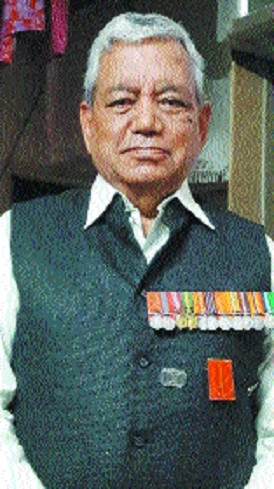
Col Abhay Balkrishna Patwardhan (Retd)
By Kartik Lokhande :
Col A B Patwardhan (Retd) was part of the daring raid on gun position of Pakistan in Western Sector during the 1971 war
VIDARBHA HEROES OF 1971 WAR
It was 12 O’clock midnight on December 14, 1971. Six gun-assault parties, one fire-support party, and one Special Frontier Force (SFF) Stick Party, silently left an Indian forward post, in search of Pakistani gun position. After crawling and walking through the dark for 40 minutes, the team reached ‘that’ spot. They all took respective positions, waited in the chill, without speaking a word. At exactly 1 am, the support party commander’s orders crackled on the radio handsets, “For all stations, Dhamaka; I say again, Dhamaka.” Under the intense fire support extended by the support party, others rained on the Pakistani gunners. Intense action followed. Indian forces directed the attack towards the known Pak gun deployment pattern.
The end result was history that had no parallels in the war records in the world. This attack, which came to be known as ‘Mandhol gun raid’, destroyed six guns of Pakistan and eliminated 51 enemy troops. Such a daring raid with such a brilliant result has not been recorded even during the World War-II. The raid forced Pakistan to change its war plans. Interestingly, the ‘Mandhol gun raid’ has Nagpur connection! Col Abhay Balkrishna Patwardhan (Retd), a highly decorated veteran officer of the Indian Army, had actively participated in the historic action. The man’s stout build even today tells a lot about the strength he carries within. His simple appearance tries to conceal his dynamic persona. But when he speaks, one realises that here is a veteran Army officer, who has seen it all. As India and Bangladesh both are celebrating the 50th anniversary or ‘Swarnim Vijay Varsh’ of the Bangladesh Liberation War of 1971, Col A B Patwardhan (Retd) shared with ‘The Hitavada’ his experience on the battlefield. In 1971, the 93 Infantry Brigade of 25 Infantry Division was posted in Poonch area of Jammu and Kashmir. Brigadier A V Natu, who also hailed from Nagpur, was the Brigade Commander. On December 2, 1971, the 33 Infantry Brigade of 39 Infantry Division came as reinforcement in Poonch.
On the night of December 3 and 4, Pakistan started heavy artillery shelling on Army posts, village, and Poonch town. The war had started. The legend of the 9 Para’s Major Chander Mohan Malhotra’s Charlie Group and strike team of SFF comprising Ladakhi and Tibetan commandos was about to begin. “In the small hours of December 4, reconnaisance patrol of eight was sent towards area top from where sound of firing came. The patrolling led to a clash in which 41 Pakistani soldiers died, one was injured and held as prisoner, and American and Chinese weapons, radio sets etc were seized. However, what the injured Pakistani soldier revealed during questioning was more alarming,” recalls Col Patwardhan. Pakistan’s 12 Infantry Division had planned to sent a Battalion of 2nd Infantry Brigade in Thanpir area on the intervening night of December 12 and 13, and two more Pakistani Brigades were to cross over Poonch river and mount attack on Poonch garrison and town on the intervening night of December 14 and 15. Simultaneously, 16 POK Battalion was to descend from Chandak Ridge feature and hold Kalai Bridge. This force was to marry up with armour column attacking Akhnoor sector and take Jammu region till Pathankot. “Had Pakistan succeeded, India’s 93rd Brigade defences would have been rendered untenable in defending Poonch, which the enemy had been repeatedly trying to occupy since 1947-48.
It was essential to thwart the enemy designs,” stresses Col Patwardhan. The plan had potential to scare any man as one Pakistani division of 15,000 soldiers was to attack Poonch and a Brigade-plus force of 5,500 soldiers was to block the exit route. However, Brigadier A V Natu was a man with steel nerves. He chalked out a daring plan to foil the Pakistani plan by ensuring that the enemy did not get fire support. Thus, was drawn the plan for the historic ‘Mandhol gun position raid’. A deception attack also was planned. As Col A B Patwardhan recalls, “Our SFF team was working with ‘Mukti Bahini’ in East Pakistan till the mid-war period in 1971. Later on, we were airlifted to Western Sector. When we came to know about the daring raid, we were excited.” The action at Mandhol began on midnight of December 14. Amid intense exchange of fire and commotion, the brave Indian soldiers charged towards gun pit and small arms started spitting fire. “One was shouting ‘take position’.
Another said, ‘charge lagao’. Someone else said ‘hurry up’. Amid this, we used 3 kg explosive with pencil-cell-connected timer. Around 20 minutes after we had moved some 200 metres away from the Pakistani gun position, several blasts lit the area. I was looking in that direction only. I was blinded for almost 10 minutes by the brightness of the explosions. There were seven explosions, visible from all Indian posts in Poonch,” says Col Patwardhan. Later on, when the Indian troops did a mopping up, they found shells, recovered bodies of dead Pakistani soldiers, gun etc. The bodies of 17 Pakistanis were lying in the area in front of cut-off group, which Col Patwardhan was part of. The troops assessed the result of the action and collected ‘war mementos’ as evidence of the action. By this time, it was 2 am and the groups got withdrawal signal. They started returning to the base. In the action, one Indian soldier had died, one was seriously wounded, and 15 were walking wounded. The return was no less arduous. The dead and wounded soldiers had to be carried along, while negotiating hilly track. All the time, Major Chander Mohan Malhotra told the seriously wounded soldier that he would be alright and that more missions awaited him. By the time the team reached Dhip Post, from where they had started and crossed Poonch river on the evening of the previous day, it was 5.30 am. The officers who had participated in the daring raid later earned nicknames of ‘leg cutters’ and ‘ear slashers’, for what they brought with them as ‘evidence’.
The Mandhol raid inflicted a heavy damage upon not only Pakistani war machine but also their morale. According to Col Patwardhan, due to the daring raid, all Pakistani gun batteries were moved to rear area from the forward deployment. As the men were drawn from perimeter security of gun positions, it led to marked reduction in effective Pakistani fire on Indian defences in Poonch. In fact, he adds emphatically, Pakistan had to change its war plans. The enemy plan to capture Poonch was foiled. The Mandhol gun position raid is a glorious chapter in the long history of Indian valour. The raid is part of curriculum in the Indian Miltary Academy, Dehradun. For the exceptional courage and bravery, the team involved in the action got one Maha Vir Chakra, one Vir Chakra, one Sena Medal. The 9 Para Commando got ‘1971 War Battle Honour’.