Dr Sqn Ldr Subir Mukerji, the saviour-soldier
| Date :16-Dec-2021 |
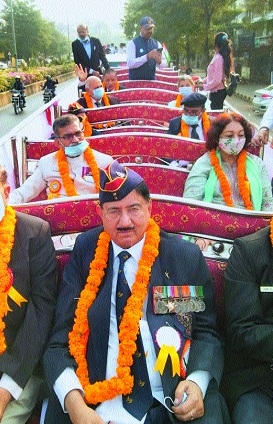
Dr Sqn Ldr Subir Mukerji
By Kartik Lokhande :
Not all the soldiers have guns in their hand. Some soldiers have scalpels too. Dr Sqn Ldr Subir Mukerji (Retd) is in the latter category. The Nagpurian, who is a veteran of 1964 Naga Conflict and 1965 Indo-Pak war, played an important role during the 1971 Indo-Pak war too. Besides discharging his professional duties as a doctor very efficiently, he did not hesitate in going extra mile to help out the injured soldiers. Keeping the force fighting fit, boosting morale of the injured soldiers with proper medical care, Dr Sqn Ldr Subir Mukerji has a unique distinction of having served in the Indian Air Force (IAF) in the two wars, and in the Indian Army in 1971 war.
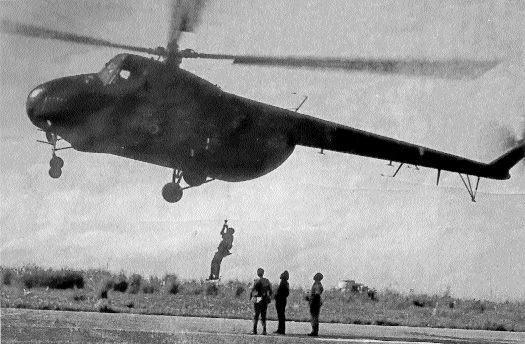
Dr Sqn Ldr Subir Mukerji evacuating casualty from MI-4
helicopter in flight after treating him on the ground.
As a doctor attending to the battle casualties in forward areas, he saw action from close quarters, evacuating casualties with sheer physical effort with the help of a rope ladder dangling from the helicopter with a steel rope and winch mechanism. “During the war we were detailed to provide medical cover to Gurkha troops in a helicopter. It was night. We jumped from 6 feet height on to the unknown rocky terrain with thorny shrubs below and hostile fire around. We were successful in evacuating severe casualties to base hospital while the walking wounded lived to fight another day,” Dr Sqn Ldr Subir Mukerji (Retd) told ‘The Hitavada’, while recounting his experiences of 1971 war. The man, who is a recipient of several medals for services rendered in war and peace both, has had his share of some moving experiences during 1971 war. For instance, a profusely bleeding wounded soldier was brought in at 2 am for medical treatment. “We had to act fast, and arrange for blood for him.
We gave a call and got eight jawans with the same blood group lined up. Cross-matching was done followed by rapid blood transfusion. We were able to save the life of the patients. Advanced life support and Standard Operating Procedure or SOP saved the troops at critical junctures,” he said. In the 1971 Indo-Pak war, which Dr Sqn Ldr Mukerji describes as ‘indeed a good learning lesson for all’, the Eastern Sector saw forward action and the Western Sector saw holding action (defensive). There were night raids by the Pakistan Air Force, which India countered by activating the batteries. Forward posts were activated and medical cover was provided by field ambulances. Main Dressing Station (MDS), Advanced Dressing Station (ADS), and field dressing stations with help of Regimental Medical Officers (RMOs) were engaged in various tasks including search, rescue, first aid, and prioritisation of casualties as per then Glasgow Coma Score. Serious cases were admitted to base hospitals. He said with pride, “Our trained medical personnel did an excellent job and saved many lives.” Shedding light on the operations, Dr Sqn Ldr Subir Mukerji (Retd) said that the principle of chain of evacuation of casualties was followed with search, rescue, first aid, organised relief service based on field care, Glasgow Coma Score, and Triage Sieve, immediate resuscitation, maintenance of airway breathing and circulation followed by stabilisation of the casualties. The doctor-soldier was posted in Western Sector in 1971. He was at field hospital that was set up underground with camouflage.
Nearby areas were under enemy fire. He and his team bravely stayed put and saved the wounded. Having served in the IAF previously, he flew a few hours during 1971 war too as the woulded had to be shifted. He was honoured with ‘Paschimi Star’ for devotion to duty. Prior to the 1971 war, Dr Sqn Ldr Subir Mukerji saw action in other areas. Having a flying experience of 246 hours mostly in casualty evacuation duties, he also survived a crash at an advanced landing ground on a mountain slope at a height of 5,600 feet! “After rescuing the other few passengers from the aircraft, I was the last person to jump out from the burning wreckage with finally the petrol tank under the fuselage bursting apart with a large and sickening thud. I then treated them at a nearby medical centre though myself sustaining burns and minor injuries,” he recalled. Dr Sqn Ldr Subir Mukerji is a decorated veteran.
He was awarded the General Service Medal Naga Hills, Samar Seva Star in 1965 Indo-Pak war, Raksha Medal in 1965 war, Paschimi Star in 1971 war, 25th Independence Medal, Sangram Medal, LS Medal, Sainya Seva Medal Clasp NEFA, SSM Clasp Assam Bengal, Himalayas for carrying out extensive casualty evacuation from the higher reaches of Uttarakhand, from places like Pithoragarh, Harsil, Dharchula, Joshimath, etc and from distant places in NEFA near the Chinese border. As far as 1971 war is concerned, he was the only IAF officer along with former other ranks to be invited to receive the Victory Flame at IAF Maintenance Command, Nagpur by Air Marshal Shashiker Choudhary, Air Officer Commanding-in-Chief, on February 2, 2021. He once again received the Victory Flame on behalf of Nagpur ex-servicemen at Amar Jawan Smarak in Ajni Square, in presence of Dayashankar Tiwari, Mayor. On September 16, 2021, he was felicitated for active participation in 1971 war, at the hands of Maj Gen Alok Beri, Commandant of NCC Officers’ Training Academy at Kamptee Cantonment. For those who think that frontline duties are all about guns and blood, he presents an example of how one can become a saviour as part of duty.
‘Lt Gen AAK Niazi, who signed surrender for Pakistan, was flown to Nagpur’ Recollecting some old memories, Dr Sqn Ldr Subir Mukerji told ‘The Hitavada’ that Lt Gen AAK Niazi who had signed the Instrument of Surrender, was flown from Calcutta to Nagpur a few days after the Pakistani surrender on December 16, 1971. From Nagpur, he was taken by road to Jabalpur in the adjoining state of Madhya Pradesh where he was placed in Prisoner of War (POW) Camp No 100. In fact, the book ‘The Betrayal of East Pakistan’ written later by Lt Gen AAK Niazi has a chapter titled ‘Surrender and POW Camp No. 100’ in which he has written that he and some others were moved from Dacca to Fort William, Calcutta. From the Fort William, they were moved to Jabalpur (the book spells it as Jubblepur) to Camp No. 100, ‘which was known as the Generals’ Camp’. As the veteran Dr Sqn Ldr Subir Mukerji recalls, Lt Gen AAK Niazi was taken to Jabalpur by road from Nagpur, where he was brought in an aircraft from Calcutta.
Mukerji family’s tradition Dr Sqn Ldr Subir Mukerji’s family has a unique and proud distinction of having served the nation in the Indian Navy, Army Medical Corps, the Indian Air Force as doctors through four generations. His father Lt Col Arun was a graduate of Staff College at Quetta (then Baluchistan) and a gallantry award winner at the Arakan front in Burma in World War-II. Even though a doctor from KEM Hospital Bombay, he led a Gurkha company in action as all the British officers were killed by the Japanese troops. Dr Sqn Ldr Subir Mukerji’s uncle Col Tarun Mukerji was also a gallantry award winner in World War-II and graduate from Staff College, Cambeley, England. His son Dr Major Shantanu Mukerji, while serving in counter insurgency operations with the Rashtriya Rifles, sustained battle injuries in Churachandpur in Manipur. “I am proud of the rich tradition in the family,” he said while signing off.