He was shopping spares amid shelling, to keep India’s war machine running
Date :20-Dec-2021
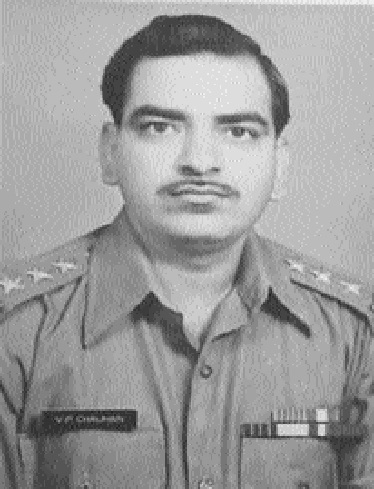
The then Captain V P Chauhan during 1971 Indo-Pak War. He played an important role in
logistics support.
By Kartik Lokhande :
VIDARBHA HEROES OF 1971 WAR
It has been 50 years since the 1971 Indo-Pak War that culminated into birth of a new nation Bangladesh. However, for Col Vilas Prithviraj Chauhan (Retd), the memories have not faded away. For, he was not just an ordinary man who could see the progress of the war while listening to news on radio. He was an active participant in the historic war. Rather, he was among those who kept the war machine of India running with sheer grit, fearlessness, and commitment to duty. “My main job was to provide logistics support for the war,” recalls the veteran while talking to ‘The Hitavada’ over telephone from Pune. A resident of Nagpur, and father of well-known lawyer Adv Deven Chauhan, Col V P Chauhan (Retd) was just 27 years old when the war broke out. Then a Captain, he was only four years into service. Born on May 12, 1944, he had joined the Indian Army in 1967.
Though unable to walk now owing to ailment relating to legs, the dynamic veteran’s thoughts dart between the past and the present with lightning speed. Recounting his participation in the 13-day war that is popularly referred to as ‘The Lightning Campaign’, Col V P Chauhan says, “My unit was moved from Aizawl (Mizoram) to Agartala (Tripura) in August 1971. We prepared for the war.” On December 4/5 night in 1971, the Pakistani Artillery was bombarding Agartala city with their guns. In this intense situation, he was given a challenging and risky operation. “I was tasked to go to Agartala city to purchase and bring a jeep-load of automobile spare parts because my EME unit was to move in enemy area in the night with our brigade (3,000 troops) to engage the Pakistani Army,” he recalls. Amid shelling, with utter disregard to his life and safety, the then Captain Vilas Chauhan entered Agartala main market, collected spare parts for two hours after requesting the owner of a shop to open at night, and returned to the base in the thick of shelling. “We had to close the door after entering the shop, switch on light, get spares off the shelf, load those in our vehicles. We had to drive through pitch dark since there was blackout at night due to threat of bombing by Pakistani aircraft or shelling. I came to know the next morning that after I had left the shop, a shell had dropped on it. The shop got partly blown off and the manager was severely injured. It was a narrow escape for me,” tells the war veteran. Individually. he was the logistics support person to his military workshop during the war. As is the case, during war, such duties warrant 24x7 attention.
He was on duty throughout 24 hours to ensure that there was no logistics failure on part of his workshop on account of non-availibility of spare parts and accessories. “I was continuously moving day and night between my unit and Agartala transport spares market,” he adds. All through, the thought of death never crossed his mind. For, he says, he was young and confident and raring to go full throttle. During the period of actual war from December 3 to December 16, his unit entered the then East Pakistan (later Bangladesh) from Agartala direction around December 5. Then, he was the main contributor responsible for lock-stock-and-barrel movement of the unit. In the war zone, his unit moved into East Pakistan from Comilla, Ashuganj, Brahmanbaria, Meghana river banks, Narayanganj, and finally entered Dacca (now Dhaka). “During the war, we had to move at night to go undetected. That meant, we had to be up after day's toil at the workshop. For 16 days, we could sleep barely for an hour or two,” he recalls. While moving from Comilla to Dacca, the men did not get food properly. On way, he could find a vendor from whom he bought 16 eggs for Re 1/-.
“I survived on these eggs during movement,” he remembers. Moving 33 vehicles in the unit from Comilla to Dacca was a Herculean effort, as they had to cross four rivers. According to Col V P Chauhan, “We had load our vehicles in ferries, cross the river, download everything, rearrange for movement by road till next river, and do the same exercise again.” Despite such a hard life during that period, a soldier never loses human touch. On the way, he also helped a woman whose husband needed medical help at Dacca and she was with her months-old baby only. “She called me bhaiyya, and I decided to help her,” he just adds. However, Captain V P Chauhan could not rest despite the end of the war marked by the signing of the ‘Instrument of Surrender’ by Pakistan on December 16, 1971. By March 15, 1972, the Indian Army was withdrwan to India. His 61 Mountain Brigade was taskd to proceed to Chittagong Hill Tracts operations to flush out rebels. So, as he tells, “From Dhaka, I moved the unit in large convoys to Comilla, then Chittagong, and finally to the southernmost part Cox’s Bazaar till end of May 1972.” At Dhaka. he was also tasked to take over the Army Base Workshop of EME. His team did it well and subsequently handed it over to Bangladesh Army. War disturbs life of all those engaged in it.
It did not spare the then Captain V P Chauhan too. His parents were in talks about his marriage with daughter of their friend, but the war broke out and everyone decided to wait for the war to end. As he recalls, “During those few days of war, I was out of communication with my family. It was only after reaching Dacca when I could call my parents on December 17 that they came to know about my wellbeing. Later on, talks about my marriage made progress.” On May 30, 1972, his unit was to move from Cox's Bazaar back to India. But, for his marriage scheduled on May 22, he moved 15 days earlier than his unit. The man who had had his share of tireless operations and sleepless nights in the line of duty, was in 261 Field Workshop EME unit on Extra Regimental Establishment post. Major K P Deswal of EME was his Officer Commaning. He was with Army Ordnance Corps depot (not Ordnance Depot) that was a mobile field formation. For his commendable contribution to the war effort, his name was forwarded for honour of Vishisht Seva Medal (VSM). The quota was over and he did not get it. But, he has no regrets about it. He is happy to have served the nation when it needed the most. It is 50 years since that action. As a young Captain back then, he was on a shopping spree for spare parts amid shelling. Now, Col V P Chauhan (Retd) is a contented man. For, he has added enough maturity and happiness to his kitty of life, amid shelling of experiences year after year, and has emerged a victor.