Subedar Ram Gandhe: Man who worked with Mukti Bahini
| Date :21-Dec-2021 |
By Kshitij Udar :
VIDARBHA HEROES OF 1971 WAR
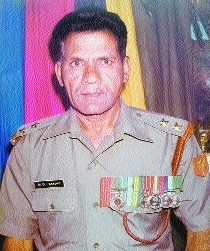
On Monday, ‘The Hitavada’ interacted with another war veteran who closely witnessed the action on the battle field during the Bangladesh Liberation War. Subedar Ram Gandhe, a war veteran from Lakhni, a small town of Bhandara district in Vidarbha had joined the Army in the year 1963 as a sepoy when he was just 23-year-old. Subedar Gandhe, while recalling his induction into the Indian Army says, “I was 13-year-old when my father passed away and as no one was there to look after the family, I was forced to work to support them amid irregular schooling. After a few years, when I was around 17 or 18-year-old, a camp was organised at our place by the Maratha Infantry for recruitment of soldiers. Looking at the condition of my family, I thought of applying and surprisingly got selected. I was very happy at that time.” Not everyone is lucky enough to get a lavish life sans struggle.
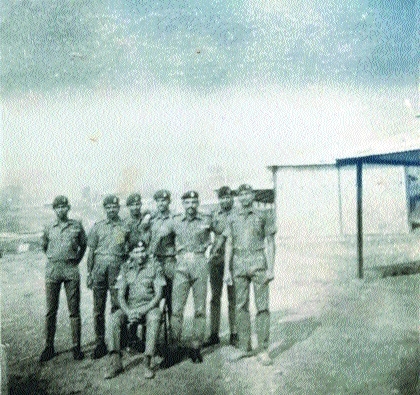
The then Naik Ram Gandhe along with the troop members deployed at Chakhabama, Nagaland.
However, Ram Gandhe is one amongst them. After his recruitment into Army, he underwent a rigorous 10-week training at Lucknow, UP and was posted to Military Hospital as a technical support staff at Meerut in Rajasthan. Talking about the Indo-Pak war in 1971, Subedar Ram Gandhe delves deep into the history while recollecting a few momentous moments of this time. “It was mid-November and I was posted with the 6 Bihar Regiment when the Commander asked me to move towards the border of Bangladesh. I moved at a very short notice from Danapur Cantonment to the new location. As there was heavy Naxal activities in the Eastern part, I was told to travel in civil dress. I started with two of my soldiers and reached the location in pitch darkness that was really scary,” he says. Subedar Ram Gandhe’s journey did not stop here at the new location. The very next day he was assigned to move ahead and be with an advancing brigade. This brigade was heading to the East Pakistan. Explaining his war journey further, Subedar Gandhe, who was with the brigade for medical support, said that it was late night when our group posted at the border was supposed to enter Pakistan with the help of the other battalion. Heavy firing and bomb blasts changed the entire situation. As continuous action was performed from the enemy side, the Indian soldiers too took their positions. The war started with shelling and bombarding from both the sides.
Being a medical staff, we were told to set up help as soon as possible. “Under gunfire, we turned another tent into medical care which was a very difficult task,” he informed. Subedar Gandhe not just worked as medical help for the troopers but was also given a task of working with Mukti Bahini to get information about the enemy. Sharing his working experience with the Mukti Bahinis, Subedar Gandhe told The Hitavada, “ It was one such experiences which I will never forget till my last breath. To work with the Mukti Bahinis was a very challenging task. We were in civil dress and was involved in finding out the location of the enemy.
I was part of that team as a medical care person. Here the war was on and slowly we were entering deep into East Pakistan. We were moving ahead under heavy bombings and shellings. I started my journey with Mukti Bahinis and reached Rangpur in Bangladesh where there was a Military Hospital which was captured by our soldiers to treat the injured. From there, I was sent to Dhaka base with a new company for the treatment of many of the Mukti Bahinis and our soldiers. It was a great experience working with Mukti Bahini and the team played a major role during the war time.” “After a 13-day conflict in December second week, the battalion I was with returned to India and I joined my regular duty. This war of 1971 will always be there in my memories. It was a pride for me that my battalion gave me a chance to serve the motherland,” adds Subedar Ram Gandhe in a firm voice.