U’khand flash floods due to hanging glacier collapse, says initial study
| Date :11-Feb-2021 |
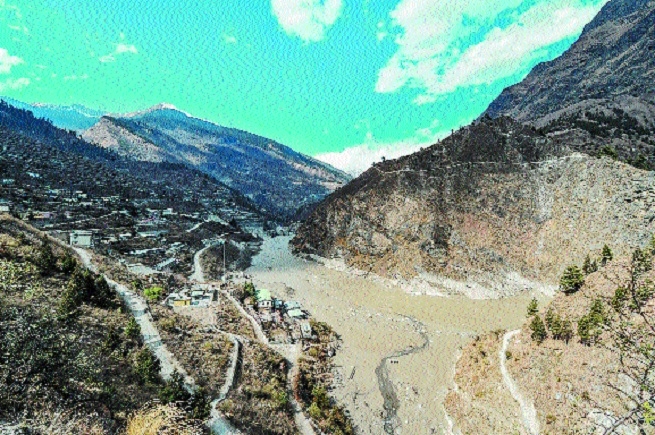
A view of Raini village, following the glacier burst in Joshimath causing a massive flood in the Dhauli Ganga river in Chamoli
district of Uttarakhand on Wednesday. (PTI)
NEW DELHI ;
THE flash floods in Uttarakhand was due to the collapse of a hanging glacier, initial observations by scientists at the Wadia Institute of Himalayan Geology suggests. A hanging glacier is a body of ice that breaks off abruptly at the edge of a precipice or steep slope. “The event happened in a hanging glacier, adjacent to Raunthi glacier, which originates from Raunthi/Mrigudhani peak (6,063 metres above sea level),” Kalachand Sain, director of the Wadia Institute of Himalayan Geology, said.
The observations also suggest that rock mass weakened over a period of time due to freezing and thawing of snow must have led to the creation of a “weak zone”, triggering its collapse, which resulted in the formation of a temporary dam that eventually breached, causing the deadly floods. Two teams of five glaciologists are studying the reasons behind Sunday’s disaster. They also undertook a helicopter survey on Tuesday. The glaciers around the area feed the Rishiganga river, which meets the Dhualiganga river.