Increase in rainfall, temperature to affect agriculture in State: Study
| Date :22-Mar-2021 |
By Kartik Lokhande :
For those who think that inter-connection between agriculture, rainfall, and temperature has to do only with farmers, think again. For, any adverse impact of rainfall and temperature may reduce the crop yields, which ultimately affects food plate. A recent study has pointed out that Maharashtra is likely to witness significant increase in monsoon rainfall as well as annual temperatures, leading to agricultural distress and water scarcity. Climatic changes after the year 2033 will seriously begin affecting parts of Maharashtra, and these changes include productivity of crops like rice, cotton, sorghum, pearl millet, sugarcane, wheat, etc.

Rahul Todmal
This has been shown in a recent study ‘Future Climate Change Scenario over Maharashtra, Western India: Implications of the Regional Climate Model for the Understanding of Agricultural Vulnerability’, published in peer-reviewed journal Springer Nature. The study suggests that almost entire Maharashtra is ‘very likely’ to experience a rise in annual average temperature by 0.5-2.5 degrees Celsius up to the year 2050. At the same time, the study points out, entire Maharashtra is expected to witness ‘a significant increase’ in monsoon rainfall from the year 2015 to 2100 barring Konkan coast. The increase may be in the range of 150-210 mm. Parts of Vidarbha and Western Ghats may record a significant increase in rainfall by 82-225 mm, reveals the study carried out by Rahul Todmal, Assistant Professor of Geography from Vidya Pratishthan’s ASC College, Baramati in Pune district. Todmal collected the data over the last two years for the study. According to him, Maharashtra is likely to experience an increase in monsoon rainfall by 18 to 22 per cent.
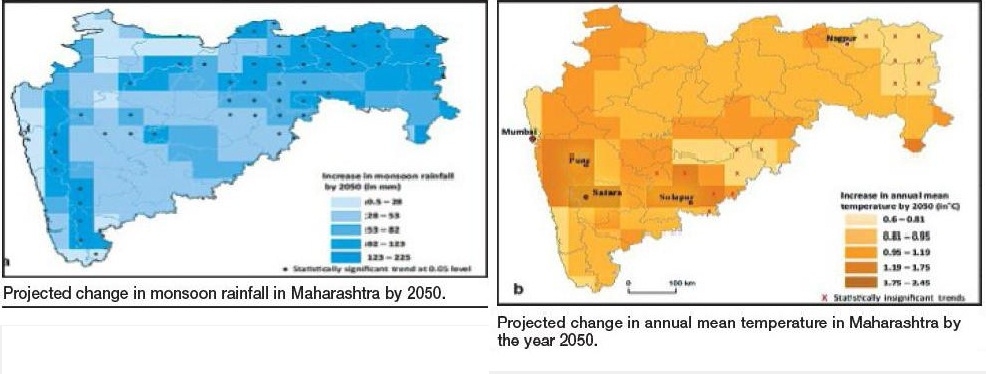
“Particularly, Vidarbha and Konkan areas may register assured increase in rainfall by 2050. This rainfall increase can be destructive and will pave the way for extreme events. It may result in repetition of the catastrophic flood events as experienced in Kolhapur, Sangli and Satara districts in August 2019,” he has pointed out in the study. Though Maharashtra has a larger share of net sown area under rainfed crops, over the last few decades it is observed that area under cash crops like sugarcane, onion, maize, and cotton is increasing at the cost of traditional or rainfed crops.
This has led to increase in agricultural water demand. Thus, uncontrolled changes in cropping pattern adding pressure on water resources and climatic changes both are posing challenge to agriculture in the State, including in Vidarbha region. As far as Cotton crop is concerned, the study cites previous researches that project 3.2 degrees Celsius rise in temperature in Buldhana, Washim, Amravati, Yavatmal districts of Vidarbha, would lead to 268 kg/ha decline in yield. Further, due to increase in minimum temperature, there may be negative impact of warmer nights on rice yield and on Rabi wheat crop. Maharashtra is very likely to experience ‘considerably warmer’ conditions post 2033. In particular, parts of Konkan and Central Maharashtra will register significant warming by 1-2.5 degrees Celsius. The study indicates that over the next five decades, annual mean minimum temperatures are expected to rise significantly across 80 per cent of Maharashtra districts.
A future increase in annual mean temperatures in areas where rainfall remains unchanged may aggravate water scarcity, particularly in semi-arid region of the State, projects the study by Todmal, who hails from a farming family in Ahmednagar district. The study recommends to the Maharashtra Government to consider these environmental changes while formulating policies regarding agriculture and water resources. Strategies should be decided to manage additional volume of water in the regions. Agronomists and agricultural scientists need to introduce drought-resistant crop varieties that can perform well under warmer conditions.
Todmal says, “As climate change affects agriculture, the main source of food, it is time to alter agricultural practices to tackle food security challenge. The policymakers, agronomists, water resources managers, farmers and common man can play vital role in facing this challenge through changes that can empower agriculture to sustain in future.” Calling the study as good, Naman Gupta, former Climate Change Advisor to Maharashtra Government, says that it provides updated projections of rainfall and temperature patterns in Maharashtra. “Findings of the study reaffirm that climate change is real and will continue affecting food and water without which human survival is impossible. It is high time to integrate climate information in existing policies and programmes not only in agriculture or water sector but also in others such as health, forests, urban and rural infrastructure, disaster management etc to ensure that adverse impacts of climate change can be minimised,” he says.
“Under the circumstances presented by the study, temperature variations may marginally affect productivity of crops like sugarcane, rice, sorghum and millet. It may have some major effect on wheat productivity. If frequency and intensity of rainfall increases, more flooding problems may be a cause for concern. Flood control methods in these principal crops are already available like broad bed furrow systems wherein cotton, sorghum, soybean and other crops can escape the type of surface flooding experienced. In addition, other climate resilient crops may take up the place of these present affected crops,” observes A N Ganeshamurthy, agriculture expert and Emeritus Scientist, Indian Council of Agriculture Research-Indian Institute of Horticultural Research.