India-Bangladesh ties a truly 360 degrees partnership: Jaishankar
| Date :05-Mar-2021 |
External Affairs Minister
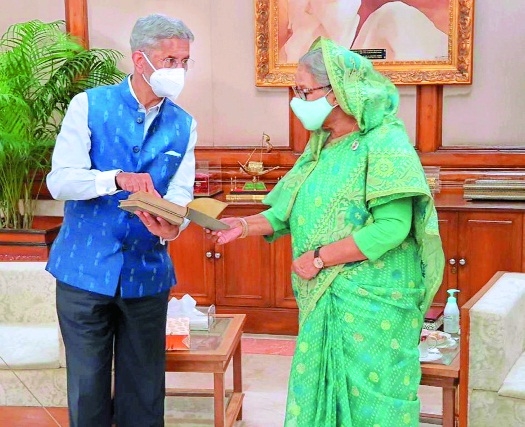
S Jaishankar meets Bangladeshi Prime Minister Sheikh Hasina in Dhaka. (PTI)
DHAKA :
PRIME Minister Narendra Modi’s planned visit to Dhaka later this month will surely be a “very memorable” one, External Affairs Minister S Jaishankar said on Thursday, as he described India’s strategic ties with Bangladesh a truly “360 degree partnership”. Jaishankar arrived here in the morning on a day-long visit to prepare the ground for Prime Minister Modi’s visit to Bangladesh later this month to participate in the celebrations of 50th anniversary of Bangladesh’s Independence and 50 years of Bangladesh-India diplomatic relations. After holding comprehensive discussions with his Bangladeshi counterpart A K Abdul Momen, Jaishankar said Bangladesh was central to India’s ‘Neighbourhood First’ policy and increasingly relevant to the country’s ‘Act East Policy’.
“We are working to prepare for the planned visit of our Prime Minister. It will surely be a very memorable visit: if I recall right it would be his first visit outside India since the coronavirus pandemic and his second as Prime Minister to Bangladesh,” he told reporters at a joint press conference along with Momen. “Many of you would remember his (Modi’s) last visit (here), that was something very transformational in our relationship,” he said. Prime Minister Modi is likely to pay a two-day visit to Dhaka from March 26 to Bangladesh to participate in a series of events. Jaishankar who called on Prime Minister Sheikh Hasina and extended Prime Minister Modi’s good wishes to her. He also conveyed to her that that Modi looks forward to visiting Bangladesh soon.
“Thank PM Sheikh Hasina for receiving me today. Conveyed warm greetings of PM @narendramodi. Her sagacity and leadership continues to inspire our relationship,” he tweeted after the meeting. Jaishankar also presented her with two books on Bangladesh written by his late father K Subrahmanyam, a prominent international strategic affairs analyst. “These are amongst the first books written on Bangladesh in early 1972. He would’ve been proud to see Bangladesh’s remarkable progress,” Jaishankar said in another tweet. Hasina gifted Jaishankar seven volumes of pre-independence period Secret Documents of the Pakistani Intelligence branch. Earlier, Jaishankar acknowledged that it was a “very special year” for the people of Bangladesh when both countries mark the Mujib Barsho, 50 years of Bangladesh’s Liberation and 50 years of India-Bangladesh bilateral relationship.
“May all your dreams come true and I can assure you that India will always be there by your side, as a reliable friend,” he said. “Our relationship is so broad & our comfort level so high that there is no domain today that is left untouched. It is a truly a 360 degree partnership,” he tweeted. “Our relations actually transcend even our strategic partnership, and I believe that our bonding is central to the realisation of a dream of a peaceful, prosperous and progressive South Asia,” he said. It is in pursuit of this vision that both sides have made remarkable progress in the relationship, especially since Prime Minister Modi’s assumption of office in May 2014, Jaishankar said.
The significance of India’s ties with Bangladesh lies in its centrality, for India’s ‘Neighbourhood First’ policy and Dhaka’s growing relevance for India’s ‘Act East’ Policy, he said. “We see Bangladesh as a key neighbour and a valued partner not only in South Asia but also in the broader Indo-Pacific region. Every outcome and achievement in our relationship resonates through this region. It is no secret that we cite it to others as an example for emulation,” he said. During his meeting with Momen, Jaishankar held wide-ranging discussions on ways to take forward the bilateral relations. “We are working so hard to expand our relationship to whole dimensions, ranging from security, trade, transport and connectivity, culture, people to people ties ensuring development of our shared resources,” he told reporters. “Our comfort levels are now so high that we have shown that there is no issue that we cannot discuss and resolve through amicable dialogue,” he said.