Nag’s tributary Pohra river struggling for its existence
09 Jun 2021 10:19:54
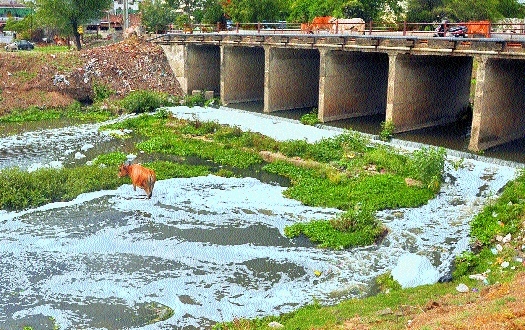
Froth floating on Pohra river near Pipla village revealing the struggle of the river for her survival amid urbanisation. (Pic by Anil Futane)
By Kaushik Bhattacharya :
Pohra river is a fine example to narrate the story of the city’s unplanned expansion at the cost of natural water streams. Pohra river is the second tributary of the Nag river after Pili river which is also struggling for its existence. Though the river’s origin remains untraceable, it flows from Yashoda Nagar in South West Nagpur and confluence with the Nag river after passing through Jaitala Road, Trimurti Nagar, Khamla, Somalwada, Manish Nagar and Besa. In absence of water flow, sewage is the only source of water in the river that covers the South-West Nagpur flowing parallel to Nag river. Nagpur Municipal Corporation (NMC), every year, initiate cleanliness campaign of all these three rivers before monsoon. Though the cleaning campaign by the civic body is underway in Pohra river, The Hitavada did a fact check and found that sewage was stagnant on many stretches, plastic and other solid wastes are afloat, making the canal not only an eyesore but also a health hazard.
The worst scene was noticed near the Pipla village where toxic froth in Pohra river gave an alarming signal. The same toxic froth was in Pili River near the Sangam in Bharatwada where Pili river is meeting Nag river. The Hitavada did a story with a heading ‘Sangam at Bharatwada: A sad tale of two dying rivers’ where the scribe spoke to the NMC officials and environmentalists to know the reason behind such frothing in river water. According to NMC, the frothing in the river is happening due to release of industrial effluent in the water body. The Effluent Treatment Plant (ETP) is mandatory for every industry situated near the river. NMC claimed that they had already restricted all industrial activities near the Nag river. But the frothing in Pili and Pohra rivers is a clear indication that the civic body was just doing superficial work in the name of cleaning.
The frothing in the water body is an indication of mixing of toxic water through industries. According to an environmentalist, “Though detergents can be treated biologically but its presence in higher concentration in any water body will have toxic effect on aquatic and terrestrial ecosystem and may also lead to bio-accumulation and end up in humans.” Talking about its effect, the expert said, “All detergents destroy the external mucus layer that protect the fish from bacteria and parasites. Additionally they can cause severe damage to the gills. Most fish will die when detergent concentration reaches 15 ppm Phosphates.” He also said, “Detergents can lead to fresh water algal bloom that releases the toxins and deplete oxygen in water body. It is really surprising that inspite of excavation work going on at bank of the river, such a huge amount of discharge of detergents remained unnoticed.”
Along with frothing, the sewage water is another major problem for the river. While talking with a former corporator, he said, “The state government had made a provision of Rs 27 crore to lay sewerage pipeline in the river bed itself, which is almost 8 km stretch.” But later the design had been altered to benefit more citizens, he claimed. According to a study by CSIR-National Environmental Engineering Research Institute (CSIR-NEERI), more than 50% wells in the city are abandoned due to sewage and other reasons. The contaminated water of Pohra river is also infecting the nearby wells in which some are abandoned and some are still in use during summer season.