Dilip Kumar epitomised composite culture of India
08 Jul 2021 08:40:10
MUMBAI :
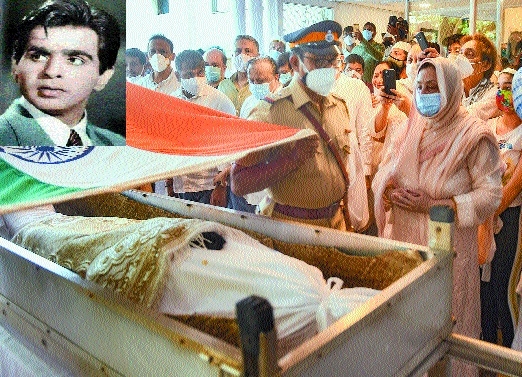
HE WAS more than a star, more than just an actor even. Dilip Kumar, or Yousuf Khan as he was born, was the legend who epitomised the composite culture of India, both in his films that explored stories of rebellion, hope and love and in his seven decades in public life. Kumar, who died on Wednesday morning at the age of 98, was the thinking, impassioned hero framed in black and white who moved on to a spectrum of roles in technicolour, his life and career a testimony to India as it grew and evolved over the decades. One of the handful of greats etched in the annals of Indian cinema, tragedy came to be affixed to his name with his turn as the brooding lover in classics such as “Devdas”, “Andaz” and the epic romance “Mughal-e-Azam”. But the ‘Tragedy King’, who did his first film “‘Jwar Bhata” in 1944, three years before Independence, and his last “Lal Quila” in 1998, was more than that. Reflecting the times his films were made in, he was the Nehruvian hero grappling with problems plaguing a young India in the cinema of the late 40s and 50s, most notably “Shaheed” and “Naya Daur”.
That idealism gave way to a certain disillusionment in the 60s with films such as “Ganga Jamuna”, an angst that found pronounced resonance with the emergence of the angry young man persona of the 70s Bachchan by when Kumar had moved on to character roles. Kumar, part of Hindi cinema’s famed triumvirate along with Raj Kapoor and Dev Anand, set hearts aflutter, spawned many wannabes and was the inspiration for generations of actors with his own brand of method acting – intensity at the core of every role that he did. Unlike Raj Kapoor and Dev Anand, he never ventured into filmmaking, preferring to stick to acting, his abiding passion. But he was never just an actor and a marquee name admired by generations of filmgoers. Kumar was also a polyglot.
The erudite Pathan from Peshawar, who started as a fruit trader, was fluent in Urdu, Hindi, Punjabi, Awadhi, Bhojpuri, Marathi, Bengali and English. His wife, actor Saira Banu, noted that he was just as well-versed with the Quran as he was with the Bhagvat Gita and could recite verses from his memory. “His secular beliefs spring straight from his heart and from his respect for all religions, castes, communities and creeds,” she wrote in the foreword of the actor’s autobiography “The Substance and the Shadow”. In the troubled early 1990s, when Mumbai was riven by communal tension, Kumar emerged as a figure of peace. During the 1993 riots in the city, stories abound of how he opened his home and made it a command centre for relief work. He was a much awarded artist, honoured with the Padma Bhushan in 1991 and the Padma Vibhushan in 2015 as well as the Dadasaheb Phalke in 1994. He was also a nominated member of the Rajya Sabha for one term and served as the sheriff of Bombay in 1980. In 1998, somewhat controversially, he was awarded the Nishan-e-Imtiaz, the Pakistan Government’s highest civilian award. As the years passed and age caught up with him, Kumar withdrew from the public eye but like most stars never faded away.