Solar power EV charging stations needed to reduce carbon footprint: Green experts
02 Aug 2021 09:01:19
By Kaushik Bhattacharya :
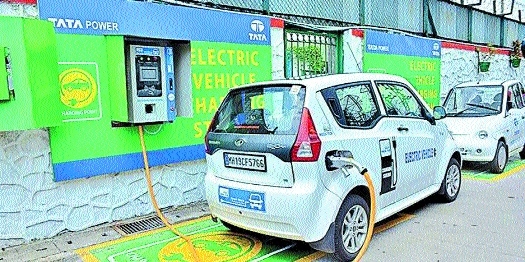
Though the decision to encourage Electric Vehicles (EV) in Maharashtra is a revolutionary move, the State Government will face challenges of new technology to reduce the carbon emission, feel green experts. The Government has planned an outlay of Rs 9,453 crore for setting up mega electric vehicle charging centres on key expressways connecting the State capital Mumbai. For charging electric vehicles, these charging stations will require electricity and it will be acquired through thermal energy. To encourage electric transportation in the State, the Government had recently green signalled Electric Vehicles Policy 2021. But if thermal power is used to generate electricity for charging stations then the carbon emission will increase further, add green experts. The environment experts are emphasising on renewal of energy instead of thermal power for such charging stations and solar energy is the best option. “Decision of implementing EV Policy is a historic one and it is in line with commitment made by India in Paris Agreement. At least 40% of power to come from non-fossil fuel source by 2030. The best part is, Government has not only framed stage wise introduction of electric vehicles but also have announced various incentives for promotion,” said Kaustav Chatterjee, Founder, Green Vigil Foundation.
He said, “Implementation need to overcome some basic challenges like need of widespread charging infrastructure as well as servicing stations, competitive price as compared to petrol, diesel and CNG-operated cars, battery life, driving range, charging time, change in consumer perception, availability of raw materials for EV’s batteries like lithium, nickel, phosphate and manganese, graphite, and cobalt, which are rare earth material.” “Most importantly, the EVs will be effective in reducing pollution, only if, the charging is done by solar energy or any other renewable source of energy, otherwise, we will be shifting the tailpipe pollution to thermal power plants, wherein we need to generate more power to cater EVs plus transmission loss,” Chatterjee added. Government is going to take many bold initiatives under EV Policy-21 like 25% electric buses in city bus service, 15% electric buses in MSRTC, 150 electric vehicle charging stations in cities like Mumbai, Pune, Nagpur, Amravati, Aurangabad and Nashik till 2025, and public EV charging stations at every 25 kilometres on both sides of Balasaheb Thackeray Samruddhi Expressway that will connect Nagpur with Mumbai. Dr J S Pandey, former Chief Scientist of CSIR-NEERI said, “Solar energy is one of the best options to reduce carbon footprint through EV charging station. However, before adopting and implementing any technology, we must do its thorough ‘life cycle assessment’ so as to optimally utilize its benefits at all the stages of its ‘life cycle’ and to minimize its likely adverse effects (if any).
This can be done through quantification of ‘Ecological and Carbon Footprints’ at various appropriate stages of the life-cycle.” Dr Pandey who has served CSIR-NEERI for many years as Head of Centre for Climate Sustainability and Skill Development said that the process of technology adoption and implementation shoud be done very carefully and in a gradual and cautious manner so that any likely adverse impact could immediately be tackled by an effective and appropriate "Region-specific and Process-specific Environmental Management Plans. This can be done by creating suitable District-wise Environment Health Cards (DEHC) based on the Ecosystem-Resilience, Elasticity and Carrying Capacity of the region. While preserving the environment and minimising the pollution, it will also help in the proper regulation of the Micro-Climate of the region, because of the interdependencies of various inter-linked BIO-GEO-CHEMICAL Processes, Dr Pandey added.