Saraswati Sanman is honour of Marathi literature: Dr Limbale
| Date :20-Aug-2021 |
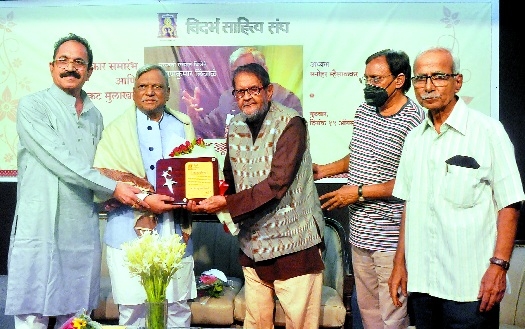
Dr Sharankumar Limbale being felicitated at the hands of Mahohar Mhaisalkar at Vidarbha Sahitya Sangh on Thursday. (Pic by Anil Futane)
Staff Reporter :
Dr Sharankumar Limbale is the third Marathi litterateur to receive this prestigious award for his contribution to Marathi literature
“Dalit Literature should cross the boundaries of class, caste, social status and language. The literature should be translated in different languages at national-level and the writers should not be recognised as Dalit writers or Ambedkarite writers or Buddhist writers,” said noted novelist, Dr Sharankumar Limbale. “Saraswati Sanman is not the honour for any Dalit writer for his Dalit literature, but the honour for entire Marathi speaking community and Marathi literature,” he said during an open interview after his felicitation by Vidarbha Sahitya Sangh (VSS) here on Thursday. Marathi novelist, poet, critic and short story writer Dr Sharankumar Limbale was selected for the 2020 Saraswati Samman, a prestigious literary recognition conferred annually by the KK Birla Foundation.
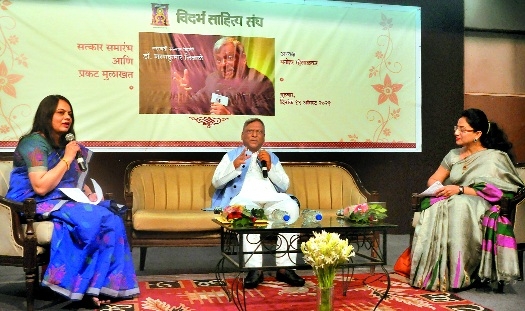
Vrushali Deshpande and Adv Snehal Shinde conducting an open interview of Dr Limbale. (Pic by Anil Futane)
The 30th edition of the prize, the highest recognition in the field of Indian literature in the country, was given to Limbale for his 2018 Marathi novel, ‘Sanatan’. Vidarbha Sahitya Sangh (VSS), to recognise his selection for this prestigious award, organised a public felicitation of Dr Limbale at the premises of VSS on Thursday. VSS President, Manohar Mhaisalkar felicitated Dr Limbale with shawl, sreefal and a memento. After his felicitation, Vrushali Deshpande and Adv Snehal Shinde conducted an open interview of Dr Limbale. Replying to a question about the same, Dr Limbale said, “People should not categorise literature as Dalit literature and term writer as Dalit writer. To get Saraswati Sanman Award is a honour of Marathi literature. This award is the highest recognition for any writer and instead of feeling pride for any Marathi author getting this award, people started criticising the same.”
Accepting the fact that because of progressive writers in Maharashtra Dalit literature has been enriched, flourished and progressed in Maharashtra, Dr Limbale, expressed his concern over Dalit literary circles in Maharashtra for not showing much enthusiasm in acknowledging that he is the first Dalit writer to get the Saraswati Samman. Fault lines have resurfaced in these circles, albeit in an oblique manner. But Limbale courageously went ahead and disregarded the objections of a sizeable section of Dalit writers to his acceptance of the award simply because it is named after goddess Saraswati, a symbol, according to them, of ‘oppressive Hindu traditions’. “I think Dalit writers should go beyond writing their own biographies, their stories of injustice, sufferings and gaining sympathies for recognising them as writers to get awards and other facilities,” he added.
Talking about Sanatan, he said, “Sanatan is an important social and historical document of the Dalit struggle. This novel is based on many imaginative characters and space brilliantly weaved the story of novel with history. Dr Limbale then unveiled his life’s journey right from his association with the Dalit literary movement of the 1970s, which later spread to other parts of the country, including, notably, Karnataka in the south and parts of northern India. Limbale started his literary journey with his autobiography Akkarmashi, published in 1984, which earned critical acclaim. Limbale was in his mid-twenties at that time. His gripping writing style, coupled with the use of his mother-dialect, and his honest, transparent narrative made his autobiography a milestone in Marathi Dalit literature.