How Ambazari Lake quenched city’s thirst in Bhonsla period
23 Sep 2021 08:53:50
By Shirish Borkar :
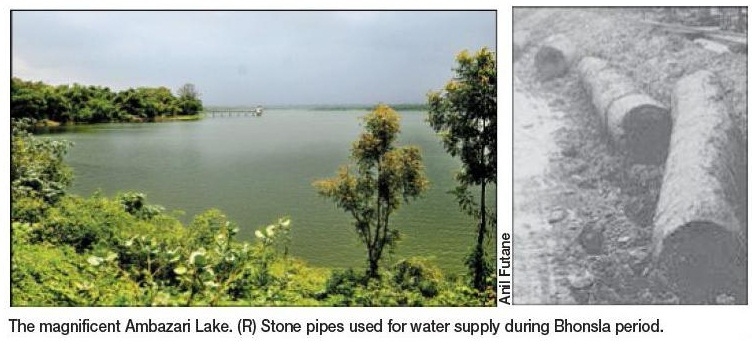
AROUND a decade ago, some workers engaged by contractors for digging to lay the foundation of three buildings, including a hotel and a mall, in and around Munje Chowk, had unknowingly broken a few stone and terra-cotta pipes. Suddenly, water started gushing from those broken pipes with great force. The civic body officials and engineers somehow managed to stop the flow but the discovery of the pipes intrigued prominent archaeologist Dr Chandrashekhar Gupta. He visited the site and stumbled upon a major evidence of ancient urban water-supply system in Nagpur.
It proved to be a great link for historians and researchers to the water distribution system prevailing in ancient times in Nagpur. Dr Gupta, then Professor and Head of the Department of Ancient Indian History, Culture and Archaeology, RTM Nagpur University, was surprised to see terra-cotta pipes with coupling and stone pipes. Along with a few colleagues and other archaeologists he tried to collect some more evidences and came to a conclusion that it was a pipeline laid more than 259 years ago and connected with Ambazari Lake by the Bhonsla Kings to distribute water to the city. These findings prompted Dr Sujata Gaurkhede, Assistant Professor and ex-Principal of Umme Salma Girls College, Nagpur, to take up research on ‘Water Resources and Water Distribution System in Nagpur during Bhonsla period (1730-1853).’ Dr Gaurkhede conducted in-depth studies from the days of Raghuji Bhonsle-I, the founder of the Bhonsle dynasty, and found that Nagpur was spread westwards till Jumma Talab or Shukrawari Lake. Nag Nadi was the southern boundary of Nagpur. Nawabpura and Juni Mangalwari were on the east. Hansapuri and Lendi Talab on the north side.
The city was spread up to Naik Talab. She attributed the construction of Ambazari Lake to Bimbaji Bhonsle. Speaking to ‘The Hitavada,’ Dr Gaurkhede said that water from Ambazari Lake was supplied to entire Nagpur. “The Telangkhedi garden was built by Vankoji Bhosale. He was also called Manya Bapu. Raghuji Bhonsle-II was the architect of modern Nagpur. During his regime, his team of experts dug Futala pond. He ensured that Telangkhedi garden was fortified from all sides. He created beautiful gardens including Telenkhedi, Sonegaon, Sakkardara, Tulsibagh, Indulibagh, Nazarbagh, and Bezonbagh. He constructed artificial lakes and deepened the natural ponds for irrigating the gardens.” “In Bhonsla period,” Dr Gaurkhede said, “Ambazari Lake was named after Bimbaji Bhosale, son of Raghuji-I, as he was instrumental in deepening the pond about 259 years ago.” Ambazari was about eight kilometer from the old city of Nagpur and was one of the sources of Nag Nadi. Dr Gaurkhede said, there were hundreds of Mango trees in its vicinity and hence, it was called Ambazari. “The old Ambazari pond was constructed diagonally by building a dam in the catchment area of Nag Nadi. It is estimated that at that time, the height of the dam was about 12 feet to 20 feet while its width was 40 to 60 feet,” she added. Dr Gaurkhede said, “The main part of this dam on the water side was secured by constructing a platform with rubble and stones The back surface of the pond was raised one foot high and foot wide.
A semi-circular octagonal shaped turret was built next to the pond. When it was completely filled with rain water, the surface area of the water was about 236 acres and the water storage was about 80, 00,000 cubic feet. At the time, water was distributed to the people from the water gate made of stone. Due to accumulation of excess rain water, it was pumped out from two dams of 128 feet length.” A stone pipeline (darpav) was laid and stone tanks were constructed in some places for storage and distribution of water to the city. Water flow was being controlled with wooden lids and pegs, Dr Gaurkhede said, adding that water was extracted from the highest outer hole by closing aqueduct near the Ambazari pond and lifting wooden lid from highest outer hole. Water used to be accumulated in a well and it was taken care that its depth was slightly less the depth of the pond. On the southern side of the tank there was a supply line connected to waterfall at the bottom of the pond.
In the dry season the stored water flowed into the tank. “A stone pipeline was laid four miles from this tank and stone pipes were 2.5 ft to 3.5 ft and 2 to 2.5 ft wide and inner holes were nine inches in diameter. One pipe was connected to another pipe with lime or mortar,” she added. Dr Gaurkhede said that tanks were prepared at various places in the city and ceramic pipes were laid under these tanks.
Water supply was turned on and off with wooden poles as required. The studies prove that Ambazari pond was used to supply drinking water to Nagpur city during Bhonsla period. Using the technology, water was also provided to Futala Pond and Sitabuldi Market, Maharajbagh, and Residency. In the second half of the 18th century Nagpur city began to develop in a modern way. The Bhonslas built ponds for irrigation and boating. By planting orange trees in and around the city, Nagpur became famous for oranges all over the world. Dr Gaurkhede said that a total of 22 gardens constructed by the Bhonsle dynasty are mentioned in records. “With untiring efforts of Raghuji –II,” she said, “Nagpur was known as the city of ponds and gardens in 18th century.”