It is the gaze that makes or breaks a film: Namrata Joshi
| Date :26-Sep-2021 |
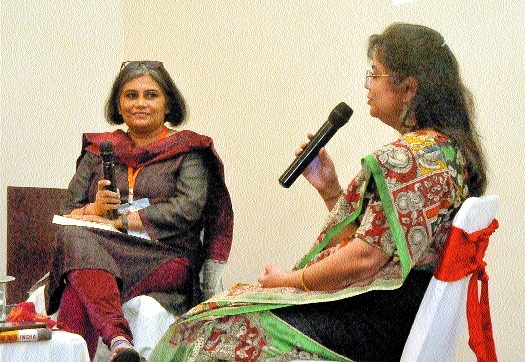
Namrata Joshi (left) responding to a query by Ruta Dharmadhikari, during the first event ahead of Vidarbha Literary Fest.
By Farina Salim Quraishi :
Well begun is half done. The first run-up event to the Second edition of Vidarbha Literary Fest (VLF) got off to a rollicking start with Namrata Joshi, film critic-turned-author and her scintillating conversation and observation in a session held at Chitnavis Centre, on Saturday. After spending over two decades writing about films in depth, the former film journalist previously associated with ‘The Outook’ and ‘The Hindu’ had the desire to conquer another writing form. It drove Namrata Joshi, one of the most prolific crítics of cinemas, to switch tracks and come out with exquisitely detailed and vividly engaging book ‘Reel India: The Cinema off the Beaten Track’. After a resoundingly successful first edition of VLF in 2019, the insightful session on the best-selling book with widely travelled Namrata Joshi proved to be first of the many events building up to VLF 2.0, scheduled to be held in February 2022. Living up to the theme of VLF 2.0 -- ‘Non-Fiction In Action’ -- Namrata spoke extensively about the book that chronicles little-known accounts about India’s infamous and incessant fascination with films, straight from interiors of the country. Everyone has a story to tell and anyone can make a film. But, if one’s story has heart, a cast of colourful and interesting characters, and a narrative arc that resonates with anyone even with a passing interest in film, only then will one have a winner at hand, said Namrata Joshi. In her book, she has crafted an empathetic narrative around India’s collective obsession -- Movies.
The characters in the book are built upon Joshi’s writings and experiences as a film journalist on assignments to little known places including Gorakhpur, Saharanpur, Malegaon, and even Barkakana; places that don’t usually emerge in film geographics. The biggest strength of the book is the plethora of stories revolving around ordinary people and their extraordinary passion for films in small towns of India. Letting in on the secret of being a good critic, Namrata said, to be really good at the job one needs to be a film appreciator first and then go about understanding films in their entirety. “Much like film-makers, there are innumerable film critics, film bloggers and writers out there. We all go to watch a movie with our own set of notions. But it is important to keep those aside and develop an appreciation for films in the first place. Any course in film-making helps widen one’s horizon, makes one see the finer nuances, and makes one a learner for life.
The more you learn, the less you know,” she observed. In the session wonderfully conducted by Dr Ruta Dharmadhikari, Head, Department of English, LAD and Smt R P College for Women, Namrata Joshi delved in detail about the book, which is nothing short of an encyclopedia on non-Bollywood film cultures reigning supreme in the hinterlands. Be it about Sindhi films made in Ulhas Nagar, spoof film industry of Salman Khan films in Malegaon, or Cinema of Resistance thriving in Gorakhpur, the book trains its focus on grassroot cinema movements gathering steam despite odds. It talks about people besotted with films and their accounts of admiration and aspiration, love and dejection, despair and failure all woven around with a loving gaze. Speaking about the gaze in films gets the guard up of the acclaimed critic. She elaborated, “It’s rather funny that while writing or speaking about a film, its gaze seldom gets a mention. A film’s story, actors, directors always get talked about but never the gaze. It is the gaze that makes or breaks a film.
Our gaze is based on our experiences. So when, Hussain Haidry tells me ‘Mulk’ was patronizing, I believe him as he is in a position to know better. It’s a constant battle. You cannot become snooty or too sure of your world views. It will be the end of learning. Every film and every session is an opportunity to learn.” Effusive in her praise about cinema moment in Kerala, Namrata said that the Malayalam film industry was at the top of its game in the pandemic world and everyone could take a leaf out of it. On the pandemic, its effect on films, OTT platforms and the future, Namrata was enthused by the new wave of content on digital platforms. The member of FIPRESCI aka International Federation of Film Critics, Munich, did not mince any words while asking Bollywood film-makers to wake up and smell the coffee. “To say the dynamics of the film industry have changed will be understating it. Mainstream cinema can no longer peddle the same old formulas.
OTT platforms have shown that while it is OK to watch a below-average offering from the comfort of one’s house, everyone would balk at spending Rs 1,000/- for a movie in the theaters for a poor film. New forces in the entertainment industry are at play and it is time to step up or vanish for mainstream ideas,” Namrata said on a concluding note. During the programme, in the ‘Pitch to Publish’ section, Dr Ghanshyam Assudani -- the visually impaired Head of the Department of English -- presented his unpublished work ‘Andhero Ka Aadar’, and moved many hearts. Arushi Nayak hosted the session, while Sachin Jahagirdar, Founder Secretary of VLF, proposed a vote of thanks. Hemant Lodha, Chairperson of VLF, presented the concluding note.