Smart City dreams of city going down the ‘drain’
03 Sep 2021 10:20:57
By Kaushik Bhattacharya :
Another rainy spell, and Nagpur is inundated once again. One wonders how water-logging became the unfortunate reality of the second capital of Maharashtra every year during Monsoon. For over hundreds of years now, Nagpur has been receiving heavy rains. The amount of rain that the city receives has remained almost the same. So, what has changed? Why does it now leads to flooding of the city after every spell? The so-called rapid urbanisation, which turned Nagpur into a concrete jungle, is one of the biggest reasons behind water-logging every year. The city planners are busy in making Nagpur a ‘Smart City’ but ignoring the fact of ‘ease of mobility and liveability’, which is the core of ‘Smart City Mission’.
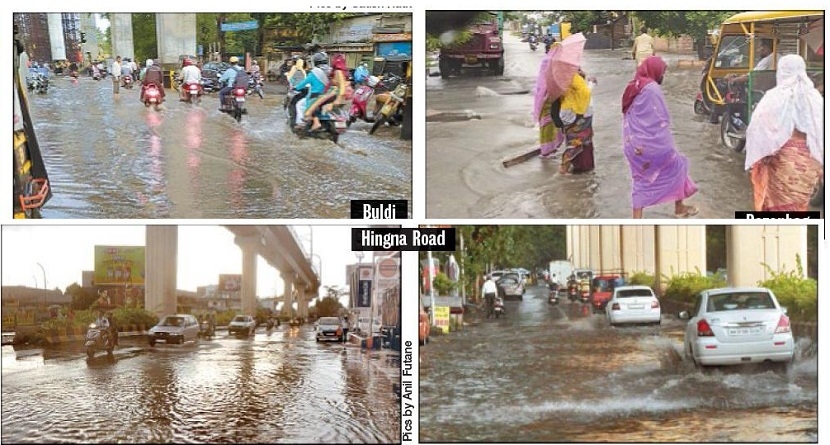
The objective of ‘Smart City Mission’ is to promote sustainable and inclusive cities that provide core infrastructure and give a decent quality of life to its citizens, a clean and sustainable environment and application of ‘Smart’ solutions. The construction of cement roads and Nagpur Metro project are signs of tremendous pace of city’s development, but the civic body ignored the maintenance of storm water drains and proper slope and alignment of roads with drainage system near their projects. As a result, Shankar Nagar Square, Ambazari T-Point, Bajaj Nagar Square, Automotive Square, Padole Square, Radisson Blu Square, Manewada Square, Hingna T-Point, Kasturchand Park Square, etc. are the major water-logging areas in the city, which are the perfect examples of miss-managed town planning by the city fathers. On Thursday, the Collector Office Observatory recorded 33.7 mm rainfall in the city whereas the Sonegaon Observatory recorded only 0.5 mm rainfall. Due to patchy rainfall in the city, the observatories recorded different data. As predicted by the Indian Meteorological Department (IMD), the rainfall activity continuing for the last 3-4 days in the city will remain the same next week too.
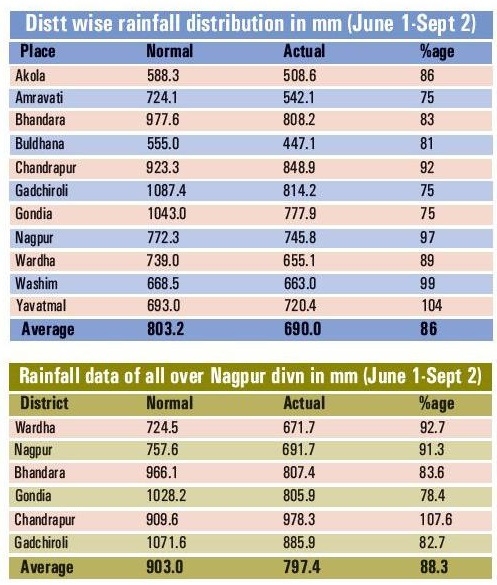
Though Nagpur district is experiencing moderate rains for the last 3-4 days, the data by IMD states that, the rainfall deficit is still there by 3 per cent in the district. According to State Irrigation Department, the rainfall deficit of Nagpur district is about 8.7% till Thursday. In Vidarbha, only Yavatmal received good monsoon so far with 104% above normal rains. However, huge deficit in rainfall was recorded in Amravati, Gadchiroli and Gondia districts. Similarly, the overall rainfall deficit in Nagpur division is 11.7%. Chandrapur is the only district in the division, which received above normal rainfall in this monsoon.