MoEF&CC effects upward revision in NPV, with certain exemptions
| Date :21-Jan-2022 |
Staff Reporter
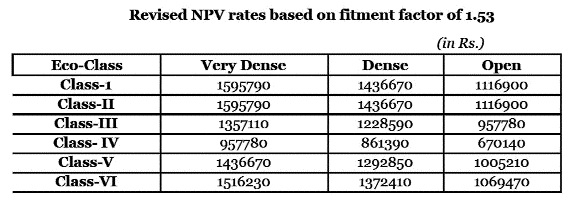
IN COMPLIANCE of the Supreme Court order, the Union Ministry of Environment and Forest and Climate Change (MoEF&CC) has effected ‘upward’ revision in the rates of Net Present Value (NPV). While effecting the hike of almost 1.5 times compared to the previous NPV rates, the Ministry has allowed certain exceptions.
NPV is the approximate value in monetary terms, of loss/diversion of forest land for non-forest use. It is calculated on the basis of services and ecological value of forest land concerned. Barring a few exemptions, those using the forest land for non-forestry purpose have to pay NPV. Sandeep Sharma, Assistant Inspector General of Forests, Forest Conservation Division, MoEF&CC, recently issued a circular regarding revision in NPV rates. The circular was addressed to Additional Chief Secretary (Forest) or Principal Secretary (Forest) of all State Governments and Union Territories in the
country.
The NPV rates have been revised upward based on fitment factor of 1.53, which means that the hike in rates is almost 1.5 times compared to the previous rates of NPV. While doing so, six eco-classes have been identified and each class has been further divided into three categories -- very dense, dense, and open forest. As per the revised rates, NPV for very dense Class-I forest is Rs 15,95,790/- per hectare. The Eco-Class-I includes tropical wet evergreen forests, tropical semi-evergreen forests, and tropical moist deciduous forests. Whereas, the lowest NPV rate -- Rs 6,70,140/- per hectare will be for Class-IV open forest. Class-IV includes tropical torn forests and tropical dry evergreen forests.
More importantly, NPV shall be 10 times of the normal NPV payable in case of National Parks and five times in the case of sanctuaries. “The use of non-forest land falling within the National Parks and wildlife sanctuaries may be permitted on payment of an amount equal to the NPV payable for the adjoining forest area. In respect of non-forest land falling within marine National Parks/wildlife sanctuaries, the amount shall be five times the NPV payable for the adjoining forest area,” states the circular.
The latest circular offers certain exemptions too. For instance, in case of schools, hospitals, children’s playground of non-commercial nature, community centres in rural areas, overhead tanks, village tanks, laying of underground drinking water, irrigation and PNG pipeline up to 4 inch diameter, electricity distribution line up to 22 KV in rural areas, ‘full exemption’ upto 1 hectare of forest land is granted from payment of NPV. However, there are certain conditions -- no felling of trees should be involved, alternate forest land is not available, the project is of non-commercial nature and is part of Plan/Non-Plan Scheme of Government, and the area is outside National Park/
sanctuary.
Full exemption is granted in case of relocation of villages from National Park/sanctuary to alternate forest land. Conditional full exemption is granted in case of collection of boulders/silts from the river belts in forest area,
laying of underground optical fiber cable, and pre-1980 regularisation of encroachments and conversion of forest villages into revenue villages.
NPV payable shall be in the range of 10 per cent to 50 per cent for underground mining depending upon ‘surface strain’. Exemption of 50 per cent is offered in case of wind power projects and hydroelectric projects up to 25 MW capacity. NPV shall be charged at 20 per cent of normal rates in case of field firing range of Ministry of Defence not involving felling of trees and if there is no likelihood of destruction of forests. Fifty per cent of normal rate shall be applicable in case of the area of riverbed in a proposed water reservoir that is to be under permanent submergence throughout the year.
For long, payment of NPV has been a contentious issue especially in forest-rich Vidarbha region. On several occasions in the past, various departments had raised concern with the Government over projects becoming financially unviable due to addition of NPV to the project cost. These projects were mostly irrigation reservoirs, roads, transmission lines etc. On the other hand, environmentalists have been of the opinion that the NPV should be increased. Against this backdrop, the upward revision of NPV rates is likely to trigger discussion regarding project cost in various project implementing agencies.