ASI Nagpur Circle lands in fresh controversy over ‘Deepotsav’ event at Paoni Fort
| Date :30-Oct-2022 |
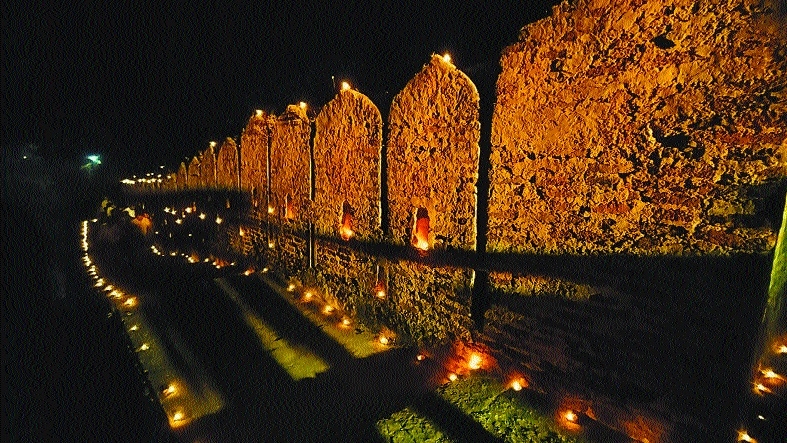
Earthen lamps lit at Paoni Fort, a Centrally-protected monument,
during ‘Deepotsav’, the other day.
By Shirish Borkar :
THE top brass of Archaeological Survey of India’s (ASI), Nagpur Circle, has once again landed in a controversy after its alleged failure to prevent local politicos and some prominent citizens in Bhandara district from organising ‘Deepotsav’ at Paoni Fort, a Centrally-protected monument, the other day. Though permission for the programme was denied, the event took place even after the multi-tasking staff had reported the matter to Vijaykumar Somshekharan Nair, Superintending Archaeologist (SA), ASI, Nagpur Circle, well in advance. As per the Ancient Monuments and Archaeological Sites and Remains (AMASR) Act, 1958 and Amendment & Validation) Act, 2010, the ASI does not allow any such events at Centrally-protected heritage monuments. However, hundreds of people visited the fort and lit 5,000 ‘Diyas’ (oil lamps) at the ancient circumambulation wall. Highly-placed sources in the ASI alleged that the SA, ASI Nagpur Circle, on October 20, 2022 had sent a copy of a letter to Conservation Assistant, Sub-Circle, Nagpur, to ensure that no ‘Deepotsav’ takes place at the protected monument.
The SA ‘instructed’ him to take necessary action against the organisers as per the provisions of the AMASR Act, if any such incident(s) occur and allegedly proceeded on leave, added the sources. Sources said, the SA has the sole responsibility to prohibit such types of incidents at these monuments to which permission is denied. If the SA is absent at the headquarters, the onus is on the next officer who is looking after the office in his/her absence, added the sources. The ASI had initiated the process of acquiring two ancient mounds of national importance at Paoni. The work for acquisition of ‘Hardulala-ki-Tekdi’ and the mound on which the modern temple of Jagannath stands was being executed as per the AMASR Act. These two mounds and remains of the circumambulation wall of the ancient Paoni Fort were already declared as national heritage monuments by the Government of India. Popularly known as ‘Kashi of Vidarbha’ due to its wide swath of temples and other monuments, Paoni was an ancient town engirdled by on three sides. In the northern side flows Vainganga river.
The rampart of Paoni Fort had undergone a number of renovations and was retained from time to time. Cutting across the southern rampart, ASI in 1993-94 revealed five constructional periods of the rampart from Pre-Mauryan, Sunga, Satvahana and Vakataka. A copper plate discovered within the rampart records the grant of Pravarsena II of Vakataka dynasty who ruled over this region. The medieval fortification is present on the west side and its south-west corner. Surmounted by five bastions, the wall was raised with small ‘Chhattris’ in pairs. Remains of a large arched gateway are still visible at the northern end. The upper part of the fort was built of bricks and lower with stones. The fort which was constructed in the early 18th century by Gond ruler Bakht Buland was taken over by Raghuji Bhosale-I around 1710 AD. The fort was attacked by the British in a campaign against Mudhoji (II) Bhonsle alias Appa Saheb in 1818. With this background, organising any such event of lighting ‘diyas’ or any other function by any individual or agency at the National heritage monument is prohibited as per the law. A senior official in the Ministry of Culture, Government of India, on the condition of anonymity informed that an inquiry would be initiated in the matter for such alleged nonchalant attitude of the In-charge of ASI Nagpur Circle. Earlier also, the senior official’s casual approach had resulted in the closure of almost all the 94 ancient centrally-protected monuments in Vidarbha for the past five days as there were no security personnel to safeguard them. with pic(s): 2) The carcass of the tigress was consigned to flames. file name: W/emails/29tigress1.jpg