Grotesque. Devoid of urban aesthetic. Disastrous.
| Date :13-Nov-2022 |
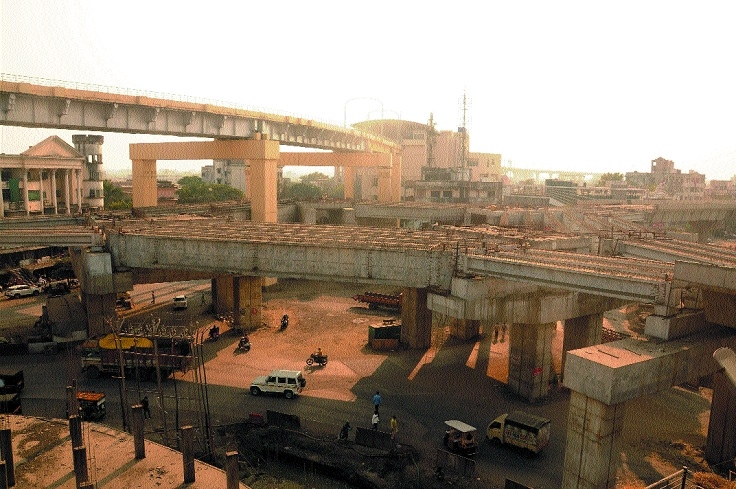
Disastrous ensemble of pillars: A section of the urban design disaster at Kalamna Market Square on Pardi Road. (Pic by Satish Raut)
By Vijay Phanshikar :
‘Grotesque’ is the word that fits best the messy urban design that has invaded the city of Nagpur in the past some years -- all in the name of development. The latest reference: The urban design disaster at Kalamna Market Square on Pardi Road in east Nagpur. Very sadly yet firmly, ‘The Hitavada’ chose to describe the messy place as a “Cemented graveyard of urban design”. From above, the Kalamna Market Square looks like a badly made snake-and-ladder board on which nothing seems to have a purposeful -- and beautiful -- placement. One cannot know when one is going to start climbing the ladder or when one is going to be sucked down through a snake’s gut. And, in the past few years, such design disasters have come up all over the city. Anywhere one goes, one gets into the messy places and intersections that have no sense of beautiful and purposeful design. What even a child of four understands of what should look good and what should look awful, appears to be beyond the grasp of the people who are in charge of deciding about what the city requires and how it should be implemented. Ask a child of four to choose her dress for the evening trip to the nearby garden and she will pick up a right combination of colour and design.
Ask an old man of 75 to get dressed for a religious function, he will choose a dress appropriate to the time and place and purpose. In other words, the basic urge everybody has is to look good in all conditions. Let us stretch this analogy to an extreme: People choose their dresses even when they are expected to attend a funeral. For that sad occasion, the dresses people choose are sober. In Nagpur, the planners and implementers of urban development schemes have not followed even that simple principle of design.
The result: The widespread mess of terrible urban design. A few years ago, ‘The Hitavada’ described the fly-over in front of the Ganesh Tekadi Temple and Nagpur Railway Station as a “design disaster”. Everybody agreed instantaneously, and even agreed to tear the monstrous structure down. That nothing has happened in that case, is an another story. But the point ‘The Hitavada’ wishes to make is about the terrible urban design -- the latest example of that being the Kalamna Market Square on Pardi Road in east Nagpur. Let us travel directly to the western perimeter of the city -- to the Futala Lake -- where the so-called planners have put into practice a terribly bad idea of constructing a viewers’ gallery from which to watch the very expensive fountain whose water springs several, several meters above the water surface. For a while, the viewers would love to watch the colourful fountain of water. In the long run, however, this is going to prove to be a bad idea from environmental point of view. At Futala Lake, another issue is the blocking of the beautiful view of the lake. Very thoughtlessly -- and shamelessly -- the planners and implementers have erected those badly-designed and terribly-executed structures. And then let us keep moving in circles in the city -- only to notice how the planners have messed up the design part of the MetroRail network and the Metro Stations. Who is doing all this? And why is he doing all this? -- is the question Nagpurians ask because it is their right to ask, because it is their city with which a messy game is being played.
When ‘The Hitavada’ questions the sanity of the so-called modern urban design, it asks a straight question: Should the design be so bad and grotesque and devoid of urban aesthetic and so much out of human scale? Let us consider how they build things in other places. Dubai -- or United Arab Emirates -- for example,. Countless lakhs of tourists from all over the world travel to UAE only to see the glory of modern urban design. The tourists generally travel to see ancient structures as mark of excellence of their forefathers’ culture and heritage. But in most such places, they also find how the planners there achieve a fine synchrony between the old design and the new urban creation. Let us travel to Washington DC or London or Geneva or Athens or Mexico City or Singapore or Tokyo or Shanghai ...! How do the planners achieve a fine balance between the old design and the new avtar? In Athens, for example (as told by famed Architect Paramjitsingh Ahuja), the planners and designers have created the New Acropolis Museum on the ruins -- complete with beauty and unity of design -- using glass as a separating element.
Let us also travel to Varanasi or Ayodhya or Ujjain to see how fine design principles have been used to create a synchronous flow of the old to the new. In Nagpur, however, there appears to be somebody who seems to claim that he -- or she -- knows everything and does not feel the need to follow basic norms of urban design. Who is that person or group of persons? Why is he -- or she -- (or the group) -- not listening to wise counsel? This question must be answered at some point. For, what we see in the city by way of new development is nothing but grotesqueness of design without any basic principles of urban aesthetics!