Aerosol pollution to deteriorate to red zone in State by 2023: Study
09 Nov 2022 08:28:24
Staff Reporter
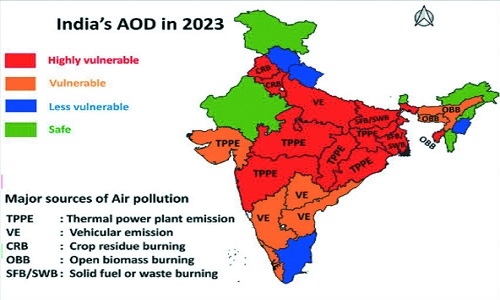
The aerosol pollution in Maharashtra is likely to deteriorate by 2023 from its current ‘orange zone’ (vulnerable) to the ‘red zone’ (highly vulnerable) and the State’s dependency on Thermal Power Plants (TPPs) is major reason behind it, revealed a study recently. The study named ‘A deep insight into State-level aerosol pollution in India’ was conducted by Dr Abhijit Chatterjee, Associate Professor and PhD scholar Monami Dutta of Bose Institute, Kolkata.
The high aerosol amounts include particulate matter (PM 2.5 and PM 10) consisting of sea salt, dust, sulphate, black and organic carbon. If inhaled, they can be harmful to people’s health. Aerosol Optical Depth (AOD) is the quantitative estimate of the aerosol present in the atmosphere and it can be used as a proxy measurement of PM 2.5.
The study provides a national scenario of aerosol pollution with the long-term (2005–2019) trend, source apportionment and future scenario (2023) for various Indian states. It was published in the peer-reviewed journal Elsevier recently.
“Air pollution in Maharashtra has mostly been influenced by coal-based TPPs in the past. Its capacity is increasing with the increase in demand for electricity. However, if the State continues to install the TPP capacity as observed in past, it would enter into the most vulnerable zone,” said Dr Chatterjee, Principal author of this study and Associate Professor of Environmental Sciences at Bose Institute.
Most of the TPPs in Maharashtra situated in Vidarbha and new TPP allotments also took place in this region only. Therefore, Vidarbha is going be a hot belt for increase in aerosol pollution, he added.
Entering the most vulnerable zone could result in an increase in morbidity rate, decrease in life expectancy along with other health issues for the people of Maharashtra and the State may witness an AOD rise of about 7% between 2019-2023, he added. Maharashtra currently falls under Orange category, which is a vulnerable zone with AOD between 0.4-0.5. However, rising aerosol pollution is expected to push the AOD higher than 0.5, resulting in entry into the most vulnerable red zone.
The values of AOD range from 0 and 1.0. While 0 indicates a crystal-clear sky with maximum visibility, a value of 1 indicates very hazy conditions. AOD values less than 0.3 fall under the green zone (safe), 0.3-0.4 is blue zone (less vulnerable), 0.4-0.5 is orange (vulnerable), while over 0.5 is the red zone (highly vulnerable).
The study identified the main sources of aerosol pollution in Maharashtra to be thermal power plants, solid fuel burning and vehicular emissions. The sources were assessed through three phases - Phase I being 2005 to 2009, Phase II (2010 to 2014) and Phase III (2015-2019).
The contribution of emissions from TPPs increased from 31% to 39% between Phase I and Phase III (2005 - 2019), mainly due to the increase in capacity and dependence on coal-based power generation, the study said.
Over the years, the contribution of solid fuel burning to aerosol pollution has been declining from 24% to 18%, while vehicular emissions have remained consistent throughout the three phases (14%-15%). Maharashtra needs to turn down its TPP capacity by 41% (10 GW) to move to the Blue Safe Zone, the study recommended.
“Maharashtra is highly influenced by coal-based TPP and the TPP contribution to air pollution is around 39%. In order to control such threats, the State Government should not only restrict further sanction of new TPPs, but also should focus on reducing the current TPP capacity by at least 10 GW,” said Monami Dutta, first-author of the study.
Explaining the science, Dutta said, “Aerosol Optical Thickness is the degree to which aerosols attenuate the solar radiation in the atmosphere. Small size particles (less than 10 micrometers) in the atmosphere alter how infrared and visible light is reflected, scattered and absorbed.”