Literature is a form of seeking values of life: Dr Bhyrappa
Date :25-Mar-2022
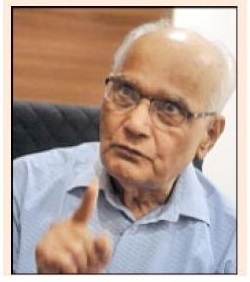
Highly acclaimed novelist Dr S L Bhyrappa makes a point during conversation.
■ By Kartik Lokhande :
JUST a few moments into conversation with the legendary Dr S L Bhyrappa, highly respected novelist, and one realises that philosophy is to him what a marble slab is to sculptor and word is to wordsmith. As one gets to know the story of his life, one feels that it is as exciting and thought-provoking as his novels are. One realises that his novels are creative expressions of impressions he collected through various experiences in the journey of life. When ‘The Hitavada’ caught up with Dr Bhyrappa during his stay in Nagpur on Thursday, he spoke about his life, romance with literature, and also political changes in the country.
Dr Bhyrappa had a childhood full of pain and suffering. Plague devastated his family. His elder sister married a month earlier, and brother died within one hour. “I, too, contracted Plague, but somehow I survived,” he recalled. However, a year later, his mother too died. He spent some years of his childhood at his maternal uncle’s home but faced cruelty there. Finally, one day he left that home. “I was out there in the vast world without any support, but I felt free. Till then, I was a dull student. However, when I was on my own, I started getting food through ‘Vaar’ (a social system under which students are offered meals on specific days of week. My performance also improved a lot and I was among the brightest students,” he added. Later on, he went to taluka place but as he did not find the high school there good enough, he went to Mysore. As he narrated the tale of his life, the expressions on his face, movement of eyeballs changed as if he was reliving those moments. At Mysore, he had time full of academic freedom and attended lectures of eminent personalities.
On a friend’s suggestion, he went to join the military. He wanted to join the Air Force but could not as he did not meet the criterion of matriculation. Again, the period of hardships started in his life. “I did not have food to eat. So, I went to a hotel and started working as supplier. However, I grew unhappy about exploitation of workers and I decided to start workers’ union. Obviously, the hotel owner was displeased. On his complaint, police picked me up on charge of stealing,” Dr Bhyrappa told ‘The Hitavada’. A lawyer who used to frequent the hotel noticed his absence. On coming to know of the development, the lawyer went to police station and rescued Bhyrappa. After working at the lawyer’s house as cook for some time, Bhyrappa then joined a drama company as a cook. One day, drama teacher noticed that Bhyrappa had potential for acting and offered a small role to him. As Bhyrappa started dreaming of making a career in theatre, another twist came in his life as the drama company closed down. Life took him to Mumbai on suggestion of a friend, who told him that people who went to Mumbai became crorepati. Life offered him very tough, yet enriching, experiences. He washed clothes of his room-mates in a room in Dadar, worked as a railway porter, and taught tuitions to his juniors in college to support himself in study years. In college, his life took turn for the better. All through, the question of death haunted him and he wanted to find out more. So, on advice of his teacher, he enrolled for BA Honours in Philosophy.
He graduated with top honours and won a gold medal in MA. And, as they say, the rest is history. Today, he is recognised as one of the most read novelists, a ‘Padma Shri’ awardee, ‘Saraswati Samman’ recipient, and Sahitya Akademi Fellowship awardee. Dr S L Bhyrappa is a fine blend of idealism and realism. In his initial works including ‘Vamshavruksha’, idealism is evident. In his later works including ‘Tantu’, realism hits the reader with full force. So, what appeals him the most -- virtue of idealism or strength of realism? He replied with a gentle smile, “I do not distinguish between both. For, I seek values of life. For me, literature is a form of seeking values of life.” Philosophy is very intricately woven in his works. Asked about this, he replied, “Tackling serious problems is philosophy.” But, his works are rich in aesthetics and structure too. “Yes, weaving philosophy with aesthetics -- Rasa, Dhwani, and Auchitya -- makes literary work interesting and helps in driving home the message,” he added. Nowadays, a lot of people are taking courses in creativity and creative writing. Asked about this, the highly respected litterateur said that unless one was imaginative no amount of courses could help in creativity. At the same time, he elaborated that if one was imaginative, course in creativity might help in structured learning of skills. The conversation, one wished, would go on. However, the clock was ticking and Dr Bhyrappa had to keep his commitment. So, after packing the journey of his life and romance with literature in those few minutes, the man rose from his chair -- to gain new experience. Obviously, when a towering intellectual like him is on eternal pursuit of adding more meaning to life, one should not come in between. So, one conversation ends. And, wait begins... for the next one!
‘India of today is strengthening its cultural roots’
BORN on August 20, 1931, Santeshivara Lingannaiah Bhyrappa has seen a vast canvas of India’s collective life in pre-Independence era and post-Independence period. He has been a keen observer, and participant, of the social, cultural, economic, political changes that the country has seen. So, when he says, “India of today is strengthening its cultural roots,” one believes. Asked about the changes he has noticed in India’s collective life since 2014 when Narendra Modi became Prime Minister, Dr S L Bhyrappa’s first reply was, “I have noticed a great positive difference.” According to Dr Bhyrappa, the level of corruption at higher level was brought in check.“Some ministers may be more efficient and some may be lesser, but there has been a qualitative improvement,” he said. However, he lamented, corruption at the lower levels was still far from removed. Counting the improvements in economy and Defence, Dr Bhyrappa also pointed out that there was big change regarding Kashmir issue since abrogation of Article 370.
Further, there was attitudinal change in society as reflected in construction of toilets in households in rural areas, distribution of LPG connections in villages, and also financial inclusion through opening of bank accounts. “An important development is transfer of subsidy directly to the bank accounts of beneficiaries of various schemes.This has eliminated the middlemen,” he observed. Still, some people were criticising the present regime for putting democracy in peril and complaining of ‘Emergencylike’ situation.
Asked about this, Dr Bhyrappa replied sharply, “They are liars and corrupt people. What were they doing in all these years when they were in power,” he wondered. He also highlighted another change in India’s collective consciousness -- strengthening of cultural roots.“The Prime Minister goes to temples, makes efforts for renovation of temples. This has started the process of going back to roots and strengthening those,” concluded Dr Bhyrappa.