Manish Nagar STP, a perfect example of faulty planning
| Date :11-Apr-2022 |
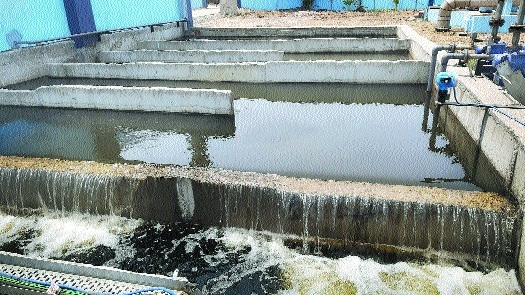
Sewage Treatment Plant in New Manish Nagar.
By Kaushik Bhattacharya :
The STP is posing health risk to residents due to sound and air pollution Without consulting the residents about the project, NIT constructed the plant in an existing garden
Clean air is a fundamental right of every individual. But, the residents of RTO Housing Society in New Manish Nagar are deprived of that right. Thanks to a Sewage Treatment Plant (STP) constructed by Nagpur Improvement Trust (NIT) to clean the water of a nullah in the residential area, which is causing health risk to residents of the locality. According to World Health Organisation (WHO), the STP, due to its working conditions, is considered as a major source of aerosols and may constitute an important health risk for plant workers as well as the surrounding inhabitants. As per various studies, bacteria contained in droplets of STPs are 10-1000 times more than that in a water source, depending on the droplet size. Nagpur Municipal Corporation (NMC), with the help of NIT, is constructing STPs over Nag river to clean the water of the river.
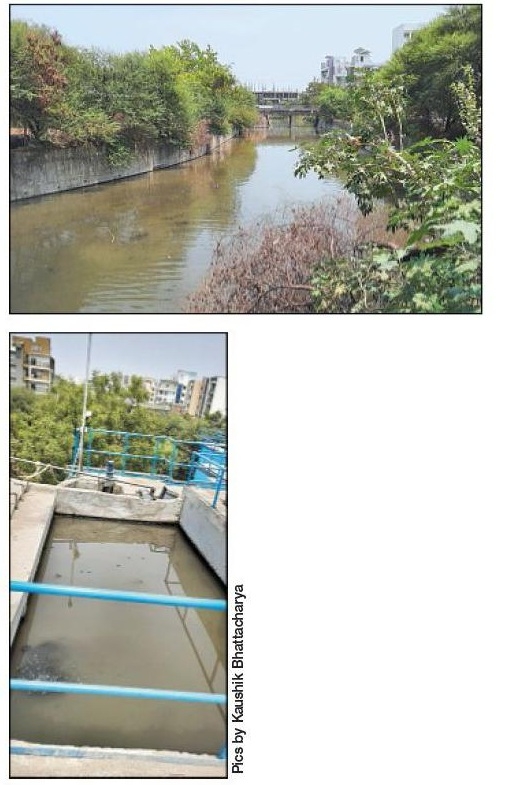
The civic body is constructing these STPs on the nullahs, which meet with Nag river at some point. Though the project is a good initiative to clean Nag river, the site selection to install STPs is a complete failure on the planning side. Without considering the public participation in the project, NMC and NIT are constructing these STPs in public utility places. In September, last year, ‘The Hitavada’, had highlighted the trouble of residents of Sonegaon area due to another STP, which was also constructed by NIT in a residential area on the back end of the lake. On Saturday, ‘The Hitavada’ scribe inspected the STP at New Manish Nagar and nearby areas and found that foul smell and loud sound from the STP were making the locality a hazardous place to live in.
“The civic body has never talked or informed us about the STP. The administration constructed this STP on a public utility land, which was earlier a park. Whenever we asked the contractors about the project, they always told us there is a water treatment plant coming up, but never told us about the STP,” Vishal Taksande, a resident of the colony, told ‘The Hitavada’. Dr Rashmi Batra, a retired professor of Institute of Science and a resident of the colony said, “The foul smell during night time is really unbearable for the residents. Sometimes, we also feel an atmospheric pressure due to the gases releasing from the huge tanks of the STP.” Dr Batra said, “The sound pollution of the STP crossed 80 dB during night time. After police complaint, the employees stopped working in night, but still, the sound pollution remains the same in day time.” According to a report, STP contains a number of atmospheric factors such as temperature, wind velocity, smog and specific humidity influence the aerosol spreads as well as the ability of micro-organisms to survive in the air. At a very low humidity and high temperature, microbes face dehydration, whereas high humidity may give cells protection against the solar radiation. “There was a small temple in the garden that compelled me to construct house here. But now, the STP is becoming a nightmare for us.
There were trees in the garden, that were chopped off for construction of the STP. Now there is no greenery in the area,” said a resident on a condition of anonymity. “We are working to reduce the sound of Sequential Batch Reactor (SBR) tank by insulating it. The tender has already been finalised and very soon, the work will also start. Whereas the foul smell in the locality is due to the nullah and not because of the STP,” an official of the STP told ‘The Hitavada’. “As requested by local residents, Green Vigil Foundation visited the STP. Air being pumped in SBR (aeration) tank by huge blowers makes a significant noise. However, the same can be controlled by minor modifications in blower and pipeline,” said Kaustav Chatterjee, Founder, Green Vigil Foundation. The smell problem will persist due to presence of a nullah flowing next to STP. The STP is operating on proven SBR technology, hence, treated water quality is expected to be good, but the positive impact on water quality can be seen only after installation of similar STPs throughout the stretch of the water body, said Chatterjee.