SC reserves order on writ petition challenging provisions of NGT
06 Apr 2022 07:43:11
Legal Correspondent
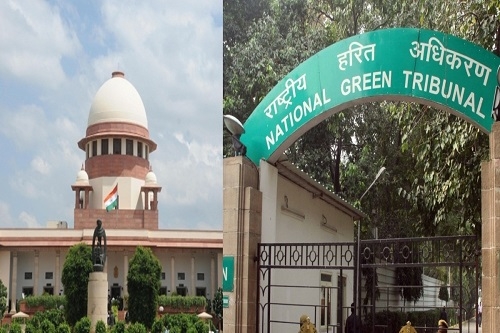
The Supreme Court, on Tuesday, reserved its final verdict on a writ petition challenging the vires on various provisions of the National Green Tribunal Act, 2010, filed by MP High Court Bar Association. The plea filed way back in the year 2011 had laid a challenge to Section 3, 10 and 22 of the NGT Act, in which a day-long hearing took place on Tuesday. Section 3 empowers the Central Government to notify the seat and benches of the tribunal at places found suitable in its opinion; and Section 22 provides for direct appeal to the SC against the orders of NGT, stated to be by-passing the remedy of writ petitions available before the High Courts under Article 226 and 227. The Petitioner Bar Association was represented by Advocate Siddharth R Gupta and Advocate Mrigank Prabhakar who led the arguments on the ground of challenge, whilst the UOI was represented through the Attorney General K K Venugopal and ASG Aishwarya Bhati.
The Parliament enacted the NGT Act 2010 bringing in place a specialised authority, viz. National Green Tribunal for adjudicating all the disputes pertaining to the environment and bio-diversities. Bench for the States of Rajasthan, Madhya Pradesh and Chhattisgarh was established at Bhopal in 2011 when the plea challenging the provisions was also filed simultaneously before the SC. The plea stated essentially that the Section 3 confers untrammelled, unguided powers on the Central Government to notify any and every district as the bench/seat of the tribunal, whereas the constitutional convention has been to consult the Chief Justice of the concerned State or for the President to have notified after due consultations with the Central Cabinet. Section 22 which provides for direct appeals to the Supreme Court against the orders of the NGT was assailed as bypassing the writ jurisdictions of the High Court stated to be the basic structure of the Constitution of India. This provision of direct appeal impliedly excludes the writ jurisdiction of the High Court and makes access to justice economically prohibitive, unaffordable, inconvenient and even impossible for litigants from larger parts of the country. The plea further stated that the NGT can by no stretch of imagination be treated as a tribunal ‘substituting the High Court’ but is at best supplemental or subservient to it. Supplemental role to the High Court and thus providing appeals from such a tribunal directly to Supreme Court must be discouraged.
Attorney General K K Venugopal to the contrary argued that the provision of direct appeal to the SC is a practice adopted for a number of tribunals, which deal with specialised disputes and there is nothing wrong in providing a provision for direct appeal. The remedy of writ before the High Court in appropriate circumstances is nowhere excluded by the enactment and thus Section 22 cannot be read to hold that it acts as a bar over the exercise of writ jurisdiction by the High Courts.
However the bench was disappointed by the fact that
provisions of direct appeal to the SC are defeating the very idea of creating the highest Constitutional Court of the country. The court is not able to devote time to essential constitutional disputes which must be the subject matter of its consideration, but to regular statutory appeals from such tribunals. In a way it has been reduced to a First Court of Appeals in the case of all these tribunals. The court went to the extent of calling the Central Government insensitive to its observations made in the previous judgements, wherein time and again enactment of such provisions has been discouraged and deprecated as adding to the backlog of the Supreme Court.