Geo-referencing platform to make land records accurate
| Date :01-May-2022 |
By Kartik Lokhande :
Deptt of Land Records, VNIT join hands to move ahead with land survey through drone, rover
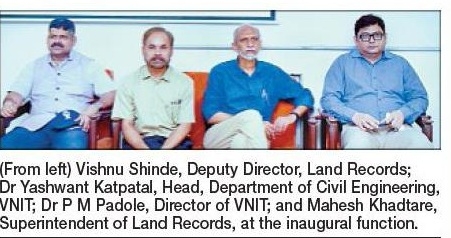
Technology can be helpful in improving accuracy and also making the processes more transparent, through a change in vision and culture. Department of Land Records, Maharashtra; and Visvesvaraya National Institute of Technology (VNIT), Nagpur, have joined hands to use cutting edge technology to move ahead with survey and measurement of land with the help of drone and rover. The survey of land is being conducted in 40,000 villages across Maharashtra, using drone and rover. Of these, 8,860 villages are in Nagpur Division. Of these villages, survey has been completed in 3,700. In fact, property cards of 800 persons are ready too. “We shall issue the property cards once the survey is over and some processes are completed,” said Vishnu Shinde, Deputy Director, Land Records, while speaking to ‘The Hitavada’. According to Shinde, using the technological advancements not only brings more transparency in land records but also saves time.
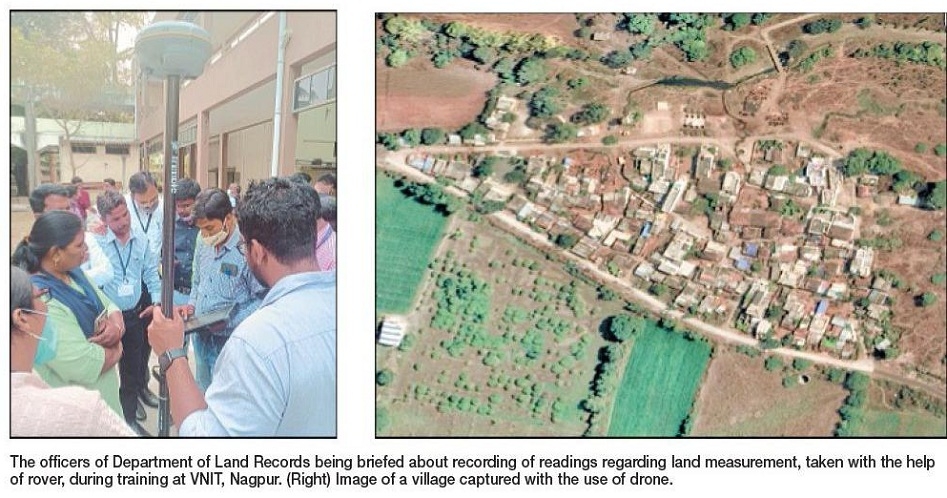
Previously, measurement of a piece of land used to take two to three days. Now, with this new technology, it can be done within one hour. Previously, for survey of land Great Trigonometrical Survey (GTS) markers dating back to British era used to come in handy as benchmarks. However, with time, many markers are lost. As a result, global positioning system (GPS) location fixed as per GTS markers, gets disturbed and inaccuracies creep in. Use of rover offers recording of co-ordinates (Latitude and Longitude) of specific spots in specified area, and hence the data so collected is more accurate and provides correct picture of land boundary. A rover is a device that has a disc atop a road and it is connected to nearest Continuously Operating Reference Station (CORS). It generates readings with co-ordinates that can be recorded on a connected tab. Earlier, the users had to set their own reference station each time they wished to undertake Global Navigation Satellite Systems (GNSS) measurement.
To offer some relief to users, Survey of India has established a network of CORS, which are capable of providing Real Time Positioning Service through Real-time Kinematic (RTK)/Network RTK with an accuracy of ±3cm, and also host an array of different positioning services targeted to cater requirements for different segments of Geospatial and scientific community. Apart from using rover, the department is using drone cameras to capture images of various areas and villages, and then geo-reference units therein. With geo-referencing, geographical information is added to the image taken with the help of drone camera so that GIS or mapping software can place the image in its real-world location. “As part of our entire exercise to make land records more accurate and make available records at click of a button, the next step will be to create a geo-referencing platform. Any individual can measure land using rover. Later on, once geo-referencing of maps is done, one can keep adding co-ordinates of various pieces of land to that platform. Once maps are geo-referenced, there will be more transparency and the chances of dispute over land boundary will be reduced to a great extent,” Shinde explained. Interestingly, for this entire exercise, Nagpur-based Visvesvaraya National Institute of Technology (VNIT) is a training partner.
The rover and drone survey, and geo-referencing training is being conducted at VNIT. Officers from four out of total six administrative divisions in Maharashtra are undergoing training. Dr Yashwant Katpatal, Head of the Department of Civil Engineering, VNIT, Nagpur, said, “Through the training in handling of rover and recording of data, using drone camera images, and then geo-referencing them, we are actually changing the vision and culture of the Department of Land Records by 180 degrees,” Dr Katpatal told ‘The Hitavada’. Explaining the concept, Dr Katpatal said that whenever rovers were used, they were connected to the nearest CORS. Survey of India has established CORS around 60-70 km distance apart from each other, across India. There are total 77 CORS in Maharashtra, including 12 in Nagpur Division. Beyond use of rovers, there is geo-referencing of images captured through drone cameras. In geo-referencing, training is given on how to fix position and angle from a point of reference. “We issue standard co-ordinate for each point of survey.
The location point becomes absolute reference in itself with unique Latitude-Longitude. As the system already has the distance between each Latitude/Longitude and gives absolute location (without need for reference of any other location), it saves time in measurement. With this exercise, co-ordinates of four corner points of a piece of land will be mentioned in Aakhiv Patrika (property card). This is bound to make land records accurate,” elaborated Dr Katpatal. The whole initiative is spearheaded by Niranjan Kumar Sudhanshu, Settlement Commissioner, Maharashtra. So far, four batches comprising 170-180 officers of Department of Land Records from different parts of the State have been trained at VNIT. The department wants six more batches to be trained. People from other parts of Maharashtra also coming for training. Department of Land Records is very happy with the training, and are seeking advanced training for their officials.