Time to move on from ad-hoc committees, create National Judicial Infra Authority: CJI
| Date :01-May-2022 |
NEW DELHI :
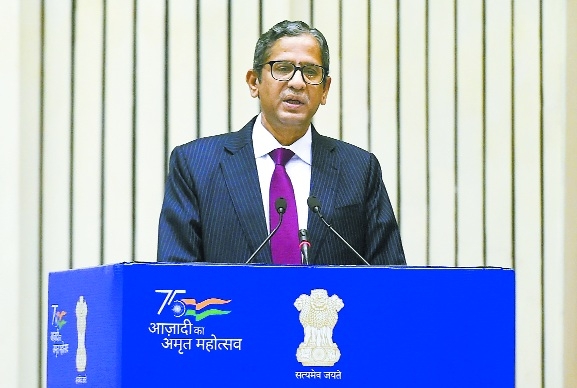
TIME has come to move from ad-hoc committees to a more streamlined, accountable and organised structure by creating a National Judicial Infrastructure Authority for the standardisation and improvement of judicial infrastructure which currently needs urgent attention, Chief Justice of India N V Ramana said on Saturday. Speaking at the Joint Conference of Chief Ministers and Chief Justices of High Courts, CJI Ramana dispelled the apprehensions that the proposed body aims at usurping the powers of any Government and shared that National Judicial Infrastructure Authority would have representation from all the stakeholders, including the representatives of the Central and State Governments. “It must however be acknowledged that it is the judiciary which best understands its own needs and requirements. Hence, the present proposal aims to bring infrastructure development under the supervision of special purpose vehicles to be headed by respective chief justices, and involve the representatives of the central and State Governments,” the CJI said.
He expressed his concern over the state of judicial infrastructure, saying that the environment of some district courts is such that even women advocates feel apprehensive about entering, and emphasised that the “courts, being temples of justice, should be welcoming and carry the requisite dignity and aura.” “I am of the firm belief that judicial infrastructure, both in terms of personnel and physical infrastructure, needs urgent attention.... There is a severe gap between the existing infrastructure and the projected justice needs of the people,” CJI remarked. Amid a debate over Hindi and the linguistic diversity in the country, Justice Ramana said that the time has come for the legal system to introduce local languages in courts. He highlighted the issue of judicial vacancies and urged the Chief Justices of High Courts to improve the judge-to-population ratio so that it is comparable to advanced democracies. As on today, out of 1,104 sanctioned posts of HC judges, there are 388 vacancies.
Justice Ramana said the practice of law before Constitutional courts should be based on one’s intelligence and understanding of law, and not mere proficiency in language. “The judiciary, as well as every other institution of our democracy, must mirror the social and geographical diversity of the country. I am receiving many representations for introducing local languages in proceedings before HCs,” he said. He termed Governments as the “biggest litigants”, accounting for nearly 50 per cent of pending cases, and said the “docket explosion” is due to non-performance of various wings of the executive and the legislature not realising its full potential. While dealing with the reasons for docket explosion, the CJI referred to growing number of contempt cases arising out of defiance of judicial orders by the executive and said that “deliberate inactions by Governments, despite judicial pronouncements, are not good for the health of democracy”.