Indigenous species in plantation? A long way to go…
| Date :12-May-2022 |
The Hitavada Team :
LOFTY ideals without supporting action achieve nothing. This holds true in case of plantation of indigenous or native species along the highways. There are guidelines, policy document, suggestion of species for various soil types... Alas! All are on paper, and precious little has been done on ground. Often, the authorities claim that the plantation guidelines will be followed once the ‘work is completed’. One wonders if the work has not been completed, how come the highways are in use already and how come announcements are made regarding ‘inauguration’ of the highways. In the meanwhile, the long serpent of cement-concrete already invades what was once the green landscape. Gradually, the word ‘sustainable’ gets dropped from that lofty ideal of ‘sustainable development’. For those who are not aware that there are specific guidelines regarding plantation, here is an official statement. At the beginning of the Green Highways (Plantation, Transplantation, Beautification & Maintenance) Policy-2015, there is a ‘Message’ by Vijay Chhibber, then Secretary, Ministry of Road Transport and Highways. It has one interesting paragraph, “There are specific guidelines in the policy regarding planting of species of trees and shrubs in their RoW (Right of Way) and in the median depending upon the climate, geography, location, soil conditions and local adaptations.”
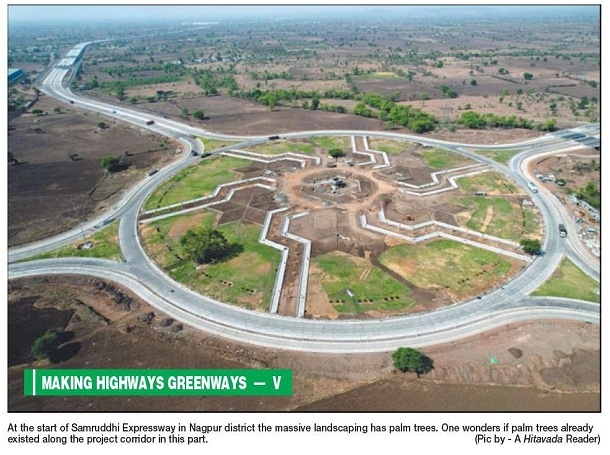
The policy document makes it clear that ‘the selection of species will be strictly done as per guidelines’ or as per the recommendation of adjoining Forest Department establishment with ‘site-specific native species’. Thus, it becomes clear that there has been focus, at least in the policy on paper, on native species as far as plantation is concerned. While selecting the species of trees for landscaping also, it has been stated that ‘a great care shall be taken’ to choose the species, ‘which already exists along the project corridor’. Now, this is interesting. Even though the policy is for national highways, the underlying principle should be applicable to State projects too. In case of Samruddhi Expressway, right at the start of the expressway in Nagpur district, there is a massive landscaping and palm trees have been planted there. One wonders if palm trees already existed along the project corridor in this part. Now, the selection of plant types and planting arrangement is based on various considerations.
These include shape and size of the canopy, texture and colour of foliage/flower/fruits in different seasons and stages of growth, adaptability and suitability to agro-climatic regions/zones, growth rate and average age of maturity and replacement cycle, after-care and maintenance required for sustenance and growth, economic and other social benefits. Obviously, all this is expected to be based on some kind of study. As per the policy document, “A study on the local flora and vegetative cover native to these sections shall be carried out as part of the field surveys to enable a choice of the suitable species for particular section.” Sadly, neither the State nor the National authorities engaged in highway construction/project execution have made it known to public or media about any such study conducted in different sections. Either they are shy of sharing (for reasons unexplained) or they have not at all ensured that such a study is conducted. There is much emphasis on native or indigenous species for economic reasons and survival rate. On paper, suggestion is to plant fruit-bearing trees like Mango, Neem, Jamun and Imli (Tamarind) near habitations across the country. Other locally useful fruit-bearing species suggested include Bel, Jackfruit, Mahua etc. These trees not only have ecological value but also cultural value.
For, one just have heard many people in the villages say that they never ‘bought’ Jamun, Imli, Guava, Bel, Jackfruit from markets as their need in this regard was sufficed by locally grown trees. The need for shade was mostly sufficed by Mango and Neem trees. Gradually, though there was a change, it offered a livelihood opportunity for villagers who plucked fruits from these trees and sold them to travellers. In some pockets of the country, Bel juice is very popular as a nutritious drink. However, lack of emphasis on plantation of these indigenous trees, has to some extent affected the nutritional value and livelihood potential for locals. As far as avenue plantation is concerned, the trees of Gulmohar, Amaltas, Kachnar, Cassia, Jacranda, and Peltophorum have been recommended for loamy soil; Arjun, Jamun, Lasoda for water-logged condition, Arjun, Kanji, and Kala Siris for alkaline soil.
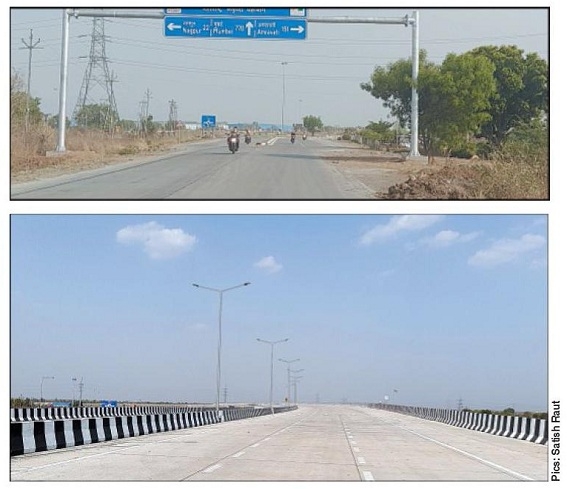
For second row of plantation, at national level, plantation of Bakain, Kanji, Silver Oak, Kala Siris, Shisham, and Arjun has been recommended for loamy soil. And, in the last (distant from highway) row, plantation of Peepal, Paker, Mahua, Mango, Neem, Imli, Jamun, Shisham have been recommended for loamy soil. Neem tree has been suggested for sandy soil; Kanji, Arjun, and Jamun for alkaline soil, and Arjun for water-logged soil. The stretches of national and State highway and Samruddhi Expressway surveyed between Nagpur and Chandrapur and Wardha, did not reveal that all these recommendations have been followed on ground except in very small portion. For instance, on Nagpur-Wardha highway, one came across a small row of Shisham trees planted by roadside. But, that was all. Along Nagpur-Chandrapur highway, one came across small rows of Neem trees, but their existence pre-dated the construction of new highway. Similarly, at some places, one came across Neem, Mango, and Arjun trees whose growth suggested that they were years old, and were not planted under new scheme of things. One can go on and on counting the benefits of plantation of indigenous/native species of trees. But, it is for the authorities to take some positive action in this regard considering potential. Also, it is for the people and environmentalists to mount pressure on the Government agencies to force them to act timely and wisely. (To be continued)