Samruddhi Expressway: Where is plantation?
| Date :09-May-2022 |
The Hitavada Team
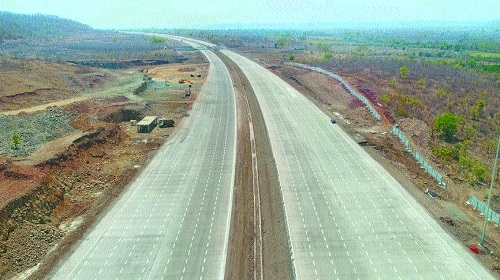
AMBITIOUS projects often become victims of delay and some objectives remain unmet. The latest case in point is Samruddhi Expressway, which has been renamed as Hinduhridaysamrat Balasaheb Thackeray Maharashtra Samruddhi Mahamarg. Much has been talked about the construction of underpasses and overpasses for wildlife. However, not much has been talked about the greening effort. The result? Samruddhi Mahamarg presents a sight in summer that could actually cause ‘dry eyes’.
Samruddhi Expressway, which starts from a location closer to Hingna in Nagpur district, is touted as one of the most ambitious physical infrastructure projects to connect Nagpur with Mumbai. It is supposed to reduce the travel time drastically, and vehicles are expected to zoom at high speed. Long, straight, and wide stretch of cement-concrete road, with elevation from ground, overwhelming (and disorienting) connecting network are said to be the defining features of Samruddhi Mahamarg. Besides, the policy planners had announced that more than 11 lakh trees would be planted on both sides of the expressway, converting it into a ‘green’ corridor.
Sadly, a long drive reveals that the defining features are actually not serving the ‘green cause’. Let us take one point at a time. The long, straight, and wide stretch of cement-concrete road offers a captivating sight initially. But, as one drives on, one gets the feeling of ‘road hypnosis’. The vehicle moves ahead at high speed, with eyes fixated on the long monotonous cement-concrete stretch. Often, experts describe this situation as ‘road hypnosis’, and caution that this could actually cause mishaps. Why does it happen? Simple. There is no soothing sight of green along the expressway. Here, ‘along’ does not mean a distance of several metres between the expressway and the tree location somewhere in a farm nearby but not on roadside. In fact, one experiences ‘dry eyes’ with eye-piercing monotony of cement-concrete with thermoplastic paint adding to the discomfort.
Though huge open spaces are left between the main expressway and connecting roads, those do not have any trees, at least in a large stretch in Nagpur district. What one sees (as visible in photographs), is open spaces without any
plantation or greening. As a result, the sight is overwhelming but not soothing.
Due to elevation, and distance, trees visible from the expressway actually offer no relief from jarring sight of cement-concrete road. Obviously, the shade of trees is not at all available anywhere.
At a later stage, even if saplings are planted on the slopes of elevated expressway, the vegetation growth is bound to offer shade downwards and not to users of main expressway. As far as median is concerned, at least in the long stretch up to toll-plaza in Nagpur district, the median is formed with neat arrangement of painted cement slabs, leaving no scope for any kind of plantation.
The authorities concerned may claim that the ‘work is still in progress’, leaving one wonder why did then the powers-that-be announced dates for opening Samruddhi Mahamarg for public on more than one occasions?
As the excavators and other machines and men are at work at various locations, one just wishes that the construction of the expressway does not prove to be a kind of a massive, expansive, and expensive tomb built over corpses of trees that existed previously on the roadside.