‘Two-way traffic can resolve Manish Nagar underpass issue’
| Date :26-Jul-2022 |
Staff Reporter
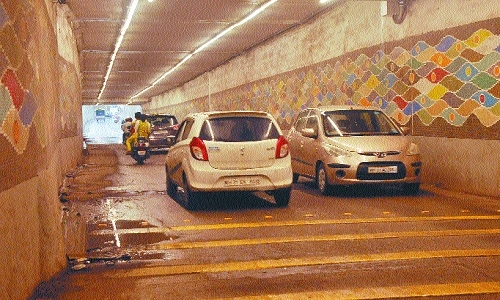
People using Manish Nagar underpass that, starts from the Ujwal Nagar Ground on Wardha Road, are facing problem of traffic chaos. The reason of traffic chaos is authorities have stopped two-way vehicular movement, which was there when the underpass was first opened, but people keep using it from both sides even today. Since it is not being done officially, a commuter going from Wardha Road is unaware of the vehicles coming from the opposite side and then, on many occasions, vehicles brush with each other. Since authorities have not found any solution, the people are suffering.
The commuters are allowed to use the underpass from Wardha Road side and those coming from opposite side are fined by the Traffic Police. If people coming from Manish Nagar want to take Wardha Road to go towards Chhatrapati Square, they do not have any other option than to use the underpass. Using double-decker bridge is a bit inconvenient, because they have to go towards airport, take a U-turn, and then, go towards Chhatrapati square or anywhere in that direction.
According to Janakrosh, the social organisation working in the field of traffic management, the two-way vehicular movement can be a solution to the issue. Senior members of Janakrosh, Prakash Khandekar and Ashok Karandikar, along with Secretary of the organisation Ravi Kaskhedikar, worked on the issue and came up with a solution. ‘The Hitavada’ Correspondent visited the underpass with Janakrosh team to know the issue and understand the solution chalked out by the organisation.
An underpass was constructed a couple of years back to resolve issue of congestion at Somalwada railway crossing issue. This underpass is about 7-metre wide, 500-metre long and at present, good for one-way, two-wheeler and small four-wheelers traffic moving from West to East connecting Wardha Road with Manish Nagar. This underpass is not a straight one, but has two sharp bends. The prescribed permissible speed is 20 kmph.
Many representations from residents and other users in this regard are understood to have been made to the Traffic Police. Use of the underpass for two-way traffic with constraints and restrictions has been considered as a solution during a joint inspection by Traffic Police and Janakrosh.
Khandekar explained the solution in detail. “The time taken to travel (including slowing down at curves) the underpass at 20 kmph is only about 1.5 to 2 minutes. The width of the underpass is narrow for two-way traffic. Some provisions should be made, restrictions should be brought and strict traffic discipline inside the underpass can prevent traffic mess. A full length divider having small width needs to be put in place to segregate traffic at the two bends. Reflectors are to be put on divider so that one should be able to see it. The traffic should move from both sides using one lane each. Speed breakers at both the ends will help control the speed of the vehicles. There are convex mirrors put at the turning in underpass, but they are needed to be put in a more effective manner. The authorities should not allow the overtaking as it would cause not only traffic mess, but also an accident.”
Khandekar particularly, pointed certain remedies. They include mandatory caution signs to be installed at each end of the underpass, namely (a) no cycles/non-motorised vehicles, (b) no parking and no stopping, (c) 20 kmph speed limit, (d) 3.25 M height limit, (e) no overtaking, (f) use of headlights while driving through the underpass, (g) no pedestrians and (h) no U-turn. Some of these signs should be selectively fixed inside the underpass, pointed out Khandekar Khandekar also suggested, then CC cameras should be installed inside the underpass for surveillance.
Blinker-based intersections should be created at Wardha Road end. Janakrosh has submitted the proposal to Municipal Commissioner Radhakrishnan B, Joint Commissioner of Police Aswathi Dorje and Deputy Commissioner of Police (Traffic) Sarang Awad.