‘Newspaper is the mind of the people’
| Date :29-Jan-2023 |
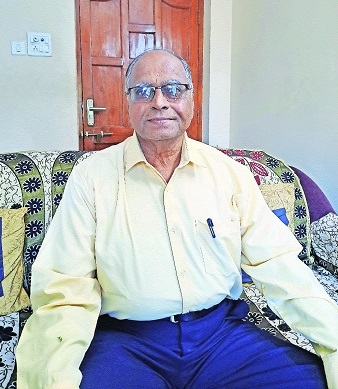
N R Pattarkine
By Kartik Lokhande :
OFTEN, many people express concern over people, especially the younger generation, not reading the newspapers in particular and print media in general. They end up wondering if newspapers will survive the onslaught of digital media. However, when one speaks to erudite scholar like N R Pattarkine, Member of the Faculty and Board of Studies for Journalism, Media and Communication, Kavikulguru Kalidas Sanskrit University, one realises that newspapers are here to stay. Observes Pattarkine, “We must look at the metaphor of a newspaper. In my opinion, newspaper is the mind of the people. It generates inquisitiveness in people. Whatever happens gets reflected in a newspaper, and what appears in newspaper evokes reaction from the society. So, newspaper is a medium of two-way conversation as well as continuous enrichment process.”
In conversation with ‘The Hitavada’ to mark the Indian Newspaper Day, Pattarkine felt that human tendency is to refer back or recapitulate with an urge to enrich own thought-process as well as to find a link between the past and the present so as to shape own imagination of future. Newspaper helps one in this regard. Comparing this significance of newspaper with television and other media, the former Executive Editor of ‘Sanskrit Bhavitavyam’ said that the images showed on television were short-lived but the word-impression one carries through a newspaper enriches thinking process for a long time. Pattarkine, who served Reserve Bank of India for 38 years and retired as an Assistant Manager, is a widely travelled scholar well versed in Sanskrit, English, Hindi, Marathi, German, French, and Telugu. Extremely well-read, he was among the Founder Members of All India Federation of Sanskrit Journalists formed in New Delhi in 1991. He is a man renowned for his knowledge of English Literature, Sanskrit, and Linguistics. A question about journalism with respect to newspapers and use of language, makes him contemplate for a few seconds and then reply, “In newspaper, you cannot be reckless about use of language. You have to own the responsibility for what you have written. Also, language has its own idiom and one has to abide by the code. At the same time, one must realise that quality writing adds to the prestige of the newspaper.”
Pattarkine has been a keen observer of changes in newspaper world. Hence, when he says that newspapers have evolved over the past three-four decades, one looks forward to him elaborating the point. According to him, three-four decades ago, the area of human experience was not so vast and so fast-paced. Then, newspapers were mostly ‘views-papers’. Now, they cater to different segments. So, there is something for everyone. Lot of information is available and today the ‘war of narratives’ is intense. In such a situation, newspapers have a unique personality feature -- editorial. “Editorial is like an anchor of a ship. And, the institution of Editor is of utmost importance. For, there will be confusion if there is no Editor or editorial,” he observes with conviction in his voice. The perspective provided in newspapers enriches collective experience of readers in an articulated manner, and helps the readers stand as not only well-informed but also knowledgeable citizens to play their role actively in society, sums up Pattarkine with a sparkle in eyes and enthusiasm in his voice, thereby emitting positivism about the future of newspapers.