Causes of urban floods entirely man-made or artificial
| Date :03-Oct-2023 |
By Paramjit Singh Ahuja
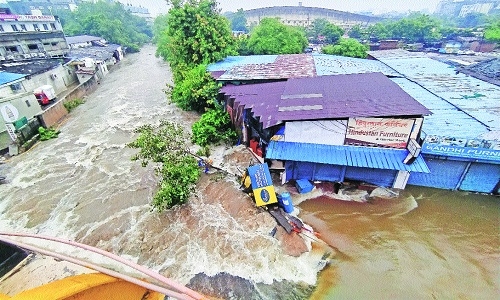
THE flooding that need not have happened has shaken Nagpur to its very core. It will take a while for the affected to pick up the pieces of their lives. For many, life won’t be the same again. The devastation that it left in its wake made national news. Localities close to the Ambazari lake were the most affected. Low-lying areas were flooded. And then there were the usual areas that have been bearing the brunt of rains ad nauseum since decades, such as Mor Bhavan, Jhansi Rani square, Lakadganj, Ganeshpeth and many more, that their flooding is now taken for granted. The avoidable loss of five precious lives and crores of rupees of personal and State assets in what can only be called a man-made tragedy of mammoth proportions has shaken the faith of citizens in the administration like never before. September 23, 2023 will be etched in the history of Nagpur for all the wrong reasons, forever. In the aftermath of the floods, State Relief and Rehabilitation Minister conducted the customary survey, directed panchnamas be conducted and announced a special package for permanent flood control. The Deputy Chief Minister instructed officials to take strong measures for ensuring that flooding does not occur even after the heaviest rains. One is thankful for that. This time around though, we must not let it go at that. Enough is enough. With confidence in the administration to deliver at its lowest as reflected by the Government’s inability to come on top of the situation, this should be the last of the wake-up calls.
Therefore, it is the citizenry that will have to help itself by seizing the initiative and working with the public servants who after all, are answerable to we the people. The monsoon is on its retreat and public memory being what it is; this incident too is in danger of being lost in some remote crevice of our brains. Before that happens, there is a window of 8-9 months prior to the onset of the next South-West monsoon during which, if we resolve to make our voices matter, (just as the citizens of Surat and Indore did by converting adversity into advantage and thereby coming on top of the situation), we would have done ourselves one hell of a big favour. Urban floods can occur when a river passing through the city breaches its embankment as it did when protective walls of the Nag River emanating from the Ambazari Lake collapsed. It can also happen due to clogging of storm water drains; lack of proper drainage system; rainfall overwhelming the capacity of drainage system; haphazard and irregular planning compounded by the problem of illegal encroachments which eliminate natural water courses necessary to drain out excess water; urban heat island effect, resulting in an increase in rainfall over urban areas; changing weather patterns (climate change) lesser but more intense rainy days; improper disposal of solid waste (domestic, commercial and industrial) and dumping of construction debris into drains; sanctioning development on floodplains, ponds and wetlands which actually have the capacity to soak extra water; increase in urbanization (built-up and paved areas replacing natural land surfaces with impervious surfaces like roads, buildings and parking lots) as a result of which, the flow of water increases; combination of storm water and wastewater in the same sewer system which upon heavy rains can become overwhelmed leading to sewage backups and urban flooding that stinks and infects, and extraction of groundwater and other activities leading to land subsidence, causing areas to sink and become more prone to flooding.
There are other reasons as well that will be too voluminous to enumerate here. In other words, the causes of urban floods are entirely man-made or artificial. It is not as if successive city administrators were unaware of these reasons, most of which is a Google or ChatGPT-3.5 search away. And it is not as if the prevention and mitigation of urban floods is rocket science. On a lighter note, perhaps we would have sorted out the sorry state of our urban infrastructure had it been rocket science! The ‘how to do it’ is set out in great detail in IS Code of Practice for Storm Water Drainage (IS : 1742 – 1983) and other Codes, in the National Building Code of India 2016 (Storm Water Drainage, Surface Water Run-off) and others. As a pre-requisite to design, data is the key. I can bet my last 500 rupees that the city hasn’t mapped its drainage system, the contours, water channels, wetlands, ponds, low lying areas, chronic water logging spots, land subsistence, flood plains, encroachments on river, lake and pond catchment areas, high flood hazard zones and urban heat islands. I'd love to lose the bet, though. Designing without data is akin to swatting a fly in the dark. Designing for addressing urban flooding requires a combination of improved infrastructure, better land use planning, sustainable urban design, and climate resilience measures that can be facilitated by geo spatial analysis of the data obtained from the mapping exercise. A ‘Mission Flood-free Nagpur’ should be launched on the lines of ‘Mission Flood-free Guwahati’. The city should embrace Sponge City Mission the goal of which is to enhance urban permeability, allowing cities to retain and utilise the rainfall they receive. This can be effectively achieved through an urban mission in the vein of the Atal Mission for Rejuvenation of Urban Transformation (AMRUT), National Heritage City Development and Augmentation Yojana (HRIDAY) and Smart City Mission.