Solution to urban floods lies in innovative engineering
| Date :04-Oct-2023 |
By Paramjit Singh Ahuja
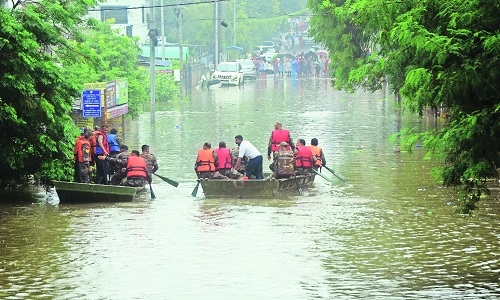
PERHAPS the most serious of the changes that are taking place (apart from rapid urbanisation) that is resulting in frequent and severe urban floods across the country (Guwahati 2010, Chennai 2015, Mumbai and Bengaluru 2017, Hyderabad 2020), is the increase in the intensity of rainfall over shorter durations as was witnessed over parts of Nagpur on September 23, 2023. These and other developments should prompt the concerned authorities to revise the Standards (BIS, NBC, etc.) by which design of roof rain water, surface rain water runoff and storm water drainage are being mandated. As an example, for the design of surface drains for runoff, a runoff of 6 mm and 12 mm respectively for an average annual rainfall of 500mm - 1000 mm and 1000mm - 2000mm respectively are recommended. These and other recommendations warrant revisiting. Amendments should be made in the Development Control Regulations by making it mandatory to demonstrate that the proposed development does not impede or alter the flow of surface run off or if it does, the project proponent should demonstrate restoration of the same at its own cost. Submission of contour data should be made mandatory for all development proposals, small and big. Amendment should also be made forbidding development on no go’ land parcels such as floodplains, catchment areas of rivers and water bodies, and wetlands.
A no go’ list consisting of such areas (based upon mapping suggested earlier in this article) should be notified. Measures such as permeable roads, roof top gardens, rain water harvesting, creation of rain gardens, green spaces and blue spaces (lakes and ponds) should be made mandatory. When proposing development of layouts, providing right of way/connectivity beyond its boundary is mandatory. However, when an adjoining layout is proposed, often the road network connectivity is broken for the sake commercial considerations. Thus, continuity of storm water drains is broken, resulting in flooding of the layouts. While sanctioning development of layouts, sanctioning authorities should stay vigilant on this account. Urban areas with limited green spaces and vegetation have reduced capacity to absorb rainwater. Trees and vegetation can help reduce runoff by absorbing and transpiring water. Spaces for plantation where most needed should be earmarked in the Development Plan by the administration. In an interview published in these esteemed columns (September 27, 2023) regarding the floods that occurred on 23rd September, I was quoted as having said that It was a man-made disaster that is irreversible. This comment was made in the context of Nagpur city which is a study in construction on low lying areas, encroachments on river, lake and pond catchment areas, clogging of storm water drains, lack of proper drainage system, rainfall overwhelming the capacity of drainage system, haphazard and irregular planning and rapidly diminishing open permeable spaces. It is not my case, however, that chronic water-logging areas such as Mor Bhavan, Jhansi Rani square, Lakadganj, Ganeshpeth and many more are beyond mitigation.
On the contrary, this chronic problem can be mitigated by increasing the carrying capacity of the storm water drains manifold, providing catch basins, culverts, and pipes to efficiently transport runoff water to appropriate discharge points, by installing French Drains, creating permeable surfaces, among other measures. Therefore, the chronic flooding of these areas cannot and should not be taken for granted. The solution to the issue of flooding in the Nagpur Municipal Corporation area (spread over 217 square kilometres) will largely be a matter of mitigation by means of innovative engineering. My concern is that the Nagpur Metropolitan Area, a mostly virgin expanse encompassing 3577 square kilometres [16.50 times larger than Nagpur city, 36% of Nagpur District and almost the size of the state of Goa (3702 square kilometres)], should not go the Nagpur city way and indeed the way of other cities such as Guwahati, Chennai, Mumbai, Bengaluru and Hyderabad. It would be imperative, therefore, to carry out Terrain Modelling of Nagpur Metropolitan Area that are planned for urbanization from agricultural land, forest or low grade land, low lying areas prone to flooding, marshy or abandoned quarries, etc. Detailed and careful consideration with respect to its drainage is necessary. A detailed contour survey should be carried out not only of the sites that are planned for urbanization but also the surrounding areas to verify the quantity and area contributing runoff, presence of any low lying and natural water body acting as holding pond or any natural drain passing through the area and beyond, whose filling up and diversion may cause water logging problem on the site or surrounding areas (source - NBC 2016).
In terms of built form, this may imply contiguous open green spaces, interconnected waterways, and channels and ponds across neighborhoods that can naturally detain and filter water. The floods of 23rd September ought to spur the Nagpur Metropolitan Region Development Authority (NMRDA) to revisit its plans. About 200 years ago, John Stewart Mill and Adam Smith proposed the method of measuring Gross Domestic Product (GDP). It was based on
economics without factoring the cost on the environment. Until climate change became a big issue; economics was about profit-taking minus the environment. For example, the traditional valuation of a tree was the value of its timber whereas its new valuation includes its oxygen, bio fertilizer, micronutrients, etc. If Tadoba and other forests were to be cut down, the traditional value of its timber would be in trillions of rupees. But its environmental cost could be extinction of most species including perhaps the human race. It is time, therefore, to replace Gross Domestic Product for Green Domestic Product as the true measure of economic activity (source - Nishi Mukerji). Before announcing projects, politicians of all hues, administrators, influencers and those whose decisions will impact the future of the only planet that we have which we call Earth should on their part engage with engineers, hydrologists, environmental consultants, urban designers, town planners, architects, NGOs, busy bees, et al vis--vis the feasibility of their proposals from an environmental perspective. More importantly, they should pay heed to their advice.
It is essential to manage storm water effectively and develop strategies to adapt to changing weather patterns and the increased risks associated with urbanization and climate change. We cannot afford to let go trillions of liters of free rain water by channelising it straight into gutters and drains thereby wasting a precious natural resource. When cities grow bigger at a hectic pace as is the case with Nagpur, a long term vision is necessary. A window of 8-9 months is what we citizens have before the advent of the next South-West monsoon for formulating an action plan, hopefully in collaboration with the administration. What are we waiting for? Change will not come if we wait for some other time. (Concludes)