4 Param Vir Chakra winners
| Date :11-Nov-2023 |
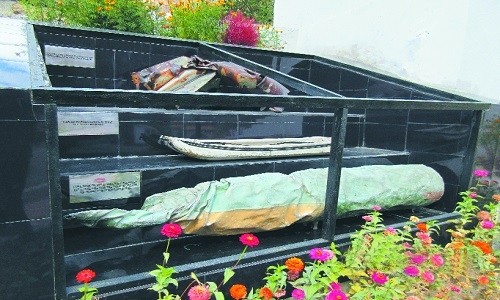
The remains of laser-guided bomb fired by the Indian Air Force on intruders at Muntho Dhalo base (top), a casualty evacuation sledge used by Pakistanis (middle), and remains of fuel tank of the aircraft flown by Flt Lt Nachiketa in Batalik Sector are preserved at a camp as memories of 1999 war. (Pic by Kartik Lokhande)
By Kartik Lokhande :
Dateline Kargil-7
Every war is won when battles are won one-by-one. It is in the victory in these battles that the seeds of victory in war are planted. These seeds often are nourished by the sweat, blood, and sacrifice of the brave soldiers. Kargil war of 1999, too, had its share of such battles and sacrifices. In fact, as the military historians say, Kargil war of 1999 saw the highest number of young officers leading from the front, and also bearing the brunt. In the thick of war, they displayed the rare raw courage and the highest level of motivation to achieve the goals. The young officers got transformed into the leaders in action, and the soldiers became the heroes.
There are umpteen number of tales. As per the records, 559 men made the supreme sacrifice during ‘Operation Vijay’ in 1999 in the icy heights of the Kargil in Ladakh region. So, there are 559 tales that could be told. During the war, four were awarded the highest gallantry medal -- Param Vir Chakra (PVC), ---- were awarded the Maha Vir Chakra, ---- Shourya Chakra, --- Ashok Chakra, --- VSM SM etc...
‘The Hitavada’ retells the tales of four PVCs namely Capt Vikram Batra, Lt Manoj Kumar Pandey, Rifleman Sanjay Kumar, and Grenadier Yogender Singh Yadav. Of these four bravehearts, Capt Vikram Batra and Lt Manoj Kumar Pandey got the PVC posthumously for their conspicuous acts of courage and bravery. Rifleman Sanjay Kumar and Grenadier Yogender Singh Yadav are still alive, and inspiring the people. ‘The Hitavada’ retells their stories, and constructs their ‘Profiles in Courage’.
‘Yeh Dil Maange
More...’
of
Shershah still
echoes there
BORN on September 9,
1974, Vikram Batra from
Palampur in Himachal
Pradesh, joined the Indian
Army on December 6, 1997
in the 13 Jammu and
Kashmir (JAK) Rifles regiment. Little did he know
that within two years of joining the Indian Army, he
would be in the middle of
a war in the high altitude.
During ‘Operation Vijay’
in 1999 to flush out the Pakistani intruders, the
Indian Army started winning
one after the other battle on
the strength of the young officers leading ably the men in
their command. In Drass
sub-sector, the enemy held
strong fortified positions,
reinforced with automatic
weapons.
On June 20, Captain
Vikram Batra, who was
Commander of Delta
Company, was tasked to
attack Point 5140. With his
company, he skirted around
the position from the east,
maintained surprise, and
reached within the assaulting distance. Displaing sterling leadership qualities, he
organised his column, and
leading from the front,physically assaulted the enemy
positions. Exhibiting daredevilry, he pounced on the
enemy like a tiger and killed
four intruders in hand-to hand fight.
It was here that Capt
Vikram Batra gave his iconic success signal ‘Yeh Dil
Maange More...’
Soon came another important task. On July 7, 1999,
Capt Batra’s company was
tasked to clear a narrow feature with sharp cuttings on
either sides leading up to
Point 4875 and Area Ledge.
The enemy defences were
heavilyfortified.As faras military significance of this feature is concerned,Point4875
is part of the Tiger Hill complex, and the most important feature in Mashkoh subsector.The feature dominates
National Highway-1A from
Mughalpura to Drass, which
is a stretchof around30 kms.
A feature ‘Rocky Knob’ links
Point 4875 with Tiger Hill.
By 1 pm on July 5, 13 JAK
Rifles had captured Point
4875 Top and Flat Top feature, Pakistani intruders still
held Area Ledge, which was
fortified with two bunkers
from where the enemy did
effective firing on Point4875.
The approach to the bunker
was along an arrow ridge that
was only one meter wide and
10 meters long. In the cover
of darkness, around 3.30 am
on July 7, the troops led by
Capt Vikram Batra moved for
attack through near vertical
climb. But, the enemy spotted the movement and
opened fire, which held up
the advance of the Indian
forces.Bynow,there was day light.
The situation would
have become more difficult.
So, Capt Vikram Batra led
the attack from the front. In
a fierce hand-to-hand fight,
he killed five enemy soldiers
atpoint-blankrange.Despite
grievous injuries, he crawled
towards the enemy bunker,
lobbed grenades into it, and
silenced the enemy gun. He
rallied his men and succeeded in achieving what was
a militarily impossible task.
Inspired by his extraordinary
fearlessness and raw courage,
the troops overwhelmed the
enemy and captured the
position. The Ledge was
cleared of the enemy by 12
noon on July 7.
For this daredevil act, the
Param Vir Chakra, India’s
highest gallantry award was
awarded post humously to
Capt Vikram Batra. As the
citation reads, “Captain
Vikram Batra displayed the
most conspicuous personal
bravery and junior leadership of the highest order in
the face of the enemy and
made the supreme sacrifice
in the highest traditions of the
Army”. For the raw courage,
he is fondly referred to as
‘Shershah’.
(To be continued)