Hundurman: The village with war heritage
| Date :06-Nov-2023 |
By Kartik Lokhande :
Dateline Kargil-4
MEMORIES of 1971 WAR
A ROAD with several twists and turns up the rugged mountains leads to a point that is presently being developed as ‘LOC View Point’, at a distance of around 10 kms from Kargil town. Most of the visitors go up to this point and after seeing the ‘Barbad’ village in Pakistani occupied territory, return to Kargil.
However, those moving up come across a ‘ghostly’ village with a board stating ‘Welcome to Hunderman’. This, is the last Indian village in Kargil area, after which defence tracks start, and then comes the border posts and further ahead is the Pak-occupied part of Gilgit-Baltistan region. Like several twists and turns on the road, this village also has a history with twists.
There are two villages by the name Hundurman, also spelt as Hunderman or Hundermo. The old ‘ghostly’ village is Hundurman Broq and the inhabited one slightly up the ledge is Hundurman. Situated in Kargil district of the Union Territory of Ladakh, the old village is located up in the mountains on the banks of river Drass. Geographically, it is said, Hundurman lies in the Baltistan region.
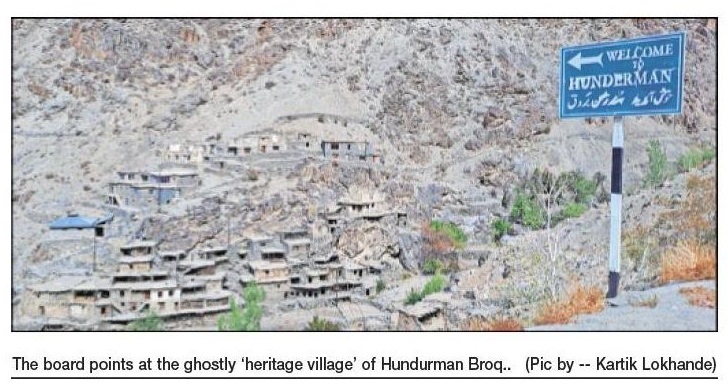
As one approached the old village, a board surfaces ‘Unlock Hunderman Museum of Memories’. Some steps ahead, one also comes across a board stating ‘Caution: You are in a border area, require special permission from the Indian Army. Please do not venture to places not mentioned in the map’.
As one takes a look at the haunted-looking houses built may be hundreds of years ago, and wonders what the museum might offer, a man walks down. Introducing himself as Mohd Baqr, a resident of Hundurman, he also works as a guide for the tourists visiting the village and the museum.
According to him, and the history available in bits and pieces in different accounts, Hundurman was under Pakistani occupation since 1947. In the 24 years (from 1947 to 1971) that it was under Pakistani occupation, life was very difficult for the people. It is said that there was no development in terms of infrastructure, communication, and health. One gets ample evidence of it during the visit to the village. Children had to walk miles to go to school. Many people lost their life while being carried to the nearest hospital, which was also miles away.
When the Indo-Pak war of 1971 erupted, though much of the world’s attention was towards what was known as East Pakistan (which later was liberated as Bangladesh), Hundurman also had its share of increased suffering. The people took to the caves for shelter and witnessed the destruction from the close quarters, states an information plaque at the museum. A few families fled to the next village in Pakistan-occupied territory, just a few kilometres away. But, most families stayed back and helped the Indian Army with food and other supplies during the 1971 war. The families that took refuge in Pakistan-occupied territory communicated with their relatives in Hundurman through letters till a few years ago. In fact, the museum exhibits a letter and its English transcript written by a man Hussain Khan (living in Brolmo) to his sister Shamshira (in Hundurman).
Today, the families separated from each other due to modern-day Line of Control, are able to stay connected through modern means of communication. Gradually, mutually beneficial relationship flourished between the locals of Hundurman and the Indian Army. The Indian Army and the locals rely on each other in times of need, as they did during the floods in 2014. The villagers shifted from old village to a new settlement slightly higher. In the new Hundurman, signs of development and modernisation are visible in the form of modern houses, electricity, television, vehicles,
piped water supply etc. The motorable road came in 2005, and electricity in 2006, according to the locals.
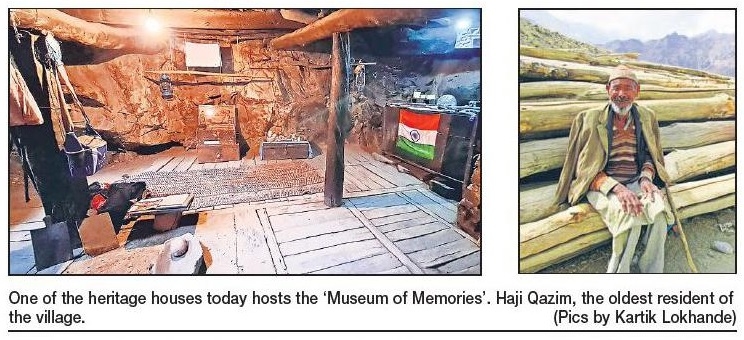
Haji Qazim is the oldest living inhabitant of the village. He is the man who has seen the arduous life in the Hundurman Broq (old) and comforts and peace in the new settlement. Clad in woollens and traditional costume, and wearing a broad smile on face apart from wrinkles on forehead, he told ‘The Hitavada’ he was 103 years old. Though he could not speak much, he remembered Maharaja Hari Singh as the king of Jammu and Kashmir.
He did remember that the British did ‘something’ that was not good. Whether the village was in India or Pakistan, he remembered only that the ‘Hukumat’ (rulers) paid the villagers for work they did. He only has some memories of the ‘war of 1971’.
But, in the recent times, conscious effort has been made to preserve not only the artefacts telling the story of the village but also the remains from the 1971 war. Mohd Baqr shows around the ‘Unlock Hundurman: Museum of Memories’, which hosts several artefacts and items including the certificates issued to old residents of the village as ‘Permanent residents of protected area’ and photo identity cards issued to them by the powers that ruled over the area; soldiers’ helmet, gun, canisters, mugs, other utility items, bullets, and shells fired during 1971 war, currency notes of India and Pakistan, etc.
But, the museum does not have only the remains from the war. Housed in an old dwarf-roofed structure, it shed light on the animal shelter, agricultural practices, games, clothes, cultural practices, kitchen and other tools. Also, there are information plaques stating that the men from Hundurman mostly work as porters for the Indian Army and the women work in the fields.
Though the produce from these fields is no longer sufficient for the families living in Hundurman, about a hundred years ago, the community was more or less self-sustained without much trade with the outside world. “They depended wholly on agriculture and cattle-rearing for food as well as clothing. Only a few essential commodities like salt were brought from Kargil in exchange for local produce, mainly tobacco. Though the community is not self-sustained anymore, and largely dependent on the outside, the people of Hundurman try to keep their traditions alive through festivals and food,” it adds.
As per the Directorate of Tourism, Union Territory of Ladakh, Hundurman Broq is a hamlet believed to be almost a thousand years old. Mohd Baqr says that many of the abandoned houses
in the old village were constructed at least 500 years ago using locally sourced materials such as stone, earth, and wood from willow and poplar trees. Lighter materials like willow mesh and clay plaster have been used for the upper floors, while heavier materials like stone or rammed earth have been used for the lower floors.
Interestingly, ‘Museum of Memories’ aims at telling the world about the villagers cherishing the memories of meeting their family members last in 1971. The museum in the abandoned war-ridden Purgi (as locals are known) settlement closer to the Line of Control, in the territory of India, is a collaborative project of Roots Collective, a non-profit organisation in Kargil, and SWS CEPT University, Ahmedabad. Many of the rediscovered artefacts are placed in the museum.
The current inhabitants of new or Upper Hundurman are the descendants of the original inhabitants belonging to the Purgi tribe and the Shia sect of Islam.
As one leaves once war-ridden village of Hundurman near Kargil, which saw military action in 1971 Indo-Pak war too, one gets the feeling that it is one of those heritage villages of India where one can get to know war and cultural history at the same time. One must not forget being closer to the Line of Control, and being watched by the military posts on top of the mountains around.
Of course, Pakistan’s misadventures did not stop despite suffering a heavy loss in 1971 war even in Kargil. Though it had to remain calm for some years to come, it did not stop hatching a conspiracy to target National Highway connecting Srinagar with Leh, with Drass-Kargil axis being an important target, as could be seen in 1999.
(To be continued)